

Discover the ultimate innovations of the future developed by Thai researchers! Meet the latest technology from KMITL that will transform our way of life and industry.

คณะวิศวกรรมศาสตร์
This project aims to develop a conceptual prototype of a weapon aiming system that simulates an anti-aircraft gun. Utilizing an optical camera, the system detects moving objects and calculates their trajectories in real time. The results are then used to control a motorized laser pointer with two degrees of freedom (DoF) of rotation, enabling it to aim at the predicted position of the target. Our system is built on the Raspberry Pi platform, employing machine vision software. The object motion tracking functionality was developed using the OpenCV library, based on color detection algorithms. Experimental results indicate that the system successfully detects the movement of a tennis ball at a rate of 30 frames per second (fps). The current phase involves designing and integratively testing the mechanical system for precise laser pointer position control. This project exemplifies the integration of knowledge in electronics (computer programming) and mechanical engineering (motor control).
คณะทันตแพทยศาสตร์
Objective or Background: Dental caries is still one of the most significant dental problems worldwide, with prevalence rates up to 90% among children and adults. Cariogenic bacteria, especially Streptococcus mutans, is the primary microorganism involved in the pathogenesis through carbohydrate metabolism and biofilm formation, which are challenging to eradicate. Histatin-5 (HST-5), a human salivary antimicrobial peptide, has demonstrated antimicrobial activity against various fungal and bacterial pathogens. Phytosphingosine (PHS), an endogenous bioactive sphingolipid found in fungi, plants, and humans, also shows antimicrobial properties. This study aimed to evaluate the killing activity of HST-5 alone and in combination with PHS against S. mutans under biofilm-stimulating conditions. Materials and Methods: Antimicrobial activity against a planktonic culture of S. mutans was evaluated using a time-kill assay, and biofilm-forming capacity was confirmed by crystal violet staining assay. The killing ability against 24h pre-formed biofilm was determined using Transferable Solid Phase (TSP) pin lid model. Synergistic activity between HST-5 and PHS was evaluated using the checkerboard technique. Additionally, the cytotoxicity of the tested agent on human gingival fibroblast cells (hGFs) was assessed after 1 h of incubation using an MTT assay. Results: A time-kill assay revealed that both HST-5 and PHS exhibit time- and concentration-dependent activity against the planktonic form of S. mutans. PHS achieved over 90% killing activity within 15 min at 5 μg/ml, whereas HST-5 required 30 min to reach 90% killing at 20 μM. The biofilm formation capacity of S. mutans was confirmed. The inhibitory concentrations (IC50) of HST-5 and PHS against S. mutans biofilm were 25 μM and 13.5 μg/ml, respectively. A synergistic interaction between HST-5 and PHS, with IC50 values reduced by 8-fold and 16-fold, respectively. No cytotoxic effects were observed in hGFs cells at the concentration of the synergistic interaction. Conclusions: Therefore, the combination of HST-5 and PHS may enhance the effectiveness of anti-infective agents against S. mutans biofilm, potentially preventing the development of dental caries.

คณะวิศวกรรมศาสตร์
The evaluation of mango yield and consumer behavior reflects an increasing awareness of product origins, with a growing demand for traceability to understand how the produce has been cultivated and managed. This study explores the relationship between mango characteristics and cultivation practices before harvest, using location identification to provide insights into these processes. To achieve this, a model was developed to detect and locate mangoes using 2D images via a Deep Learning approach. The study also investigates techniques to determine the real-world coordinates of mangoes from 2D images. The YOLOv8 model was employed for object detection, integrated with camera calibration and triangulation techniques to estimate the 3D positions of detected mangoes. Experiments involved 125 trials with randomized mango positions and camera placements at varying yaw and pitch angles. Parameters extracted from sequential images were compared to derive the actual 3D positions of the mangoes. The YOLOv8 model demonstrated high performance with prediction metrics of Precision (0.928), Recall (0.901), mAP50 (0.965), mAP50-95 (0.785), and F1-Score (0.914). These results indicate sufficient accuracy for predicting mango positions, with an average positional error of approximately 38 centimeters.
คณะบริหารธุรกิจ
BrushXchange is a toothbrush brand dedicated to reducing plastic waste in Thailand by offering toothbrushes made from recycled plastic with replaceable bristles. These products help minimize waste generated by traditional toothbrushes. The design is modern and user-friendly, emphasizing durability, comfort, and affordability, making it appropriate for health-conscious and environmentally aware consumers. The brand aims to drive change in the oral care industry by providing high-quality products at accessible prices. Its marketing strategy focuses on using social media platforms like Instagram and TikTok and collaborating with organizations that promote sustainability. The product is distributed through retail stores such as Lotus’s and Tops. BrushXchange also prioritizes environmental responsibility by using recycled paper packaging and organizing sustainability campaigns. The brand's long-term goal is to become a widely recognized brand image in the eco-friendly toothbrush market in Thailand while encouraging sustainable living habits within society.
คณะวิศวกรรมศาสตร์
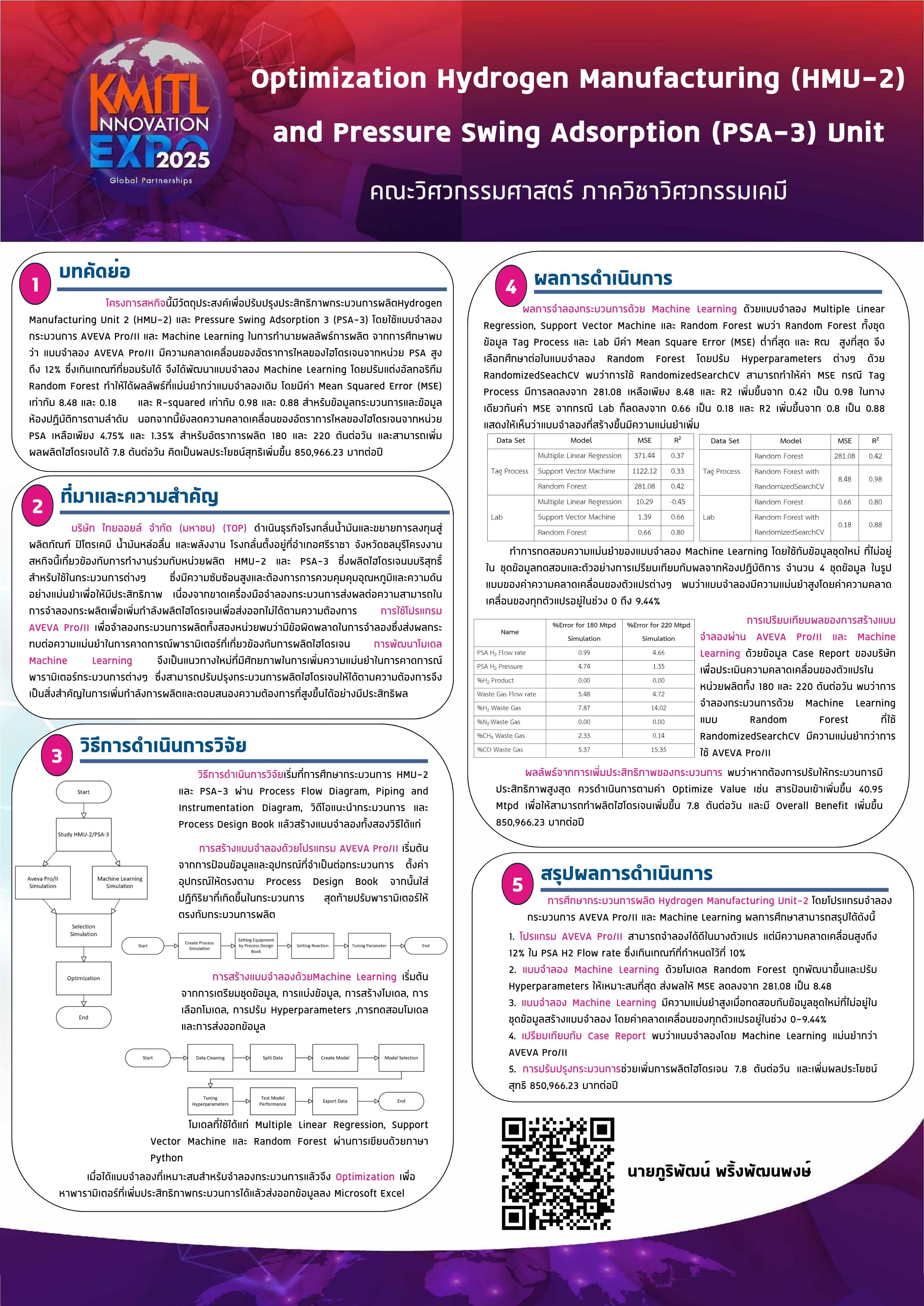
This cooperative education project aims to enhance the efficiency of Hydrogen Manufacturing Unit 2 (HMU-2) and Pressure Swing Adsorption 3 (PSA-3) by using AVEVA Pro/II process modeling and a Machine Learning model for process simulation. The study found that the AVEVA Pro/II model predicted outcomes with deviations ranging from 0–35%, including a hydrogen flow rate deviation from the PSA unit of 12%, exceeding the company’s acceptable limit of 10%. To address this, a Machine Learning model based on the Random Forest algorithm was developed with hyperparameter tuning. The Machine Learning model demonstrated high accuracy, achieving Mean Squared Errors (MSE) of 8.48 and 0.18 for process and laboratory data, respectively, and R-squared values of 0.98 and 0.88 for the same datasets. It outperformed the AVEVA Pro/II model in predicting all variables and reduced the hydrogen flow rate deviation to 4.75% and 1.35% for production rates of 180 and 220 tons per day, respectively. Optimization using the model provided recommendations for process adjustments, increasing hydrogen production by 7.8 tons per day and generating an additional annual profit of 850,966.23 Baht.
วิทยาลัยการจัดการนวัตกรรมและอุตสาหกรรม
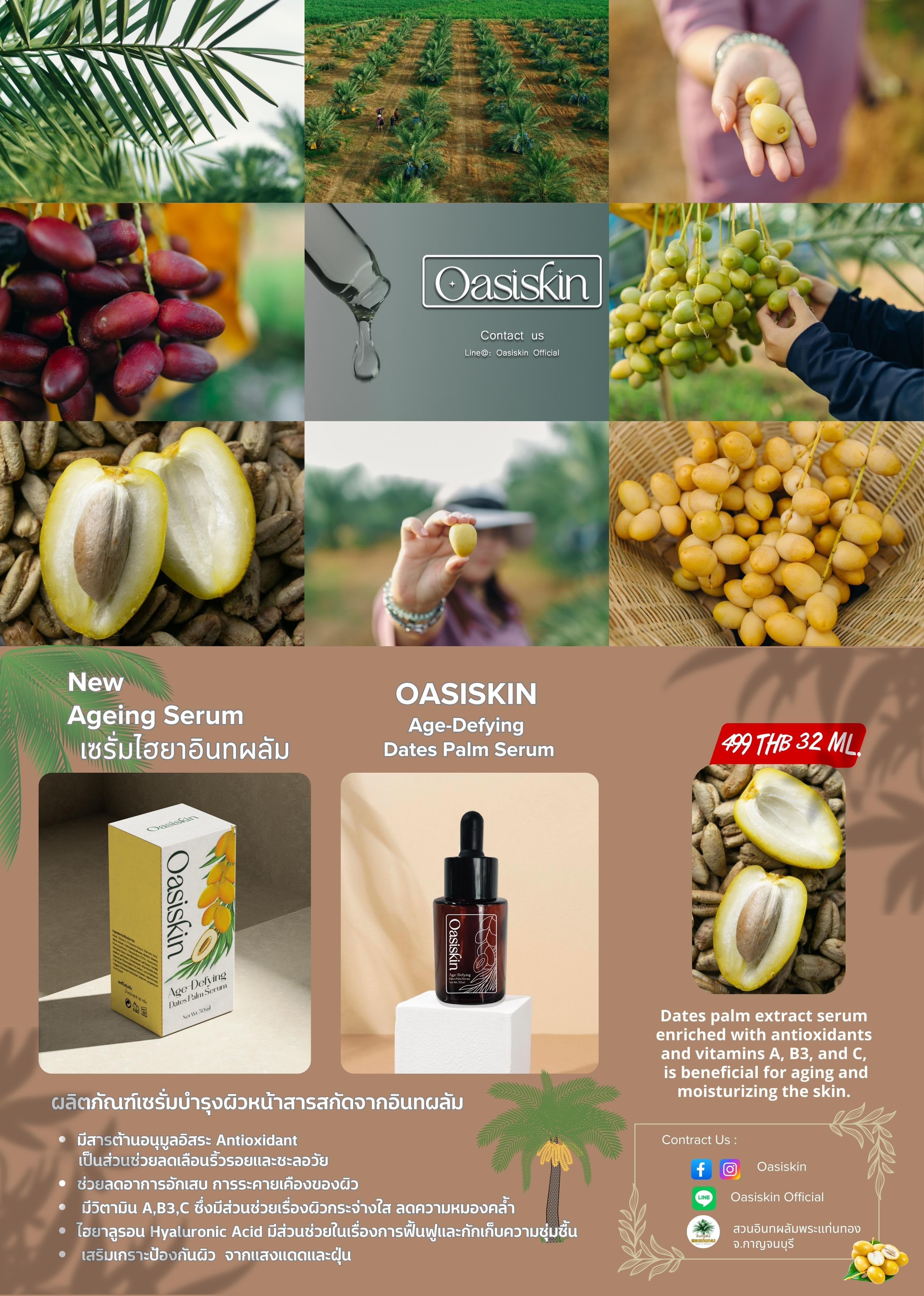
The Age-Defying Dates Palm Serum is an innovative skincare product formulated with date palm extract, known for its high antioxidant content that helps reduce wrinkles and retain skin moisture. Combined with hyaluronic acid, the serum enhances hydration and skin elasticity. This research explores factors influencing consumers’ purchasing intentions, revealing a preference for anti-aging properties, product safety, and natural ingredients. This serum aims to provide a novel option in the skincare market by utilizing high-quality natural extracts.
คณะอุตสาหกรรมอาหาร
Spent hens are laying hens that are over 18 months to 2 years old and no longer productive. The texture of spent hen meat is significantly tougher compared to broiler chickens, capons, and native chickens. Therefore, to increase the value of spent hens, a study was conducted to modify the texture of the meat by restructuring it with carrageenan and tenderizing it by marinating it in bromelain solution at different concentrations. The experiment found that restructuring with carrageenan and using bromelain enzyme resulted in a newly formed product and significantly improved the tenderness of the meat compared to chicken meat that was not treated with carrageenan and bromelain enzyme.
คณะเทคโนโลยีการเกษตร
Climate change affects agricultural systems worldwide, including Thailand, and may lead to reduced crop yields, impacting food security. Bambara groundnut is a crop with the potential to adapt to changing environments and can thrive in areas with limited resources. This research aims to study the impact of climate change on Bambara groundnut yields in Thailand using the DSSAT (Decision Support System for Agrotechnology Transfer) model, an important tool for predicting plant growth under various environmental conditions. This study utilizes climate data, soil composition, and genetic information of Bambara groundnut to simulate and analyze yield trends under future climate scenarios. Four study areas in Thailand were selected: Songkhla, Lampang, Yasothon, and Saraburi. The CSM-CROPGRO-Bambara groundnut model was used to assess the impact of changing temperature and rainfall on the growth and yield of Bambara groundnut. The results of this study are expected to provide farmers and researchers with valuable information for planning cultivation and managing peanut production in response to climate change. Additionally, the findings can help formulate policy guidelines to promote the cultivation of climate-resilient crops and support the country's food security.
คณะเทคโนโลยีการเกษตร
Threadfin breams is an economically important fish that can be found in fisheries in both the Gulf of Thailand and Andaman Sea and is cheap. In addition, the consumption of raw fish as sashimi is increasingly popular in Thailand. Therefore, it is necessary to promote its consumption to increase its value. This study investigated the preservation of threadfin breams (N. furcosus) for raw or sashimi consumption. The preservation of threadfin breams consisted of Ikejime (K) and cold seawater (S) methods, and the preservation of the fish by Gutting (G) and whole (W) and storing for 3 days on ice (I) or in a refrigerator (F). The freshness quality of threadfin breams was evaluated by sensory, physicochemical (TVB-N, TMA-N and pH), freshness index (Ki-value) and microbiological methods. It was found that after being stored for 3 days, the KGF group of threadfin breams had the highest overall sensory score, which was 8.36±0.80 points, and the KWI, SWI and SWF groups of threadfin breams had the lowest overall sensory scores, which were 8.13±0.77, 8.13±0.77 and 8.13±0.81 points, respectively. And the overall sensory scores of all experimental groups of fish increased significantly (p<0.05). The TVB-N value of threadfin breams in KGF group had the lowest TVB-N value, which was 1.37±0.93 mg nitrogen/100 g sample. The threadfin breams in SGI group had the highest TVB-N value, which was 2.36±1.15 mg nitrogen/100 g sample. The TVB-N of fish in all experimental groups increased significantly (p<0.05). The TMA-N value of threadfin breams in KGF group had the lowest TMA-N value, which was 1.56±0.88 mg nitrogen/100 g sample. The threadfin breams in SWF group had the highest TMA-N value, which was 2.17±1.22 mg nitrogen/100 g sample. The TMA-N of fish in all experimental groups increased significantly (p<0.05). The pH value of threadfin breams in KGF group had the lowest pH value, which was 6.40±0.12. The threadfin breams in SWF group had the highest pH value, which was 6.78±0.25. The pH of fish in all experimental groups increased significantly (p<0.05). Ki value The threadfin breams in KGF group had the lowest Ki value, which was 9.05±0.73%. The threadfin breams in KWI group had the highest Ki value, which was 12.88±4.19%. The Ki value of all experimental groups of fish increased without statistical significance (p>0.05). In terms of freshness quality in microbiology, it was found that in all experimental groups, Salmonella spp., S. aureus, B. cereus, C. perfringens and E. coli were found in all experimental groups of threadfin breams. All types of microorganisms in all groups of threadfin breams increased with statistical significance (p<0.05). When compared with the freshness quality criteria in terms of sensory, chemical, physical, freshness index and microbiology, it was found that all groups of threadfin breams were very fresh and suitable for raw consumption during the preservation and storage for 3 days. After 3 days of storage, the threadfin breams should be consumed cooked because the freshness quality of the fish is not suitable for raw consumption due to the increase in various parameters. The increase in various parameters is due to the deterioration of the fish and the activities of microorganisms. Therefore, threadfin breams is suitable to promote raw consumption within 3 days of storage. In addition, fish preservation, especially by Ikejime method, then cutting open the belly and storing in the refrigerator, can help improve the freshness of the fish. The results of this study can be used to develop techniques for preserving fish after capture for fishermen and can promote the increase in the value of threadfin breams in the future.