
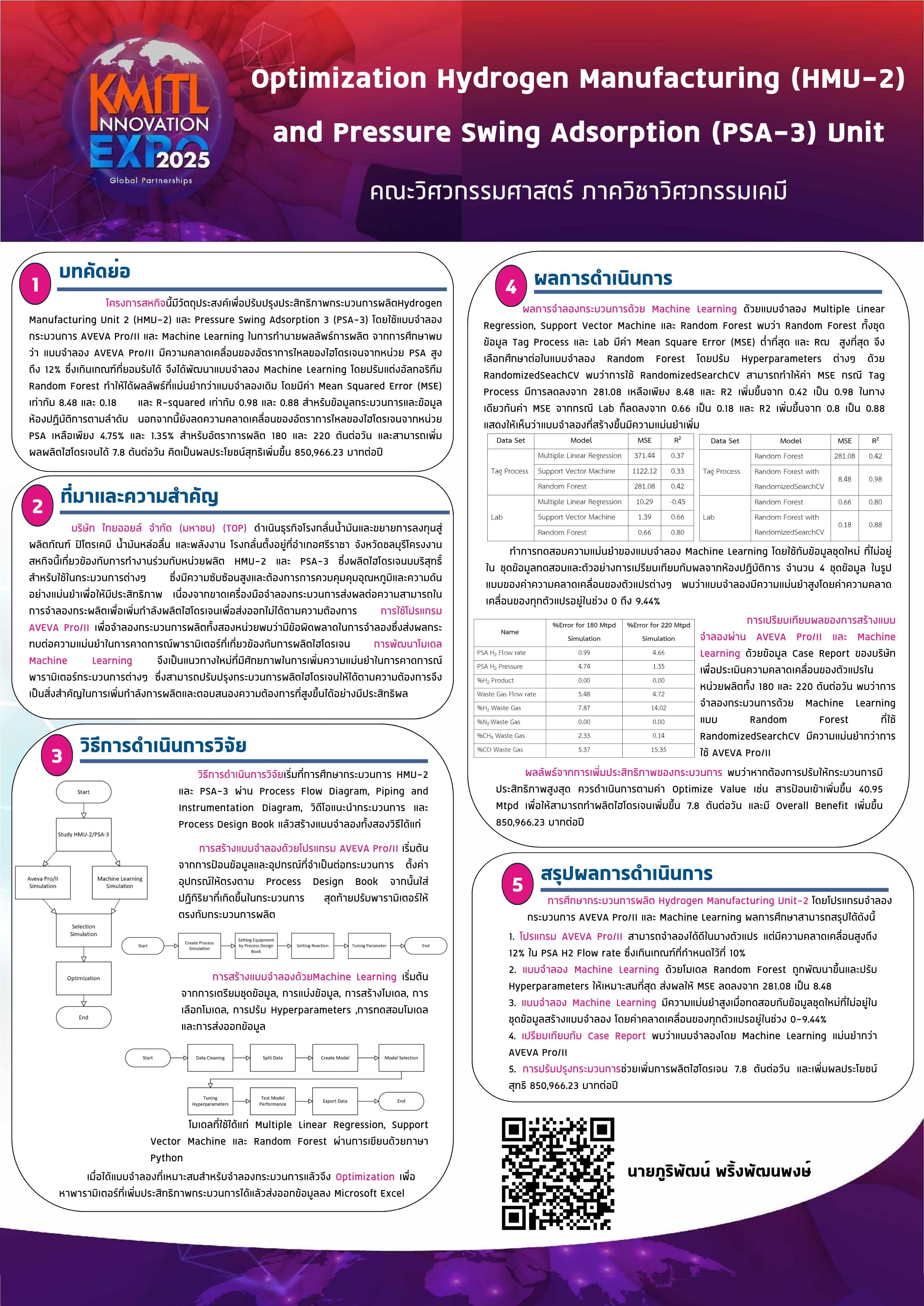
This cooperative education project aims to enhance the efficiency of Hydrogen Manufacturing Unit 2 (HMU-2) and Pressure Swing Adsorption 3 (PSA-3) by using AVEVA Pro/II process modeling and a Machine Learning model for process simulation. The study found that the AVEVA Pro/II model predicted outcomes with deviations ranging from 0–35%, including a hydrogen flow rate deviation from the PSA unit of 12%, exceeding the company’s acceptable limit of 10%. To address this, a Machine Learning model based on the Random Forest algorithm was developed with hyperparameter tuning. The Machine Learning model demonstrated high accuracy, achieving Mean Squared Errors (MSE) of 8.48 and 0.18 for process and laboratory data, respectively, and R-squared values of 0.98 and 0.88 for the same datasets. It outperformed the AVEVA Pro/II model in predicting all variables and reduced the hydrogen flow rate deviation to 4.75% and 1.35% for production rates of 180 and 220 tons per day, respectively. Optimization using the model provided recommendations for process adjustments, increasing hydrogen production by 7.8 tons per day and generating an additional annual profit of 850,966.23 Baht.
บริษัท ไทยออยล์ จำกัด (มหาชน) (TOP) ประกอบธุรกิจโรงกลั่นน้ำมันที่มีกระบวนการผลิตที่ทันสมัยและมีประสิทธิภาพสูง เพื่อผลิตและจำหน่ายน้ำมันปิโตรเลียมสำเร็จรูปป้อนตลาดในประเทศเป็นส่วนใหญ่ ทั้งยังขยายการลงทุนให้ครอบคลุมการผลิตผลิตภัณฑ์ปิโตรเคมี นํ้ามันหล่อลื่นพื้นฐาน เอทานอล รวมถึงการลงทุนในธุรกิจไฟฟ้า ตลอดจนธุรกิจขนส่งผลิตภัณฑ์ปิโตรเลียม และปิโตรเคมีทางเรือ ธุรกิจขนส่งผลิตภัณฑ์ปิโตรเลียมสำเร็จรูปทางท่อ และธุรกิจให้คำปรึกษาทางด้านพลังงาน ซึ่งมีโรงกลั่นอยู่ที่อำเภอศรีราชา จังหวัดชลบุรี โครงงานสหกิจนี้เกี่ยวข้องกับการทำงานร่วมกับหน่วยผลิต Hydrogen Manufacturing 2 (HMU-2) และ Pressure Swing Adsorption 3 (PSA-3) ซึ่งผลิตไฮโดรเจนบริสุทธิ์สูงสำหรับใช้ในกระบวนการต่าง ๆ เช่น Hydrocrackers, Hydrodesulphuriser และ Hydrotreaters หน่วยผลิตนี้มีบทบาทสำคัญในการแยกก๊าซธรรมชาติเหลือใช้จากกระบวนการก่อนหน้า ซึ่งมีความซับซ้อนสูงและต้องการการควบคุมอุณหภูมิและความดันอย่างแม่นยำเพื่อให้กระบวนการทำงานได้อย่างมีประสิทธิภาพ เนื่องจากการขาดเครื่องมือจำลองกระบวนการที่มีประสิทธิภาพส่งผลต่อความสามารถในการผลิตและประสิทธิภาพโดยรวม ทำให้ไม่สามารถส่งไฮโดรเจนให้กระบวนการข้างต้นได้ตามความต้องการ การใช้โปรแกรม AVEVA Pro/II ซึ่งเป็นเครื่องมือสำคัญในการจำลองกระบวนการผลิตในหน่วย HMU-2 และ PSA-3 พบว่ามีข้อผิดพลาดในการจำลองบางกระบวนการ ซึ่งส่งผลกระทบต่อความแม่นยำในการคาดการณ์พารามิเตอร์ที่เกี่ยวข้องกับการผลิตไฮโดรเจน การพัฒนาโมเดล Machine Learning จึงเป็นแนวทางใหม่ที่มีศักยภาพในการเพิ่มความแม่นยำในการคาดการณ์พารามิเตอร์กระบวนการต่าง ๆ เช่น อุณหภูมิ ความดัน และอัตราการไหล การนำเทคนิค Machine Learning มาช่วยในการคาดการณ์และปรับปรุงกระบวนการผลิตไฮโดรเจนให้ได้ตามความต้องการของหน่วยผลิตในบริษัทจึงเป็นสิ่งสำคัญในการเพิ่มประสิทธิภาพการผลิตและตอบสนองความต้องการที่สูงขึ้นได้อย่างมีประสิทธิผล

คณะวิทยาศาสตร์
This study aimed to investigate the effectiveness of extracts from moringa seeds, roselle seeds, and tamarind seeds as coagulants to improve water quality in surface water sources. Extracts from these seeds serve as environmentally friendly coagulants and provide alternative options for enhancing surface water quality. The turbidity of surface water sources ranged between 14 and 24 NTU. The coagulation process used the Jar Test method, where the moringa seed, roselle seed, and tamarind seed extracts functioned as both primary coagulants and coagulant aids. In the preparation process, the seeds were finely ground and extracted using a 0.5-M sodium chloride (NaCl) solution. These extracts were then applied as coagulants to reduce turbidity and enhance water quality, with each concentration tested in 300 ml of water. The results indicated that the most effective way to remove turbidity using 2,000 mg/L of moringa seed extract, achieving a turbidity reduction of approximately 73.19% at a cost of 0.0309 baht per 300 ml of water. Followed by Tamarind seed extract, with a concentration of 4,000 mg/L, followed with a turbidity reduction of approximately 56.75% at a cost of 0.0933 baht per 300 ml. Lastly, roselle seed extract at 6,000 mg/L achieved a turbidity reduction of approximately 32.67% at a cost of 0.0567 baht per 300 ml of water.
คณะวิศวกรรมศาสตร์
This project focuses on the development of an automatic license plate recognition system that supports both standard and special license plates in Thailand. By utilizing Machine Learning technology, the system enhances the efficiency of license plate reading. It can process data from both images and videos. Users can register and subscribe to the service, allowing them to send data for processing through RESTful API, WebSocket, and registered IP cameras.
คณะเทคโนโลยีการเกษตร
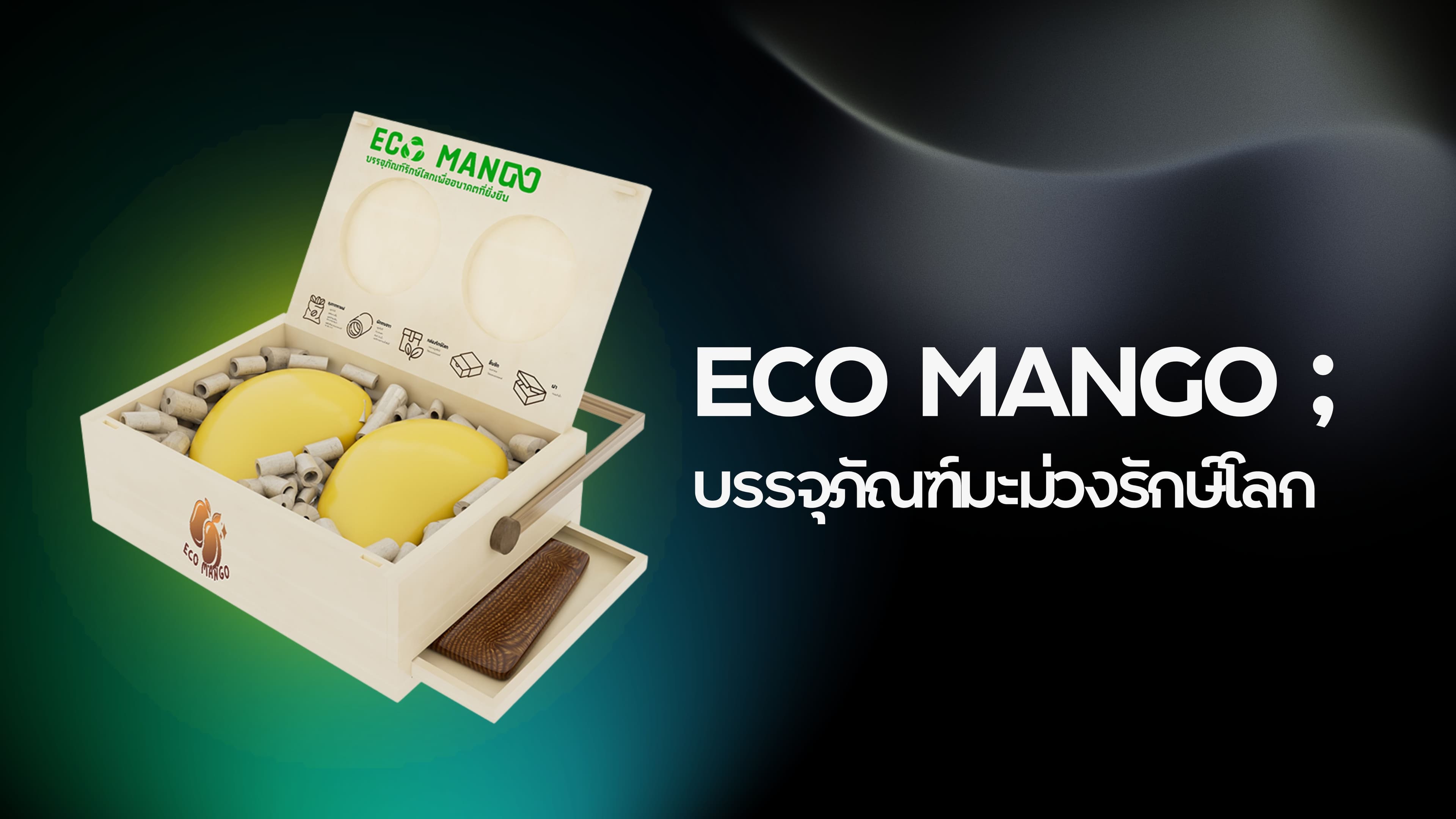
"Eco Mango Pack: Eco-friendly Packaging for a Sustainable Future" focuses on developing innovative packaging for Nam Dok Mai mangoes, considering fruit safety, shelf life, and environmental impact. The selected materials include a box made from coconut husk, and dry water hyacinth stems have been utilized as internal cushioning to enhance shock resistance. Additionally, dried coffee grounds are incorporated into the packaging to extend the mango's shelf life. The design also takes into account the needs of small-scale farmers, making the packaging suitable for community enterprise production and reducing production costs. This project aims to add value to Thai agricultural products, support the circular economy concept, and promote the use of environmentally friendly materials in the packaging industry.