
Climate change affects agricultural systems worldwide, including Thailand, and may lead to reduced crop yields, impacting food security. Bambara groundnut is a crop with the potential to adapt to changing environments and can thrive in areas with limited resources. This research aims to study the impact of climate change on Bambara groundnut yields in Thailand using the DSSAT (Decision Support System for Agrotechnology Transfer) model, an important tool for predicting plant growth under various environmental conditions. This study utilizes climate data, soil composition, and genetic information of Bambara groundnut to simulate and analyze yield trends under future climate scenarios. Four study areas in Thailand were selected: Songkhla, Lampang, Yasothon, and Saraburi. The CSM-CROPGRO-Bambara groundnut model was used to assess the impact of changing temperature and rainfall on the growth and yield of Bambara groundnut. The results of this study are expected to provide farmers and researchers with valuable information for planning cultivation and managing peanut production in response to climate change. Additionally, the findings can help formulate policy guidelines to promote the cultivation of climate-resilient crops and support the country's food security.
การเปลี่ยนแปลงสภาพภูมิอากาศส่งผลกระทบต่อระบบเกษตรกรรมทั่วโลก รวมถึงการเพาะปลูกพืชอาหาร ถั่วหรั่ง (Bambara groundnut) เป็นพืชตระกูลถั่วที่มีความสามารถทนแล้ง เจริญเติบโตได้ดีในดินที่มีความอุดมสมบูรณ์ต่ำ และให้คุณค่าทางโภชนาการสูง จึงมีศักยภาพในการเสริมความมั่นคงทางอาหารของประเทศ อย่างไรก็ตาม การเปลี่ยนแปลงของอุณหภูมิ ปริมาณน้ำฝน และความแปรปรวนของสภาพอากาศ อาจส่งผลต่อการเจริญเติบโตและผลผลิตของถั่วหรั่ง ทำให้เกิดความไม่แน่นอนในระบบการเกษตร งานวิจัยนี้มีเป้าหมายเพื่อประเมินผลกระทบของการเปลี่ยนแปลงสภาพภูมิอากาศต่อผลผลิตถั่วหรั่งในประเทศไทย โดยใช้แบบจำลอง DSSAT (Decision Support System for Agrotechnology Transfer) ซึ่งเป็นเครื่องมือที่ช่วยจำลองสภาพแวดล้อมและพฤติกรรมการเจริญเติบโตของพืชภายใต้สภาวะต่างๆ การศึกษานี้จะช่วยให้สามารถคาดการณ์แนวโน้มผลผลิตของถั่วหรั่งในอนาคต และนำไปใช้ในการวางแผนการเพาะปลูก รวมถึงพัฒนากลยุทธ์ในการปรับตัวของเกษตรกรให้สามารถรับมือกับสภาพภูมิอากาศที่เปลี่ยนแปลงได้อย่างมีประสิทธิภาพ

คณะวิศวกรรมศาสตร์
Our project seek to create an Al-powered tarot card reader that bridges the gap between traditional fortune-telling and modern technology. By leveraging a combination of 3D modeling, natural language processing, text-to-speech (TTS), and speech-to-text (STT) systems, the service will deliver an interactive and culturally sensitive experience in Thai and English. Users will input their queries through voice, which will be processed via STT, and receive engaging Al-generated tarot readings through TTS. Additionally, a 3D animated avatar will mimic a real-life fortune teller, adding a visual dimension to the experience. Hosted on a user-friendly website, this platform will redefine fortune-telling by blending tradition with innovation, making it both accessible and engaging for modern users.
คณะวิทยาศาสตร์
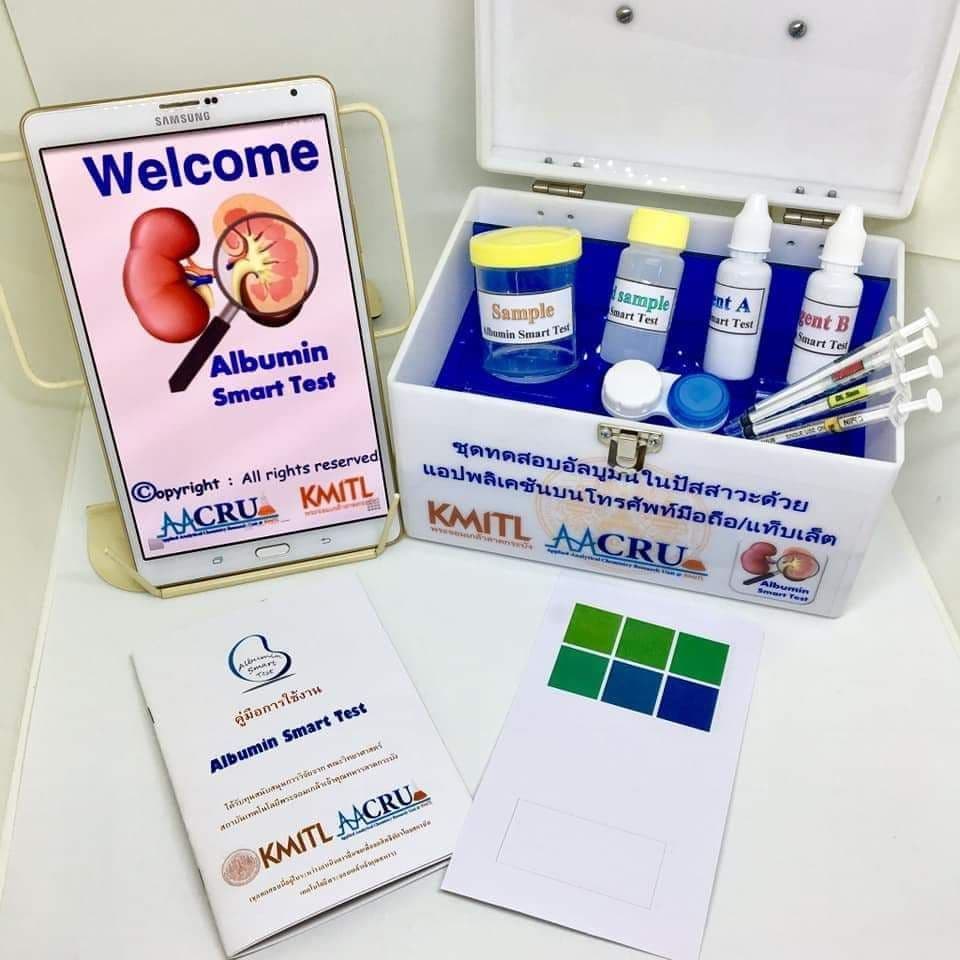
Albumin Smart Test is an innovative device for screening of kidney disease by mobile phone. The device composes of (1) container and testing device with specific reagents for the albumin detection. (2) The mobile phone, installed with "Albumin smart test" application. The test is started by dropping patient urine and the reagent. Color of the product is occurred and is captured by the application with subsequent evaluation of the albumin amount. The results is displayed on screen within 3 mins. This innovative device is simple, rapid and user-friendly.

คณะแพทยศาสตร์
This research studies the effect of CBD on the excitability of mice nociceptive trigeminal ganglion neurons. The electrophysiological parameters of the mouse trigeminal ganglion cells are measured using a Whole Cell Current Clamp Model on a primary cell culture treated with 0.5 uM CBD for 24 hours compared to a control group. After obtaining the results statistical analysis is done using a Mann Whitney-U test.