
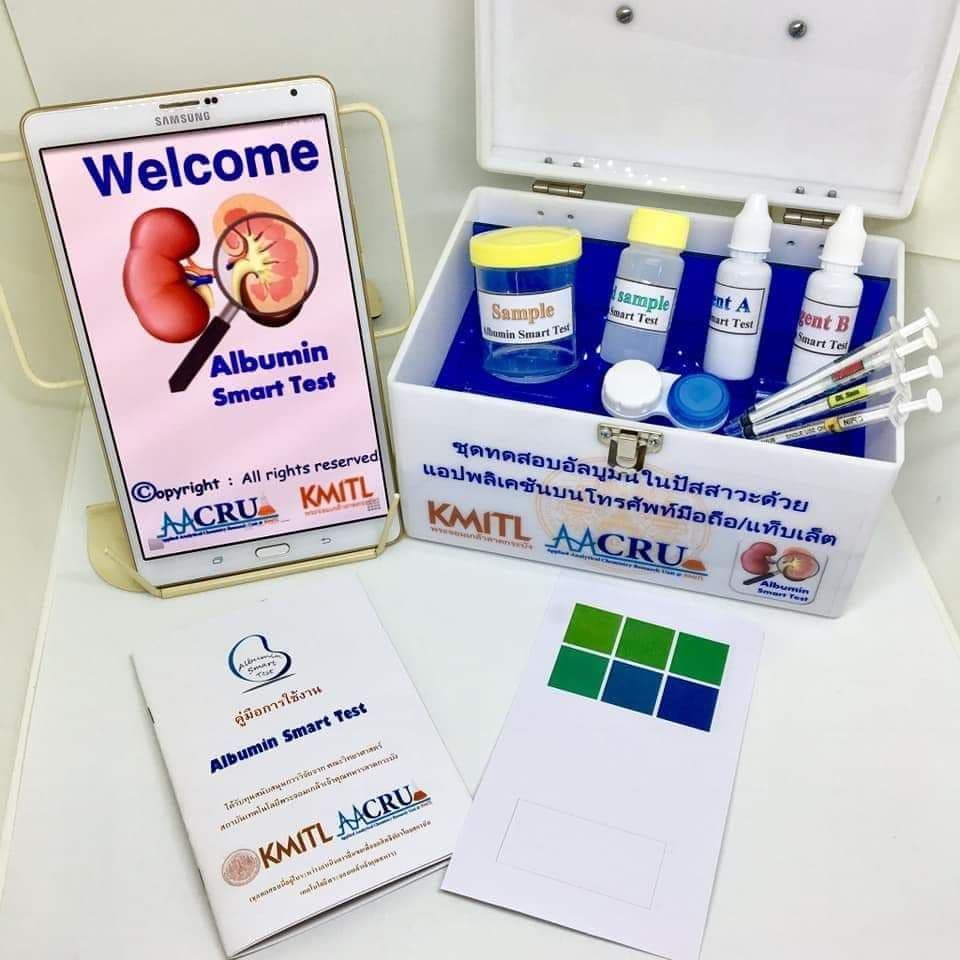
Albumin Smart Test is an innovative device for screening of kidney disease by mobile phone. The device composes of (1) container and testing device with specific reagents for the albumin detection. (2) The mobile phone, installed with "Albumin smart test" application. The test is started by dropping patient urine and the reagent. Color of the product is occurred and is captured by the application with subsequent evaluation of the albumin amount. The results is displayed on screen within 3 mins. This innovative device is simple, rapid and user-friendly.
อัลบูมิน (Albumin) คือโปรตีนชนิดหนึ่ง โดยทั่วไป จะไม่พบอัลบูมินในปัสสาวะ ยกเว้นในกรณีที่ไตทำงานผิดปกติ ซึ่งมักพบในผู้ป่วยที่ป่วยเป็นโรคเบาหวานเป็นระยะเวลานาน หรือที่เรียกว่า "โรคไตจากเบาหวาน" (Diabetic nephropathy) จะพบ อัลบูมินปนในปัสสาวะ ดังนั้น ปริมาณอัลบูมินในปัสสาวะ (Urinary albumin) จึงสามารถใช้เป็นดัชนีบ่งชี้การทำงานของไตในผู้ป่วยเบาหวานได้ โดยถ้าพบปริมาณอัลบูมินในปัสสาวะที่เก็บภายใน 24 ชั่วโมง น้อยกว่า 30 มิลลิกรัม จะถือว่าไตทำงานเป็นปกติ แต่ถ้าพบปริมาณอัลบูมินอยู่ในช่วงตั้งแต่ 30 ถึง 300 มิลลิกรัม จะจัดว่าไตทำงานผิดปกติในระยะแรก เรียกว่า "ภาวะไมโครอัลบูมินูเรีย" (Microalbuminuria) ซึ่งหากผู้ป่วยเข้ารับการรักษาตั้งแต่ระยะนี้ จะลดโอกาสเสี่ยงต่อภาวะไตวายเรื้อรังได้อย่างมาก วิธีการตรวจวัดระดับอัลบูมินในปัสสาวะในปัจจุบัน ทำโดยเก็บตัวอย่างปัสสาวะของผู้ป่วย ส่งไปที่ห้องปฏิบัติการของโรงพยาบาล ถึงแม้จะให้ผลถูกต้องแม่นยำ หากแต่มีขั้นตอนในการวิเคราะห์หลายขั้นตอน ใช้เวลานานกว่าจะรู้ผล อีกทั้งเครื่องมือมีขนาดใหญ่และมีความซับซ้อน ต้องใช้ผู้เชี่ยวชาญทำการทดสอบ ผู้ป่วยไม่สามารถวัดระดับอัลบูมินได้เอง ดังนั้นจึงจำเป็นต้องมีอุปกรณ์ตรวจคัดกรองปริมาณอัลบูมินที่ใช้ทดสอบนอกห้องปฏิบัติการได้ โดยควรเป็นอุปกรณ์ขนาดเล็ก พกพาสะดวก ใช้งานง่าย เหมาะสำหรับการวินิจฉัยนอกห้องปฏิบัติการ หรือ ‘Point-of-care testing’ ในปัจจุบัน ชุดตรวจวัดอัลบูมินในปัสสาวะแบบภาคสนามที่มีจำหน่าย จะทำการทดสอบโดยจุ่มแถบตรวจวัดที่เคลือบด้วยน้ำยาซึ่งจะทำปฏิกิริยากับอัลบูมินในปัสสาวะ แล้วเกิดการเปลี่ยนแปลงที่แถบสี โดยระดับความเข้มสีจะแปรผันกับปริมาณของอัลบูมินที่ต้องการตรวจวัด ถึงแม้จะใช้งานง่าย แต่มีข้อจำจัดคืออาจมีความคลาดเคลื่อน เนื่องจากเป็นการตรวจวัดด้วยสายตา การแปลผลอาจจะไม่ละเอียดพอ ไม่ใกล้เคียงกับความเป็นจริง อีกทั้งสีของปัสสาวะอาจรบกวนการทดสอบได้ เพื่อเป็นการพัฒนาวิธีทดสอบให้มีประสิทธิภาพ มีความถูกต้องแม่นยำมากขึ้น จึงได้ประดิษฐ์ Albumin Smart Test สำหรับตรวจคัดกรองอัลบูมินในปัสสาวะโดยใช้โทรศัพท์มือถือขึ้น โดยออกแบบให้ใช้งานง่าย รู้ผลเร็ว พกพาไปใช้ ณ ที่ใดก็ได้ และสามารถหักล้างการรบกวนจากสีของตัวอย่างปัสสาวะได้

คณะอุตสาหกรรมอาหาร
This research project focuses on developing an "instant coconut milk ice cream powder" enriched with dietary fiber and insect protein powder — a concept rooted in creating an alternative dessert product in powdered ice cream form with key strengths in health, nutritional value, and sustainability. Coconut milk, a plant-based ingredient, serves as the primary raw material in place of cow's milk, making the product suitable for individuals with lactose allergy or lactose intolerance. The product is further enriched with inulin dietary fiber to enhance its functional nutritional value, supporting the growth of beneficial gut microorganisms, helping to improve digestive balance, and aiding in blood sugar level control. Additionally, insect protein powder is incorporated as a high-quality protein source representing a future alternative protein that distinguishes this product from conventional ice cream. Furthermore, the instant powdered coconut milk ice cream format offers practical advantages — it is easy to prepare, convenient, and simple to transport and store. The product can be reconstituted into ice cream by adding water, blending, and freezing prior to consumption. It can also serve as a base for other ice cream flavors, or be further applied as an ingredient in other desserts or blended beverages. There is also commercial potential to extend the product as a health food ingredient for the food service industry. The product is developed with the concept of low fat and low sugar content, utilizing clean, safe, standardized, and environmentally friendly domestic raw materials

คณะสถาปัตยกรรม ศิลปะและการออกแบบ
-
วิทยาลัยอุตสาหกรรมการบินนานาชาติ
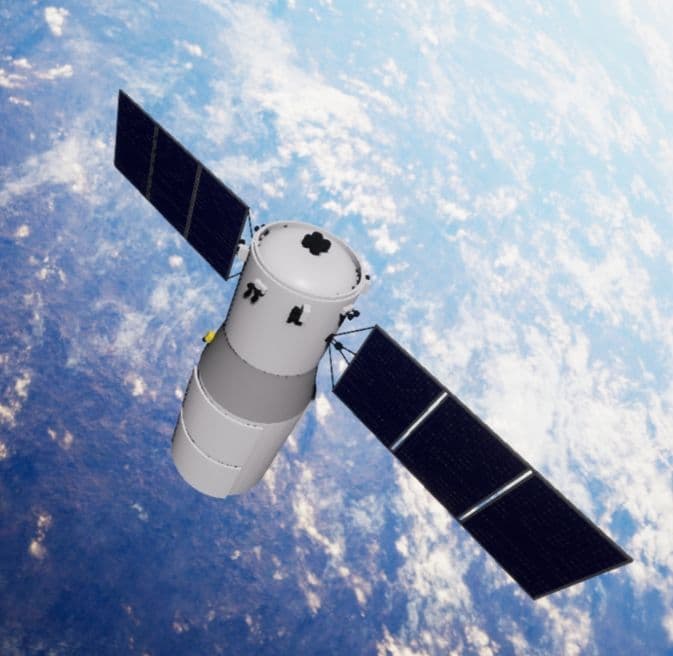
The capture of a target spacecraft by a chaser is an on-orbit docking operation that requires an accurate, reliable, and robust object recognition algorithm. Vision-based guided spacecraft relative motion during close-proximity maneuvers has been consecutively applied using dynamic modeling as a spacecraft on-orbit service system. This research constructs a vision-based pose estimation model that performs image processing via a deep convolutional neural network. The pose estimation model was constructed by repurposing a modified pretrained GoogLeNet model with the available Unreal Engine 4 rendered dataset of the Soyuz spacecraft. In the implementation, the convolutional neural network learns from the data samples to create correlations between the images and the spacecraft’s six degrees-of-freedom parameters. The experiment has compared an exponential-based loss function and a weighted Euclidean-based loss function. Using the weighted Euclidean-based loss function, the implemented pose estimation model achieved moderately high performance with a position accuracy of 92.53 percent and an error of 1.2 m. The in-attitude prediction accuracy can reach 87.93 percent, and the errors in the three Euler angles do not exceed 7.6 degrees. This research can contribute to spacecraft detection and tracking problems. Although the finished vision-based model is specific to the environment of synthetic dataset, the model could be trained further to address actual docking operations in the future.