


Our project seek to create an Al-powered tarot card reader that bridges the gap between traditional fortune-telling and modern technology. By leveraging a combination of 3D modeling, natural language processing, text-to-speech (TTS), and speech-to-text (STT) systems, the service will deliver an interactive and culturally sensitive experience in Thai and English. Users will input their queries through voice, which will be processed via STT, and receive engaging Al-generated tarot readings through TTS. Additionally, a 3D animated avatar will mimic a real-life fortune teller, adding a visual dimension to the experience. Hosted on a user-friendly website, this platform will redefine fortune-telling by blending tradition with innovation, making it both accessible and engaging for modern users.
ในปัจจุบัน AI Chatbots และ LLM ถูกนำมาใช้ในหลายธุรกิจ รวมถึงการให้คำแนะนำและการพยากรณ์ อย่างไรก็ตาม ในตลาดการพยากรณ์ออนไลน์ยังไม่มีระบบ AI ที่สามารถให้บริการพยากรณ์ไพ่ทาโรต์ได้อย่างมีประสิทธิภาพและให้ประสบการณ์ที่ใกล้เคียงกับนักพยากรณ์จริง จากการสังเกตพฤติกรรมของผู้ใช้สื่อโซเชียลในไทย พบว่ามีผู้ใช้จำนวนมากที่นิยมใช้ ChatGPT และ AI อื่น ๆ เพื่อขอคำพยากรณ์เกี่ยวกับอนาคตของตนเอง ซึ่งบ่งบอกถึงความสนใจในบริการลักษณะนี้ อย่างไรก็ตาม ยังไม่มีแพลตฟอร์มที่พัฒนาเพื่อจุดประสงค์ในการดูดวงโดยเฉพาะ ดังนั้น โครงการนี้จึงมีเป้าหมายในการพัฒนา AI ที่สามารถโต้ตอบกับผู้ใช้ได้อย่างสมจริง โดยใช้โมเดลภาษาและเทคโนโลยีที่ทันสมัย

คณะอุตสาหกรรมอาหาร
Most rice is consumed as cooked, milled rice, but a small portion is also ground into flour or separated into a starch fraction and used by the food industry as a gluten-free ingredient. This study aims to find out if different types of rice flour and starch, such as white and colored rice, could be used in industry. This study employs green modification techniques to slow down the digestion process by combining polyphenols with starch. Our initial study found that the raw colored rice has a lower glycemic index than other types of rice, such as brown or white rice. Another study that looked at how the quality of colored rice flour was changed by different methods also discovered that out of the six green methods (annealing, heat moisture treatment, ultrasound, pregelatinization, wet-microwave, and dry-microwave). It found that ultrasound improved the polyphenol bioaccessibility in the rice flour and reduced the digestion rate. The pregelatinization process led to the flour having high solubility and an estimated glycemic index. Different techniques affected the flour/starch quality in different ways. Therefore, for further industrial application, it could also be easier to select the method for food product based on their required techno-functional quality of flour/starch. In addition to the modification techniques, this study showed that the high bioaccessible polyphenol content and high polyphenol content in rice greatly slowed down the rate of digestion. This study also open for further exploring the possibility of using high polyphenol agricultural waste to modify starch and flour in a sustainable manner.
คณะสถาปัตยกรรม ศิลปะและการออกแบบ
A commercial architecture consists of a community mall and home offices. The project’s main concept concerns the lack of activities around the given site. The project tackles the main issues of underdevelopment by aiming to bring back the liveliness of the local people back by integrating work-life symbolism and natural spaces, resulting in an interesting design.
คณะเทคโนโลยีการเกษตร
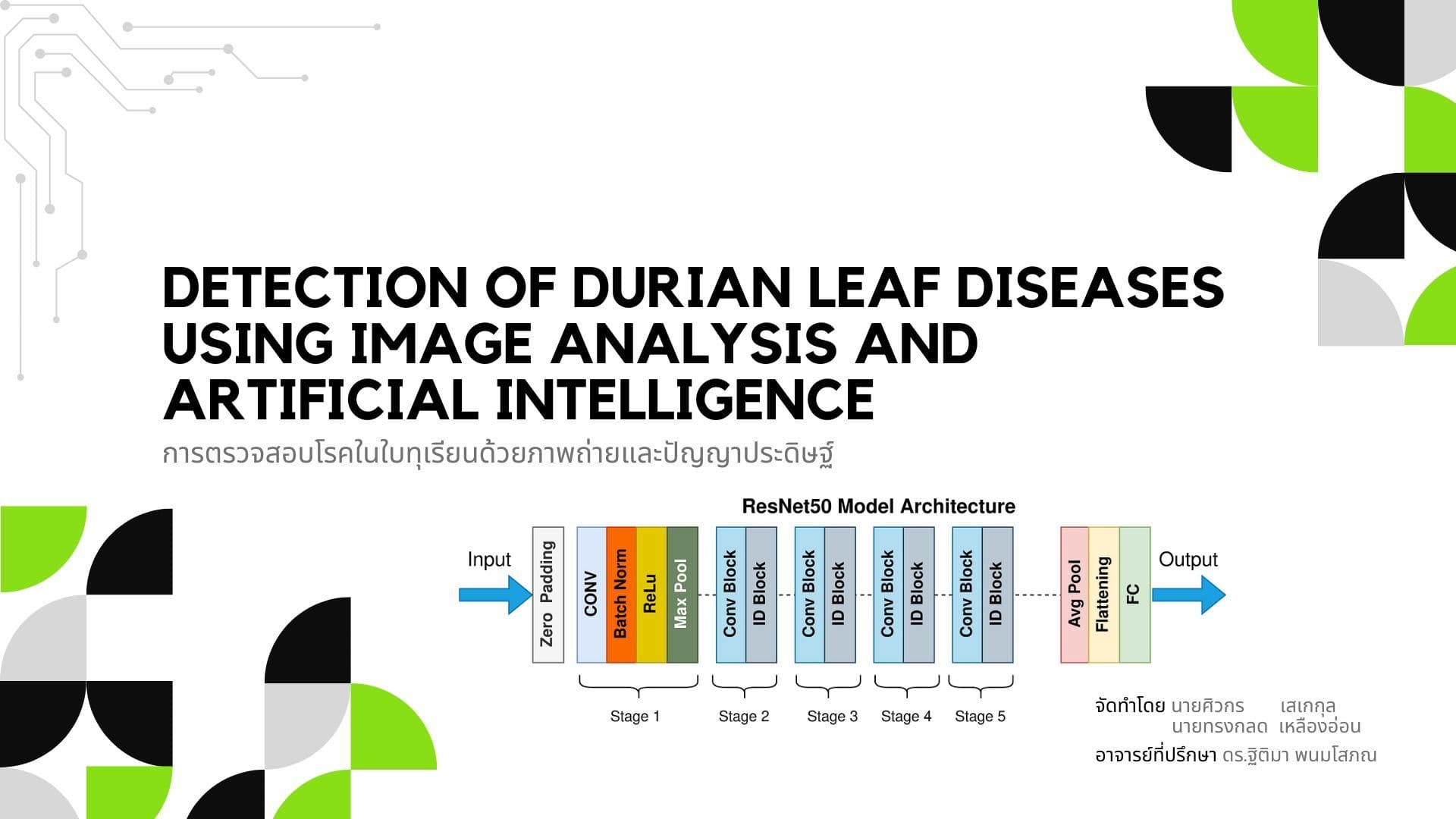
Durian is a crucial economic crop of Thailand and one of the most exported agricultural products in the world. However, producing high-quality durian requires maintaining the health of durian trees, ensuring they remain strong and disease-free to optimize productivity and minimize potential damage to both the tree and its fruit. Among the various diseases affecting durian, foliar diseases are among the most common and rapidly spreading, directly impacting tree growth and fruit quality. Therefore, monitoring and controlling leaf diseases is essential for preserving durian quality. This study aims to apply image analysis technology combined with artificial intelligence (AI) to classify diseases in durian leaves, enabling farmers to diagnose diseases independently without relying on experts. The classification includes three categories: healthy leaves (H), leaves infected with anthracnose (A), and leaves affected by algal spot (S). To develop the classification model, convolutional neural network (CNN) algorithms—ResNet-50, GoogleNet, and AlexNet—were employed. Experimental results indicate that the classification accuracy of ResNet-50, GoogleNet, and AlexNet is 93.57%, 93.95%, and 68.69%, respectively.