

Discover the ultimate innovations of the future developed by Thai researchers! Meet the latest technology from KMITL that will transform our way of life and industry.

คณะเทคโนโลยีการเกษตร
The development of a board game to enhance cooking skills focuses on a popular and well-known dish—burgers. This study integrates learning with interactive gameplay, allowing players to gain knowledge about burgers, including their ingredients, preparation methods, and even the basics of running a burger business. Through hands-on activities and engaging game mechanics, players can develop both their culinary skills and entrepreneurial mindset while enjoying the fun and immersive experience of the board game.
คณะวิศวกรรมศาสตร์
In Thailand, the quantity of old tires has been increasing annually, posing a significant environmental challenge due to their non-biodegradable material. However, old tires contain an internal porous structure, which suggests their potential application as sound-absorbing materials. Porosity is a key characteristic that enables materials to trap sound waves, making them effective for noise reduction. Therefore, this study aims to investigate and develop sound-absorbing materials from old tire rubber powder. The methodology involved mixing old tire powder with fresh latex at a ratio of 1:2, followed by drying at a temperature of 120°C for four hours. Subsequently, the physical properties influencing sound absorption, including density, porosity, and water absorption, were analyzed. The results indicated that the sound-absorbing material produced from old tire rubber powder showed a density of 0.96 g/cm³, a porosity value of 0.45, and a water absorption of 11.03%. Therefore, the findings suggest that old tire rubber powder has the potential to be effectively utilized as a sound-absorbing material.
คณะวิศวกรรมศาสตร์
This thesis project was conducted to identify the optimal conditions for producing concentrated butterfly pea juice using vacuum evaporation to preserve key compounds in butterfly pea flowers, such as anthocyanins—natural pigments with high antioxidant properties. The study applies a Box-Behnken Design, a statistical method that facilitates analysis of multiple factors. The research focuses on the ratio of dried butterfly pea flowers to water, extraction temperature, and evaporation temperature, each of which has a direct effect on the preservation of key compounds, color, aroma, and flavor. The results indicate that using a dried flower-to-water ratio of 1:15, an extraction temperature of 60°C, and an evaporation temperature of 40°C under low pressure can minimize the loss of essential compounds and best retain the properties of the concentrated butterfly pea juice. Findings from this research provide a foundation for developing an industrial production process for concentrated butterfly pea juice and enhance the potential for creating new products from butterfly pea flowers.
คณะอุตสาหกรรมอาหาร
This research investigates active packaging films made from polyvinyl alcohol (PVA) and nanocellulose fibers (NFC), incorporating silver nanoparticles (AgNPs) synthesized from Terminalia chebula extract, which possesses antibacterial and antifungal properties. The developed films were tested for their mechanical properties, microbial inhibition, and biodegradability. The results showed that the addition of AgNPs from Terminalia chebula enhanced product protection and effectively extended the shelf life of strawberries while being environmentally friendly.
คณะอุตสาหกรรมอาหาร
This study aims to investigate the co-fermentation process between lactic acid bacteria (LAB) and Saccharomyces cerevisiae in the production of sour beer, with a focus on its impact on product quality, including pH, organic acid content, sugar content, and sensory characteristics. In this experiment, selected LAB strains and S. cerevisiae were utilized under controlled fermentation conditions. The microbial ratio was optimized to enhance growth and the production of key compounds. The findings indicate that co-fermentation significantly reduces pH compared to fermentation with yeast alone. Furthermore, an increase in lactic acid was observed due to sugar consumption by LAB, contributing to the distinctive flavor profile of sour beer.
คณะอุตสาหกรรมอาหาร
This study aims to investigate the co-encapsulation technique of vitamin C and coenzyme Q10 within liposomes to enhance their stability and encapsulation efficiency and evaluate their antioxidant activity and release behavior under simulated gastrointestinal conditions. Liposomes were prepared using the High-Speed Homogenization Method, and their characteristics, including particle size, zeta potential, encapsulation efficiency, and antioxidant activity, were analyzed using DPPH, ABTS, and FRAP assays. The results demonstrated that co-encapsulation significantly improved the stability of vitamin C and coenzyme Q10 compared to single encapsulation. The liposomes exhibited high encapsulation efficiency and maintained strong antioxidant activity. The release profile under simulated gastrointestinal conditions also indicated a sustained and controlled release. These findings highlight the potential of the co-encapsulation technique in enhancing the efficacy of functional bioactive compounds, making it applicable to the food and nutraceutical industries.
คณะอุตสาหกรรมอาหาร
Bio-calcium powders were extracted from Asian sea bass bone by heat-treated alkaline with fat removal and bleaching supplementary method. Cereal bars (CBs) were fortified with produced bio-calcium at 3 levels: (1) increased calcium (IS-Ca; calcium ≥10% Thai RDI), (2) good source of calcium (GS-Ca; calcium ≥15% Thai RDI), and (3) high calcium (H-Ca; calcium ≥30% Thai RDI) which were consistent with the notification of the Ministry of Public Health, Thailand: No. 445; Nutrition claim issued in B.E. 2023. Moisture content, water activity, color, calcium content and FTIR analysis of bio-calcium powders were measured. Dimension, color, water activity, pH and texture of fortified CBs were determined. Produced bio-calcium could be classified as a dried food with light yellow-white color. Calcium contents in bio-calcium powder was 23.4% (w/w). Dimension, weight and color except b* and ΔE* values of fortified CBs were not different (P > 0.05) from those of the control. Fortifying of bio-calcium resulted in harder texture CBs. An increase of fortified bio-calcium amounts decreased carbohydrate and fat but increased of protein, ash and calcium in the fortified CBs. Shelf life of CBs was to be shorten by fortification of bio-calcium powder because of the increment of moisture, water activity and pH. Yield of bio-calcium production was 40.30%. Production cost of bio-calcium was approximately 7,416 Bth/kg while cost of fortified CBs increased almost 2-3 times compared to the control. Calcium contents in IS-Ca (921.12 mg/100g), GS-Ca (1,287.10 mg/100g) and H-Ca (2,639.70 mg/100g) cereal bars could be claimed as increased calcium, good source of calcium and high calcium, respectively. In conclusion, production of cereal bar fortified with Asian sea bass bone bio-calcium powder as a fortified food was possible. However, checking the remained hazardous reagents in bio-calcium powder must be carried out before using in food products and analysis of calcium bioavailability, sensory acceptance and shelf life of the developed products should be determined in further studies.
คณะเทคโนโลยีการเกษตร
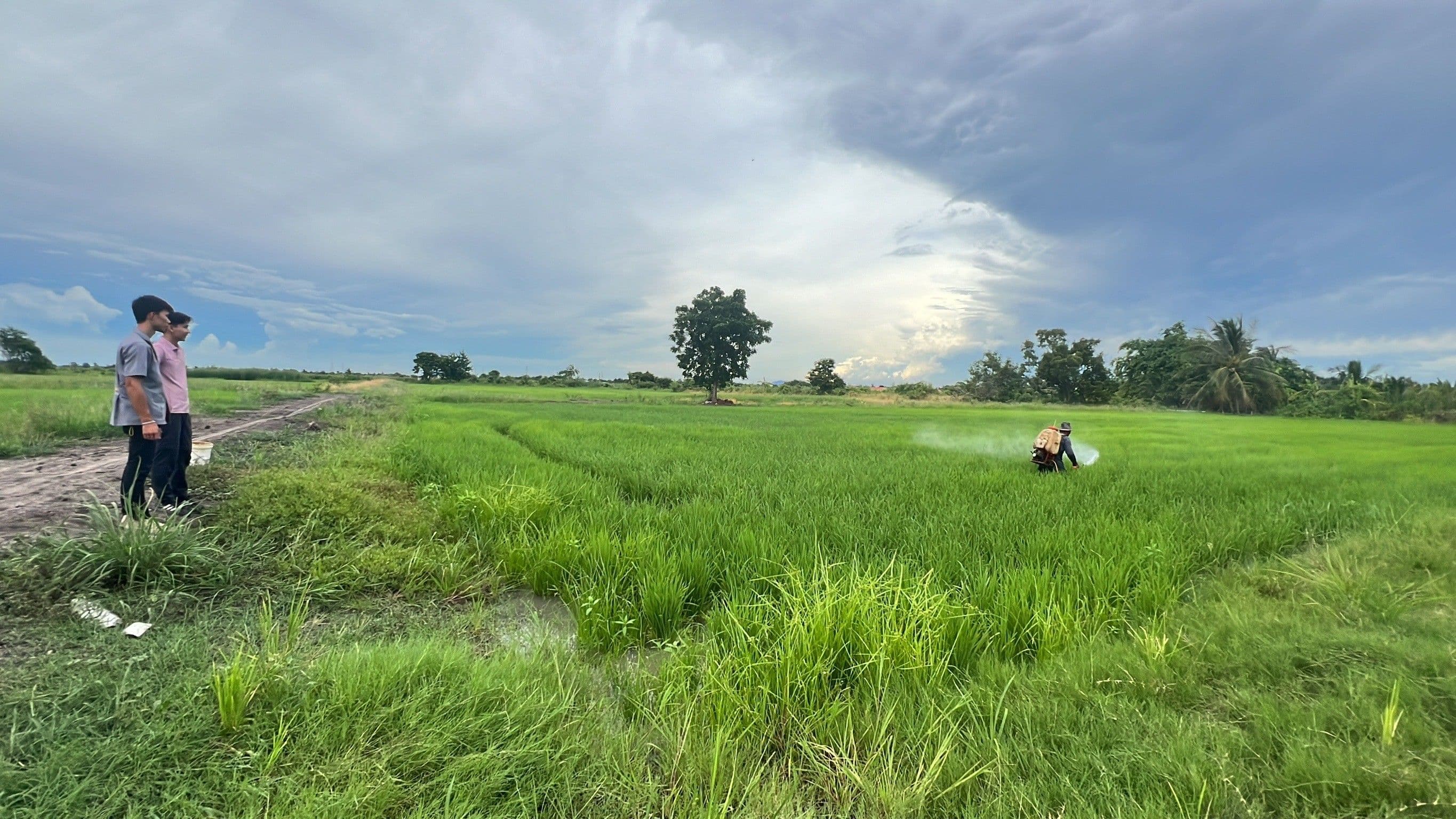
During this cooperative education program at the Bang Bo District Agricultural Office, Samut Prakan Province, a study was conducted on the costs and returns of rice cultivation using chemical inputs compared to using biopesticides in combination with chemical inputs among farmers in Bang Phli Noi Subdistrict, Bang Bo District, Samut Prakan Province.The objectives of this study were: To examine the costs and returns of rice cultivation using chemical inputs compared to using biopesticides in combination with chemical inputs among farmers in Bang Phli Noi Subdistrict, Bang Bo District, Samut Prakan Province. To explore the challenges of using biopesticides in rice cultivation among farmers in Bang Phli Noi Subdistrict, Bang Bo District, Samut Prakan Province. The study found that in the 2024/25 growing season, the total production cost for rice cultivation using biopesticides in combination with chemical inputs was 5,099.50 THB per rai, consisting of variable costs of 4,432.50 THB per rai and fixed costs of 667.00 THB per rai. Meanwhile, the total production cost for rice cultivation using only chemical inputs was 5,129.00 THB per rai, consisting of variable costs of 4,390.00 THB per rai and fixed costs of 739.00 THB per rai. The cost difference between the two methods was 114.50 THB per rai. Regarding the returns on rice cultivation in the 2024/25 growing season, the field using biopesticides in combination with chemical inputs yielded 1,000.00 kilograms per rai, with an average selling price of 8,500.00 THB per rai. Farmers earned a total revenue of 8,585.00 THB per rai and a profit of 3,485.50 THB per rai. On the other hand, the field using only chemical inputs yielded 1,000.00 kilograms per rai, with an average selling price of 8,500.00 THB per rai. Farmers earned a total revenue of 8,500.00 THB per rai and a profit of 3,371.00 THB per rai. The total income difference between the two cultivation methods was 114.50 THB per rai. In terms of challenges related to the procurement of biopesticides, it was found that biopesticides are difficult to obtain, with limited or no availability in certain areas. Additionally, relevant agencies do not provide continuous support for biopesticides, making this the most significant issue. Regarding the use of biopesticides, the most critical challenge is that once fresh biopesticides are mixed, they must be used immediately and cannot be stored, as their effectiveness deteriorates over time.

คณะเทคโนโลยีการเกษตร
This project presents a design and management approach for agricultural land in Kanchanaburi Province. The case study area is situated in Wangdong Subdistrict, Mueang Kanchanaburi District, covering an area of approximately 18 rai (7.2 acres). As the user seeks a simplified lifestyle in the countryside, surrounded by nature, the design aligns with this vision of simplicity and sustainability. The land is systematically allocated to optimize the benefits for both daily living and agricultural industry development. The crop cultivation zones are designed to suit the local climate and plant varieties, ensuring high-quality yields for continuous utilization. Meanwhile, the livestock zones are clearly delineated to maintain balance and organization. This approach not only ensures food security and income generation but also promotes a lifestyle that harmonizes with nature, minimizes environmental impact, and supports the long-term development of an efficient and eco-friendly agricultural industry. Comprehensive attention is given to the positioning of various zones, considering wind direction and sunlight exposure. Additionally, the design undergoes a rigorous drafting and review process to ensure the optimal outcomes for the land's utilization.