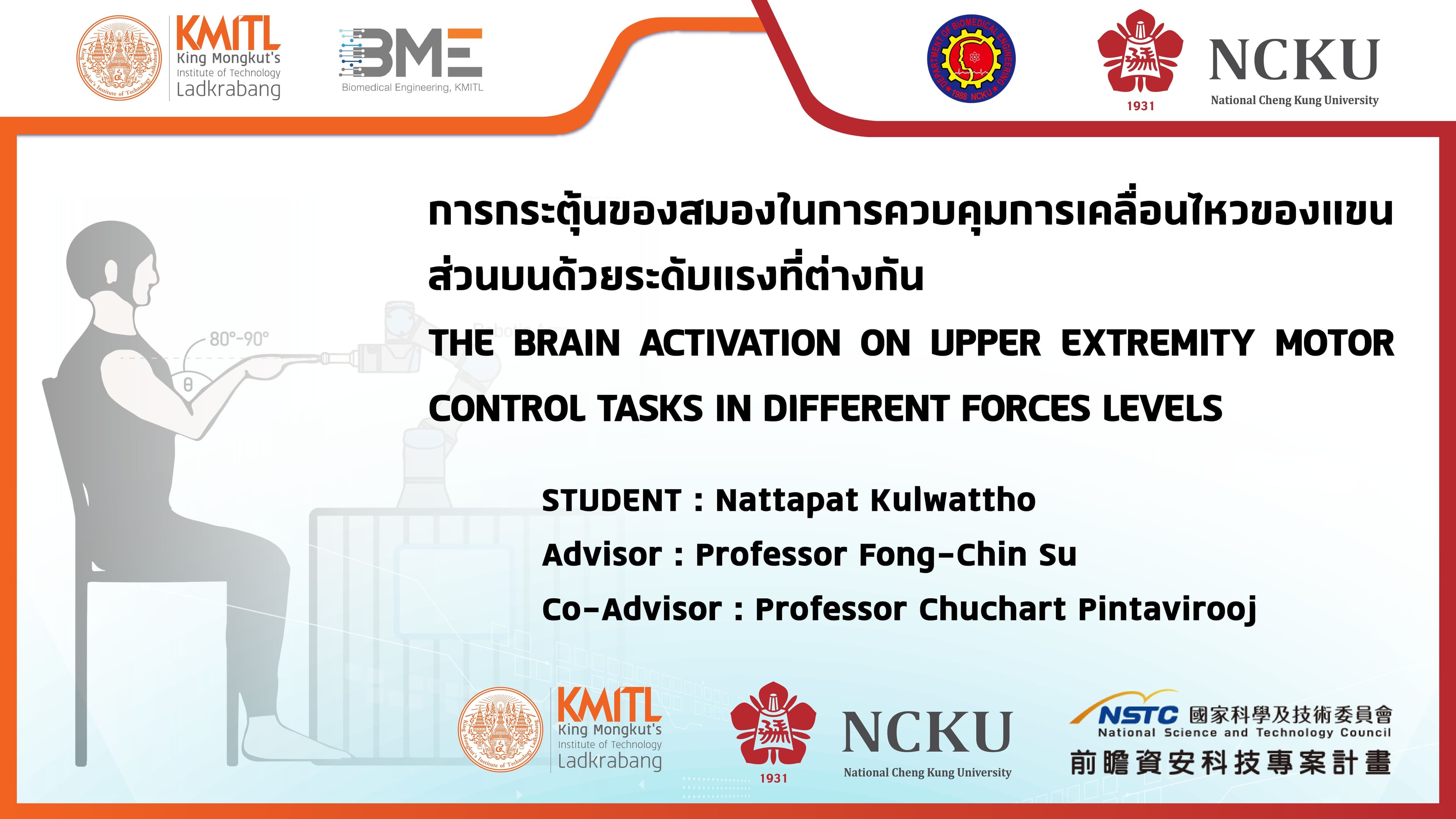
Motor control is a critical process for muscle contraction, which is initiated by nerve impulses governed by the motor cortex. This process is vital for performing activities of daily living (ADLs). Consequently, a disruption in communication between the brain and muscles, as seen in various chronic conditions and diseases, can impair bodily movement and ADLs. Evaluating the interaction between brain function and motor control is significant for the diagnosis and treatment of motor control disorders; moreover, it can contribute to the development of brain-computer interfaces (BCIs). The purpose of this study is to investigate brain activation in designed upper extremity motor control tasks in regulating the pushing force in different brain regions; and develop investigation methods to assess motor control tasks and brain activation using a robotic arm to guide upper extremity force and motor control. Eighteen healthy young adults were asked to perform upper extremity motor control tasks and recorded the hemodynamic signals. Functional Near-Infrared Spectroscopy (fNIRs) and robotic arms were used to assess brain activation and the regulation of pushing force and extremity motor control. Two types of motion, static and dynamic, move along a designated trajectory in both forward and backward directions, and three different force levels selected from a range of ADLs, including 4, 12, and 20 N, were used as force-regulating upper extremity motor control tasks. The hemodynamic responses were measured in specific regions of interest, namely the primary motor cortex (M1), premotor cortex (PMC), supplementary motor area (SMA), and prefrontal cortex (PFC). Utilizing a two-way repeated measures ANOVA with Bonferroni correction (p < 0.00625) across all regions, we observed no significant interaction effect between force levels and movement types on oxygenated hemoglobin (HbO) levels. However, in both contralateral (c) and ipsilateral (i) PFC, movement type—static versus dynamic—significantly affected brain activation. Additionally, cM1, iPFC, and PMC showed a significant effect of force level on brain activation.
This observational study aims to investigate the relationship between brain activation in specific regions and various motor tasks involving upper extremity movement with force control. Utilizing fNIRs, the research will monitor hemodynamic changes in four key brain areas: the prefrontal cortex (PFC), premotor cortex (PMC), supplementary motor area (SMA), and primary motor cortex (M1) during task performance. The primary population for this investigation consists of healthy young adults, allowing for a clearer understanding of how force control affects brain activation. The scope of the study includes assessing brain activation measured by fNIRs during upper extremity motor and force control tasks, as well as examining how upper extremity movements and force control influence brain activation.
คณะเทคโนโลยีสารสนเทศ
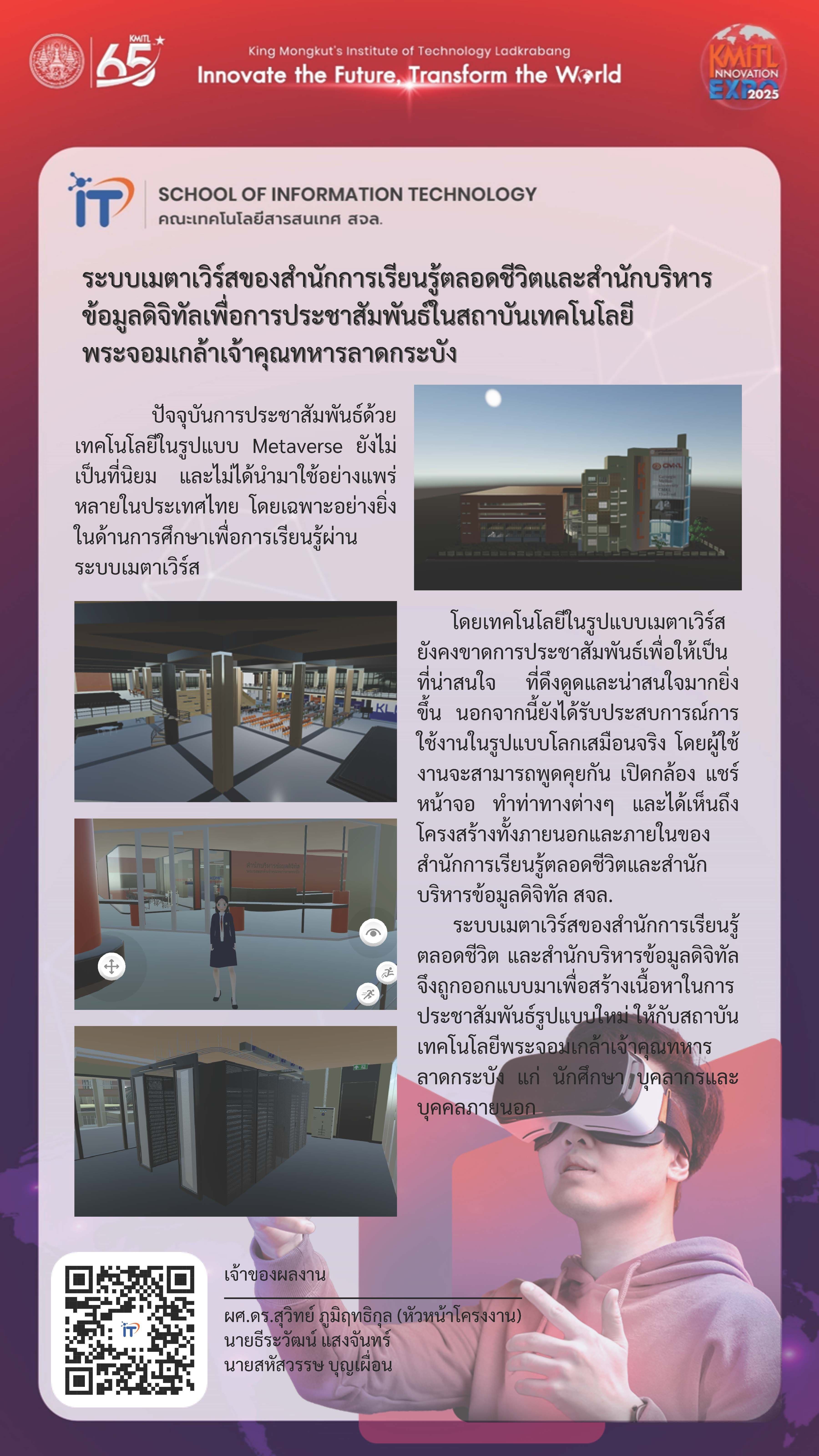
This thesis aims to present the development of a metaverse project for the KMITL Lifelong Learning Center (KLLC) and KMITL Data Management Center (KDMC) for Public Relations at King Mongkut's Institute of Technology Ladkrabang, with the main goal of creating a metaverse prototype to promote learning and public relations through virtual reality technology for students, staff, and external individuals. In this project, the developers have created a metaverse system to simulate a virtual experience for users at the KMITL Lifelong Learning Center (KLLC) and KMITL Data Management Center (KDMC) for Public Relations at King Mongkut's Institute of Technology Ladkrabang. Users will be able to access the system through a web application developed with Unity, which is the tool used to create the metaverse system. The design allows users to visit and interact with various locations within the building to promote public relations in a more widespread virtual format. The developers used Maya and Unity software to create a metaverse system for modeling 3D objects and managing various functions, providing users with a realistic and novel experience. This project is expected to promote learning and the dissemination of information in an easily accessible modern format, creating opportunities for education and learning for those who cannot travel to see the actual locations. This makes metaverse technology an important tool for effectively developing learning and engagement in the digital age.

คณะอุตสาหกรรมอาหาร
The Mahachanok mango sauce is crafted from low-grade mangoes sourced from Ban Nong Bua Chum in Kalasin Province. Utilizing advanced food science technology, it effectively reduces agricultural waste and enhances product quality. This sauce is enriched with prebiotic fiber that supports the growth of beneficial gut microorganisms. With low sugar content, it is a healthy choice free from artificial colors and flavors. Its rich, natural taste makes it versatile, perfect for enhancing a wide variety of dishes, both savory and sweet.
คณะวิศวกรรมศาสตร์
Design and Development of a Remote Battery Management System This research focuses on the design and development of a battery management system that enables remote monitoring and control, allowing users to customize battery cell properties as needed. The system is specifically designed for use with graphene battery cells and can be effectively applied to alternative energy systems for residential use.