
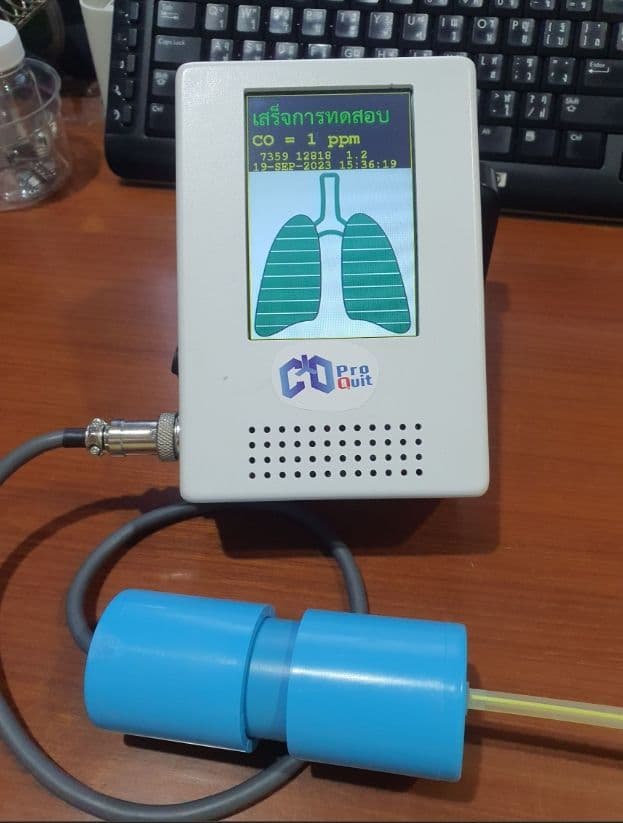
CO Breathalyzer with Voice Response is the device to measured the level of CO residual in a person's lung who consume tobacco. Measuring residual CO in human breath can identify the tobacco addiction level instead of measuring nicotine in blood.
เพื่อทดแทนการนำเข้าจากต่างประเทศ

คณะอุตสาหกรรมอาหาร
Spent hens are laying hens that are over 18 months to 2 years old and no longer productive. The texture of spent hen meat is significantly tougher compared to broiler chickens, capons, and native chickens. Therefore, to increase the value of spent hens, a study was conducted to modify the texture of the meat by restructuring it with carrageenan and tenderizing it by marinating it in bromelain solution at different concentrations. The experiment found that restructuring with carrageenan and using bromelain enzyme resulted in a newly formed product and significantly improved the tenderness of the meat compared to chicken meat that was not treated with carrageenan and bromelain enzyme.
คณะวิศวกรรมศาสตร์
This project focuses on developing a test device for an AC charger for electric vehicles according to the IEC 61851-1 Annex A standard by simulating the test circuit inside an electric vehicle according to the standard to test the operation of the AC charger. The test topic is related to the communication between the electric vehicle and the charger via a Pulse Width Modulation (PWM) control circuit system and creating an operation manual (WI) to prepare for testing in accordance with ISO/IEC 17025 standards, which are general requirements for laboratory capabilities in conducting tests and/or calibrations. The overall picture of this project is to develop test equipment and create an operation manual by collecting knowledge and various devices and then comparing the data to meet the abovementioned standards to test the Type II AC charger in each state. The test equipment consists of a communication part between the test equipment and the AC charger using a PLC S7-1200 and an HMI to control the operation of the switches in the test equipment circuit, including controlling parameters and displaying results. The equipment used to measure values is an oscilloscope and a multimeter that have undergone a calibration process to comply with the specified standards.
คณะวิศวกรรมศาสตร์
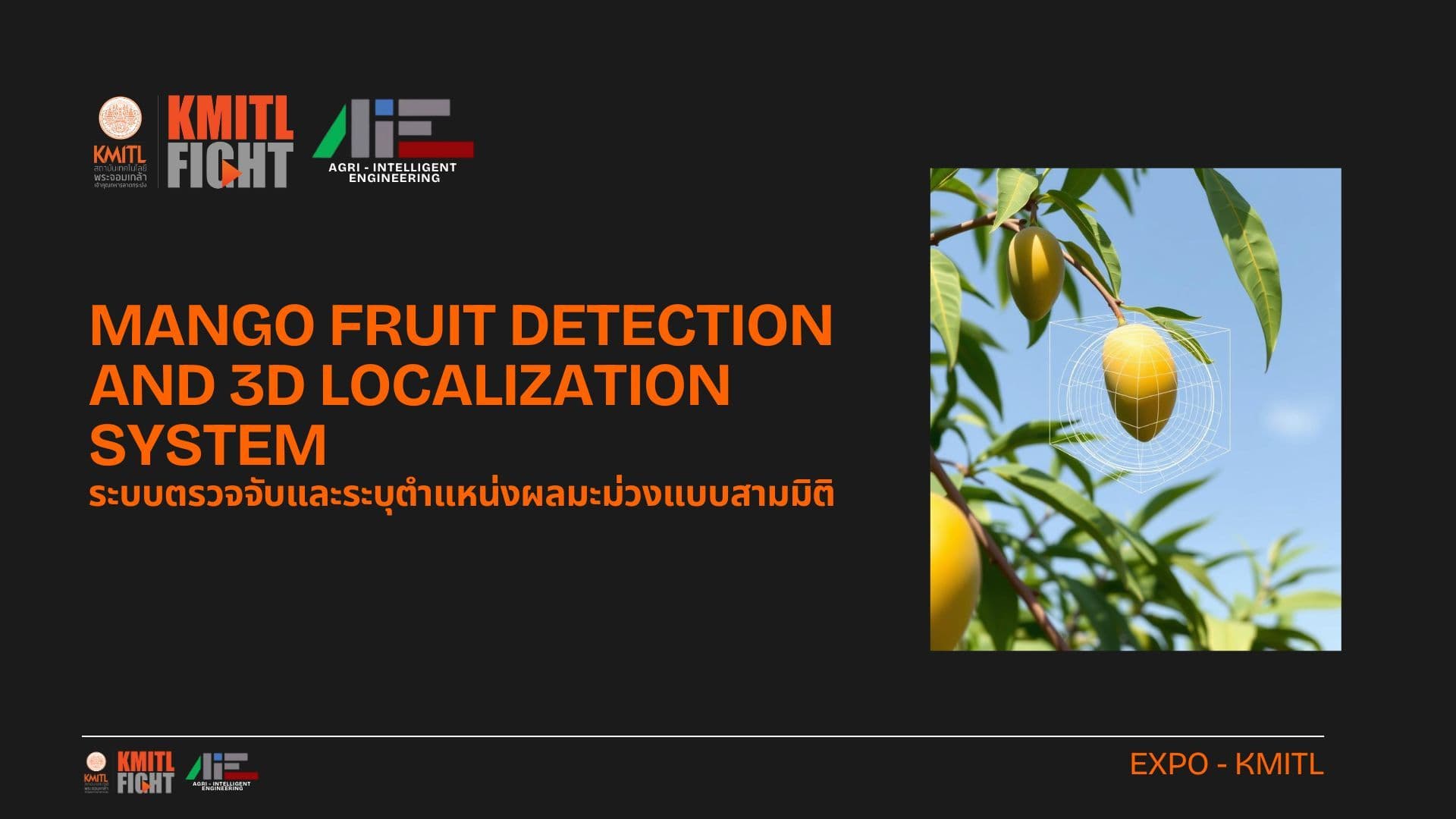
The evaluation of mango yield and consumer behavior reflects an increasing awareness of product origins, with a growing demand for traceability to understand how the produce has been cultivated and managed. This study explores the relationship between mango characteristics and cultivation practices before harvest, using location identification to provide insights into these processes. To achieve this, a model was developed to detect and locate mangoes using 2D images via a Deep Learning approach. The study also investigates techniques to determine the real-world coordinates of mangoes from 2D images. The YOLOv8 model was employed for object detection, integrated with camera calibration and triangulation techniques to estimate the 3D positions of detected mangoes. Experiments involved 125 trials with randomized mango positions and camera placements at varying yaw and pitch angles. Parameters extracted from sequential images were compared to derive the actual 3D positions of the mangoes. The YOLOv8 model demonstrated high performance with prediction metrics of Precision (0.928), Recall (0.901), mAP50 (0.965), mAP50-95 (0.785), and F1-Score (0.914). These results indicate sufficient accuracy for predicting mango positions, with an average positional error of approximately 38 centimeters.