
This project focuses on developing a test device for an AC charger for electric vehicles according to the IEC 61851-1 Annex A standard by simulating the test circuit inside an electric vehicle according to the standard to test the operation of the AC charger. The test topic is related to the communication between the electric vehicle and the charger via a Pulse Width Modulation (PWM) control circuit system and creating an operation manual (WI) to prepare for testing in accordance with ISO/IEC 17025 standards, which are general requirements for laboratory capabilities in conducting tests and/or calibrations. The overall picture of this project is to develop test equipment and create an operation manual by collecting knowledge and various devices and then comparing the data to meet the abovementioned standards to test the Type II AC charger in each state. The test equipment consists of a communication part between the test equipment and the AC charger using a PLC S7-1200 and an HMI to control the operation of the switches in the test equipment circuit, including controlling parameters and displaying results. The equipment used to measure values is an oscilloscope and a multimeter that have undergone a calibration process to comply with the specified standards.
เครื่องอัดประจุไฟฟ้าสำหรับยานยนต์ไฟฟ้า (EVSE) มีบทบาทสำคัญในการพัฒนาโครงสร้างพื้นฐานสำหรับการชาร์จยานยนต์ไฟฟ้า (EV) ซึ่งเป็นเทคโนโลยีที่กำลังเติบโตอย่างรวดเร็วในยุคปัจจุบัน การทดสอบและตรวจสอบ EVSE ให้เป็นไปตามมาตรฐาน IEC 61851-1 จึงมีความสำคัญอย่างยิ่งในการรับรองความปลอดภัย ประสิทธิภาพ และความน่าเชื่อถือของ EVSE ในช่วงหลายปีที่ผ่านมา ตลาดยานยนต์ไฟฟ้าเติบโตอย่างรวดเร็วทั่วโลก โดยเฉพาะในประเทศที่มีนโยบายส่งเสริมการใช้ EV เช่น จีน ยุโรป และสหรัฐอเมริกา ความต้องการในการติดตั้ง EVSE เพิ่มขึ้นอย่างต่อเนื่อง ซึ่งความปลอดภัยในการใช้งาน EVSE ถือเป็นประเด็นที่สำคัญมาก การเกิดความผิดพลาดในระบบชาร์จจนอาจนำไปสู่การเกิดไฟฟ้าลัดวงจร ไฟฟ้าช็อต หรือความเสียหายต่อระบบยานยนต์ การปฏิบัติตามมาตรฐาน IEC 61851-1 จึงเป็นสิ่งจำเป็นเพื่อให้แน่ใจว่า EVSE ที่ติดตั้งทั่วโลกมีมาตรฐานเดียวกัน ทั้งในด้านความปลอดภัยและการทำงาน นอกจากนี้ยังเป็นการเพิ่มความเชื่อมั่นให้กับผู้ใช้งาน EV ในการชาร์จยานยนต์ไฟฟ้าในสถานีต่างๆ อย่างปลอดภัย ในปัจจุบัน อุปกรณ์ EVSE ที่ถูกพัฒนาขึ้นมาใหม่อาจยังไม่ผ่านการทดสอบตามมาตรฐาน IEC 61851-1 อย่างครบถ้วน ซึ่งอาจส่งผลให้ระบบชาร์จมีปัญหาในการสื่อสารหรือควบคุมกระแสไฟระหว่างการชาร์จ การทดสอบ EVSE ตามมาตรฐานนี้จึงเป็นสิ่งจำเป็นเพื่อยืนยันว่าอุปกรณ์สามารถทำงานได้ถูกต้องตามข้อกำหนด และมีการตอบสนองที่รวดเร็วเมื่อมีการเปลี่ยนแปลงสัญญาณควบคุม นอกจากนี้ การทดสอบ EVSE กับระบบจริงอาจมีความเสี่ยงในการเกิดความเสียหายต่อยานยนต์ไฟฟ้าหรือระบบชาร์จ หากอุปกรณ์ยังไม่ผ่านการทดสอบที่ถูกต้อง การสร้างแบบจำลองวงจรการสื่อสารของยานยนต์ไฟฟ้าจึงเป็นวิธีที่ช่วยให้การทดสอบสามารถทำได้อย่างปลอดภัยโดยไม่ต้องเสี่ยงต่อการเกิดความเสียหายต่อระบบจริง

คณะครุศาสตร์อุตสาหกรรมและเทคโนโลยี
This research confirms the potential of bamboo fiber as a sustainable raw material for the textile industry, demonstrating exceptional properties that meet both functional requirements and environmental friendliness. The study focuses on integrating sustainability concepts with material innovation, encompassing fiber property analysis, production process development, and product design. The research objectives were to: 1) develop the properties of bamboo fiber for production; 2) study factors in designing environmentally friendly textile products from bamboo fiber; and 3) forecast future prospects for environmentally friendly textile product design using bamboo fiber. The findings revealed that 60-day-old bamboo possessed optimal properties for fiber separation, with an average fiber size of 5.32 μm, smaller than other natural fibers, resulting in superior moisture absorption and ventilation properties. When blended with recycled polyester fiber in a 30:70 ratio, the yarn exhibited strength and unique tactile characteristics. Although the antibacterial properties against Staphylococcus aureus were low, the fibers demonstrated excellent whiteness and softness. Factor analysis identified four key components in product design: Local Materials, Green Products, Healthy, and Sustainability. Consumer satisfaction evaluation of the prototype products showed high levels of acceptance, with the model explaining 84.7% of consumer satisfaction. The developed production process reduced chemical usage and hazardous waste. Furthermore, utilizing fast-growing bamboo minimized long-term environmental impact, contributing to sustainable development in Thailand's rural communities across economic, environmental, and occupational stability dimensions. The research demonstrates that developing bamboo fiber blended with recycled polyester creates sustainable products that meet consumer demands for health consciousness, local material utilization, and green product promotion. Commercial implementation of these products can enhance economic value and promote environmentally friendly product development in the future.
วิทยาลัยวิศวกรรมสังคีต
Musical stories to enhance thinking skills of children aged 0-3 years using EF skills as a tool to enhance children development by focus on 3 basic skills. 1. Working memory 2. Inhibitory Control 3. Cognitive Flexibility
คณะเทคโนโลยีสารสนเทศ
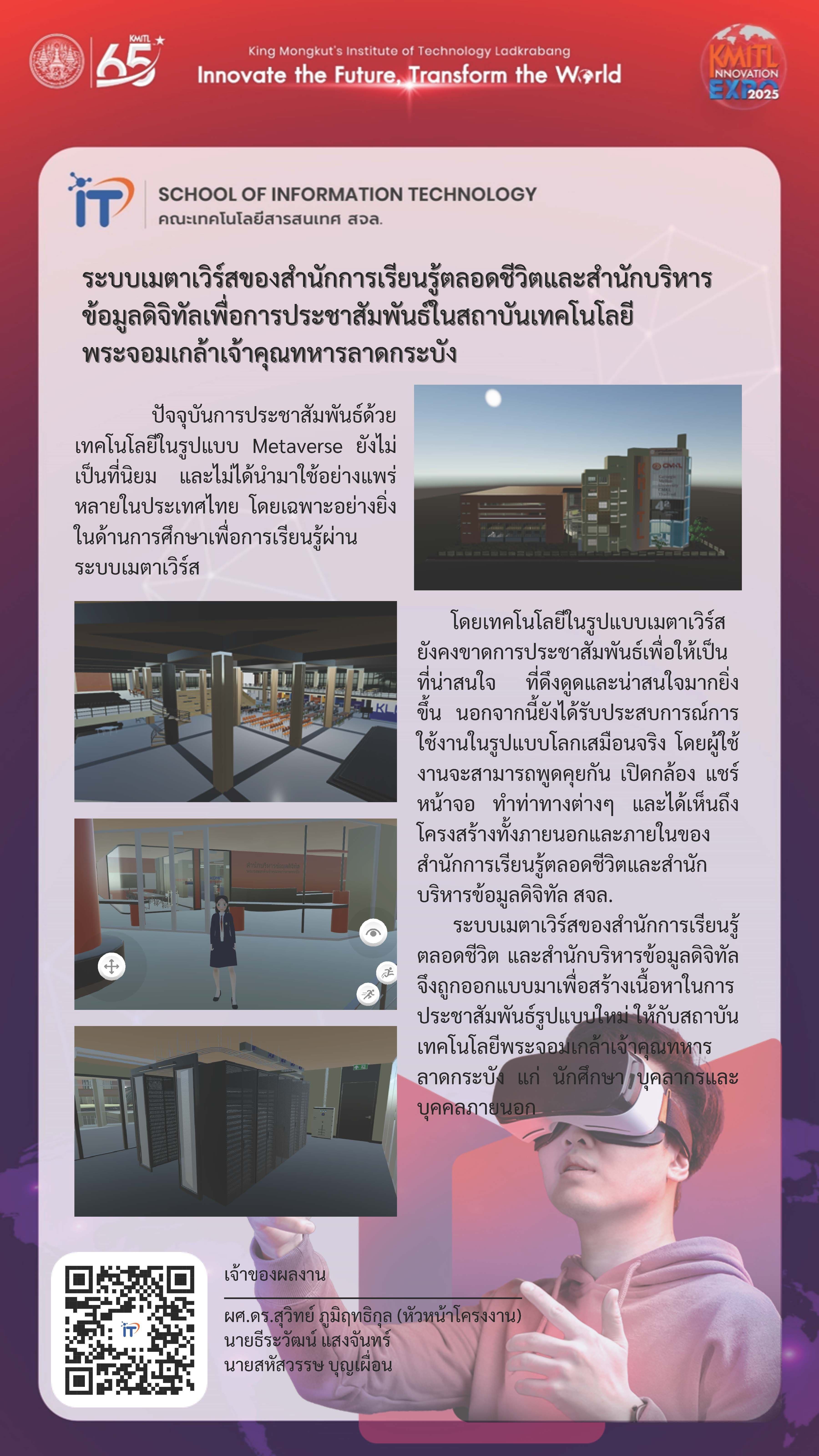
This thesis aims to present the development of a metaverse project for the KMITL Lifelong Learning Center (KLLC) and KMITL Data Management Center (KDMC) for Public Relations at King Mongkut's Institute of Technology Ladkrabang, with the main goal of creating a metaverse prototype to promote learning and public relations through virtual reality technology for students, staff, and external individuals. In this project, the developers have created a metaverse system to simulate a virtual experience for users at the KMITL Lifelong Learning Center (KLLC) and KMITL Data Management Center (KDMC) for Public Relations at King Mongkut's Institute of Technology Ladkrabang. Users will be able to access the system through a web application developed with Unity, which is the tool used to create the metaverse system. The design allows users to visit and interact with various locations within the building to promote public relations in a more widespread virtual format. The developers used Maya and Unity software to create a metaverse system for modeling 3D objects and managing various functions, providing users with a realistic and novel experience. This project is expected to promote learning and the dissemination of information in an easily accessible modern format, creating opportunities for education and learning for those who cannot travel to see the actual locations. This makes metaverse technology an important tool for effectively developing learning and engagement in the digital age.