

The Project Urban House is an initiative focused on developing and designing urban housing solutions that address the growing demand for city living. The project emphasizes efficient space utilization, sustainability, and designs that cater to modern urban lifestyles. Key considerations include the use of eco-friendly materials, the integration of green spaces, and the implementation of smart home technologies to enhance residents' quality of life.
1. พัฒนาทักษะด้านการออกแบบสถาปัตยกรรมภายในสำหรับที่อยู่อาศัยในเมือง 2. ส่งเสริมความคิดสร้างสรรค์และการแก้ปัญหาภายในพื้นที่จำกัด 3. ฝึกการทำงานแบบมืออาชีพและการนำเสนอโครงการ

คณะอุตสาหกรรมอาหาร
This study aims to investigate the co-fermentation process between lactic acid bacteria (LAB) and Saccharomyces cerevisiae in the production of sour beer, with a focus on its impact on product quality, including pH, organic acid content, sugar content, and sensory characteristics. In this experiment, selected LAB strains and S. cerevisiae were utilized under controlled fermentation conditions. The microbial ratio was optimized to enhance growth and the production of key compounds. The findings indicate that co-fermentation significantly reduces pH compared to fermentation with yeast alone. Furthermore, an increase in lactic acid was observed due to sugar consumption by LAB, contributing to the distinctive flavor profile of sour beer.
คณะครุศาสตร์อุตสาหกรรมและเทคโนโลยี
The Research aims to create Computer Assisted Instruction (CAI) on Kitchen Design for Residence for 20 undergraduate students at the Interior Environmental Design Division, School of Industrial Education and Technology, King Mongkut’s Institute of Technology Ladkrabang. This CAI is a self-learning program for Interior environmental design courses focused on kitchen design for residences. The program is designed to interact with students to create learner engagement and improve learning achievement by providing course content and end-of-chapter quizzes. The research hypothesis is CAI: Interior Environmental Design: Kitchen design for residence affects learners’ learning achievement and students' knowledge toward learning by this CAI. The Development testing (DT) with E1/E2 is the criterion for this instructional media to examine learning achievement. The research findings indicate that CAI is an effective instructional media, scoring 71.50/89.00, which meets the criteria of 80/80, demonstrating students’ learning achievement. Students achieved higher scores than before by using Computer-Assisted Instruction (CAI).
คณะวิศวกรรมศาสตร์
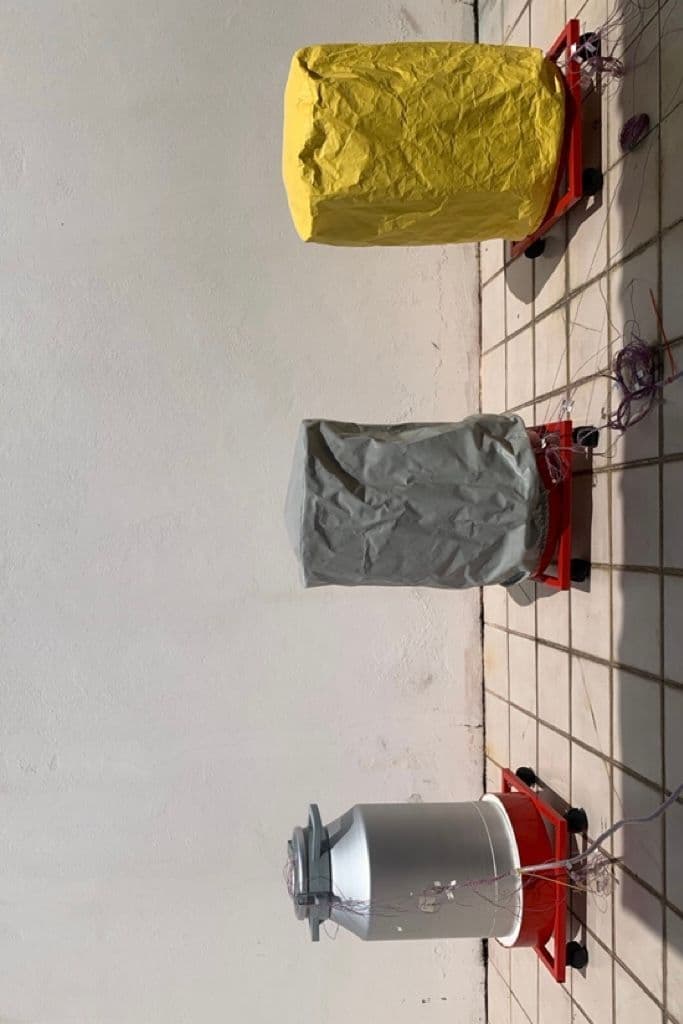
This study was conducted to develop a prototype cooling cover for transporting raw milk, aiming to provide a solution for maintaining the quality of raw milk during transportation to milk collection centers. The cooling cover is made using Phase Change Material (PCM), produced from water mixed with a gelling agent, in an amount of 5.6 kg, attached around an aluminum milk tank (with a capacity of 25 L). The cover is then covered with a UV-reflective fabric in two types: polyvinyl chloride (PVC) and high-density polyethylene (HDPE). The temperature reduction performance of both types of covers was evaluated by measuring water temperatures at various points along the radial and vertical directions of the milk tank at six points, using type-T thermocouples, under three environmental conditions: a constant temperature of 25 °C, 35 °C, and outdoor ambient temperature (average temperature 35.5 °C) for a minimum duration of 180 min. The experimental results revealed that at 120 min., the water in the tank covered with PCM-PVC and PCM-HDPE covers had temperatures lower than the ambient temperature by 12.6 °C and 12.9 °C, respectively, under a constant ambient temperature of 25 °C, and under a constant ambient temperature of 35 °C lower by 16.7 °C and 16.4 °C, respectively, and outdoor conditions. Since the temperature reduction performance of PCM-PVC and PCM-HDPE covers showed no significant difference, the performance of microbial quality preservation of raw milk was assessed only with PCM-PVC cover in comparison to a non-covered case (control), by measuring coliform and Escherichia coli counts using compact dry plates. Results indicated that after 120 min., milk in the tank covered with PCM-PVC had an average coliform count of 1.6 × 10^4 CFU/ml and E. coli count of 2 × 10^3 CFU/ml, which was lower than the non-covered control with an average coliform count of 1.5 × 10^4 CFU/ml and E. coli count of 1.1 × 10^4 CFU/ml. This study concludes that the temperature reduction achieved by the cooling cover can help inhibit coliform growth to levels below raw milk quality standards, demonstrating the potential of the cooling cover in maintaining the quality and safety of raw milk during transport, ultimately contributing to an improved quality of life for Thai dairy farmers.