

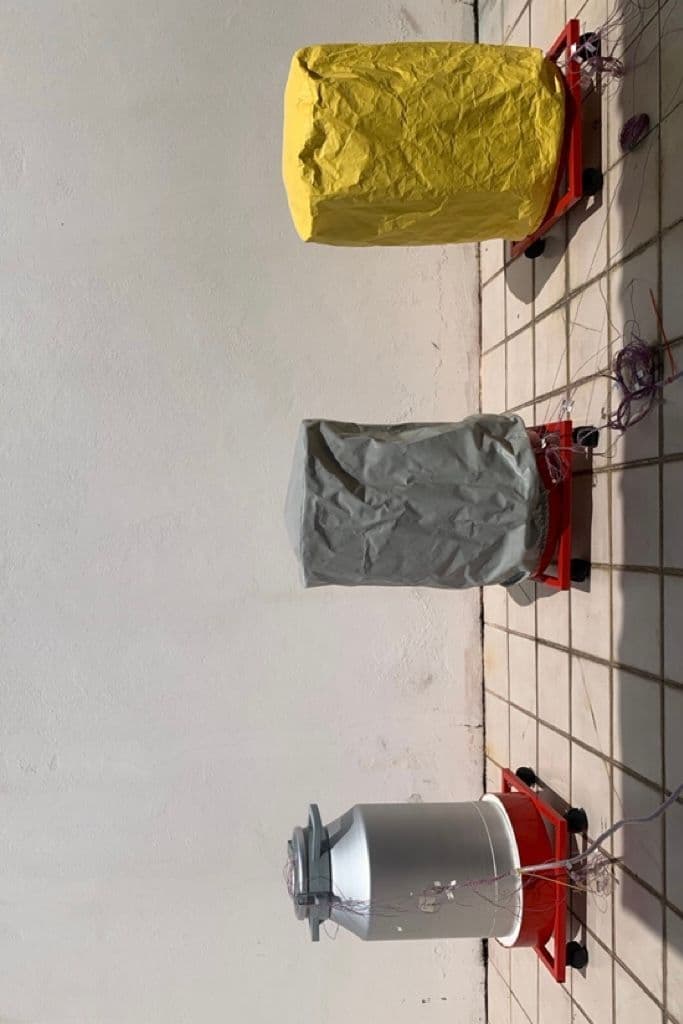
This study was conducted to develop a prototype cooling cover for transporting raw milk, aiming to provide a solution for maintaining the quality of raw milk during transportation to milk collection centers. The cooling cover is made using Phase Change Material (PCM), produced from water mixed with a gelling agent, in an amount of 5.6 kg, attached around an aluminum milk tank (with a capacity of 25 L). The cover is then covered with a UV-reflective fabric in two types: polyvinyl chloride (PVC) and high-density polyethylene (HDPE). The temperature reduction performance of both types of covers was evaluated by measuring water temperatures at various points along the radial and vertical directions of the milk tank at six points, using type-T thermocouples, under three environmental conditions: a constant temperature of 25 °C, 35 °C, and outdoor ambient temperature (average temperature 35.5 °C) for a minimum duration of 180 min. The experimental results revealed that at 120 min., the water in the tank covered with PCM-PVC and PCM-HDPE covers had temperatures lower than the ambient temperature by 12.6 °C and 12.9 °C, respectively, under a constant ambient temperature of 25 °C, and under a constant ambient temperature of 35 °C lower by 16.7 °C and 16.4 °C, respectively, and outdoor conditions. Since the temperature reduction performance of PCM-PVC and PCM-HDPE covers showed no significant difference, the performance of microbial quality preservation of raw milk was assessed only with PCM-PVC cover in comparison to a non-covered case (control), by measuring coliform and Escherichia coli counts using compact dry plates. Results indicated that after 120 min., milk in the tank covered with PCM-PVC had an average coliform count of 1.6 × 10^4 CFU/ml and E. coli count of 2 × 10^3 CFU/ml, which was lower than the non-covered control with an average coliform count of 1.5 × 10^4 CFU/ml and E. coli count of 1.1 × 10^4 CFU/ml. This study concludes that the temperature reduction achieved by the cooling cover can help inhibit coliform growth to levels below raw milk quality standards, demonstrating the potential of the cooling cover in maintaining the quality and safety of raw milk during transport, ultimately contributing to an improved quality of life for Thai dairy farmers.
โดยทั่วไปการขนส่งน้ำนมดิบจากฟาร์มของเกษตรกรรายย่อยไปยังศูนย์รวบรวมน้ำนมดิบขนส่งโดยใส่ น้ำนมดิบในถังโลหะผลิตจากเหล็กกล้าไร้สนิม (Stainless steel) หรืออะลูมิเนียมที่ไม่มีการควบคุมอุณหภูมิ ส่งผลให้ อุณหภูมิของน้ำนมดิบมีโอกาสเพิ่มสูงขึ้นอย่างต่อเนื่อง ซึ่งส่งเสริมให้เชื้อจุลินทรีย์เจริญได้ดีจนทำให้น้ำนมดิบเสื่อมเสียคุณภาพและเป็นอันตรายต่อผู้บริโภค เนื่องจากอุณหภูมิมีอิทธิพลต่อคุณภาพของน้ำนมดิบอย่างมากโดยเฉพาะคุณภาพด้านจุลินทรีย์ น้ำนมดิบอุดมไปด้วยสารอาหารที่เป็นประโยชน์และมีความเป็นกรด-ด่าง (pH) ประมาณ 6.6 - 6.8 ซึ่งเป็นสภาวะที่เหมาะกับการเจริญเติบโตของเชื้อจุลินทรีย์หลายชนิด การเก็บรักษาน้ำนมดิบที่อุณหภูมิบรรยากาศจึงเป็นการส่งเสริมให้เชื้อจุลินทรีย์สามารถเพิ่มจำนวนได้อย่างรวดเร็วจนเกินเกณฑ์มาตรฐานได้ภายในเวลา 2-5 ชั่วโมง การใช้เครื่องทำความเย็นเป็นวิธีการลดอุณหภูมิน้ำนมดิบที่มีประสิทธิภาพในระยะยาว ซึ่งเครื่องทำความเย็นโดยทั่วไปเป็นระบบทำความเย็นแบบอัดไอซึ่งมีราคาแพง ต้องการระบบส่งไฟฟ้าที่มีความเสถียรและการบำรุงรักษาอย่างถูกต้องสม่ำเสมอ ทำให้เกษตรกรผู้เลี้ยงโคนมรายย่อยที่มีจำนวนโคนมไม่เกิน 20 ตัวไม่มีความจำเป็นที่จะนำระบบทำความเย็นมาใช้เพราะอาจไม่คุ้มค่ากับการลงทุน เมื่อเทียบกับผลผลิตที่เกิดขึ้น (Economy of scale) ด้วยเหตุนี้เกษตรกรเหล่านี้จึงต้องขนส่งน้ำนมดิบหลังการรีดเสร็จให้เร็วที่สุด และต้องไม่เกิน 2 ชั่วโมง เพื่อให้เป็นตามข้อกำหนดมกษ. 6003 - 2553 ไม่เช่นนั้นต้องลดอุณหภูมิน้ำนมดิบให้ต่ำกว่า 4 °C แล้วนำส่งศูนย์รวบรวมน้ำนมดิบภายในเวลา 24ชั่วโมงการศึกษานี้จึงจัดทำขึ้นเพื่อเสนอนวัตกรรมการทำความเย็นที่มีต้นทุนต่ำและใช้งานง่าย นั่นคือ เสื้อคลุมเย็นที่ประกอบขึ้นจากวัสดุเปลี่ยนสถานะ (Phase Change Material, PCM) ที่สามารถหาซื้อได้ทั่วไป คณะผู้วิจัยคาดหวังว่านวัตกรรมนี้จะสามารถช่วยเกษตรกรรายย่อยให้สามารถรักษาคุณภาพน้ำนมดิบระหว่างการขนส่งจากฟาร์มไปยังศูนย์รวบรวมน้ำนมดิบได้โดยสร้างภาระทางการเงินให้กับเกษตรกรน้อยที่สุด
คณะเทคโนโลยีการเกษตร
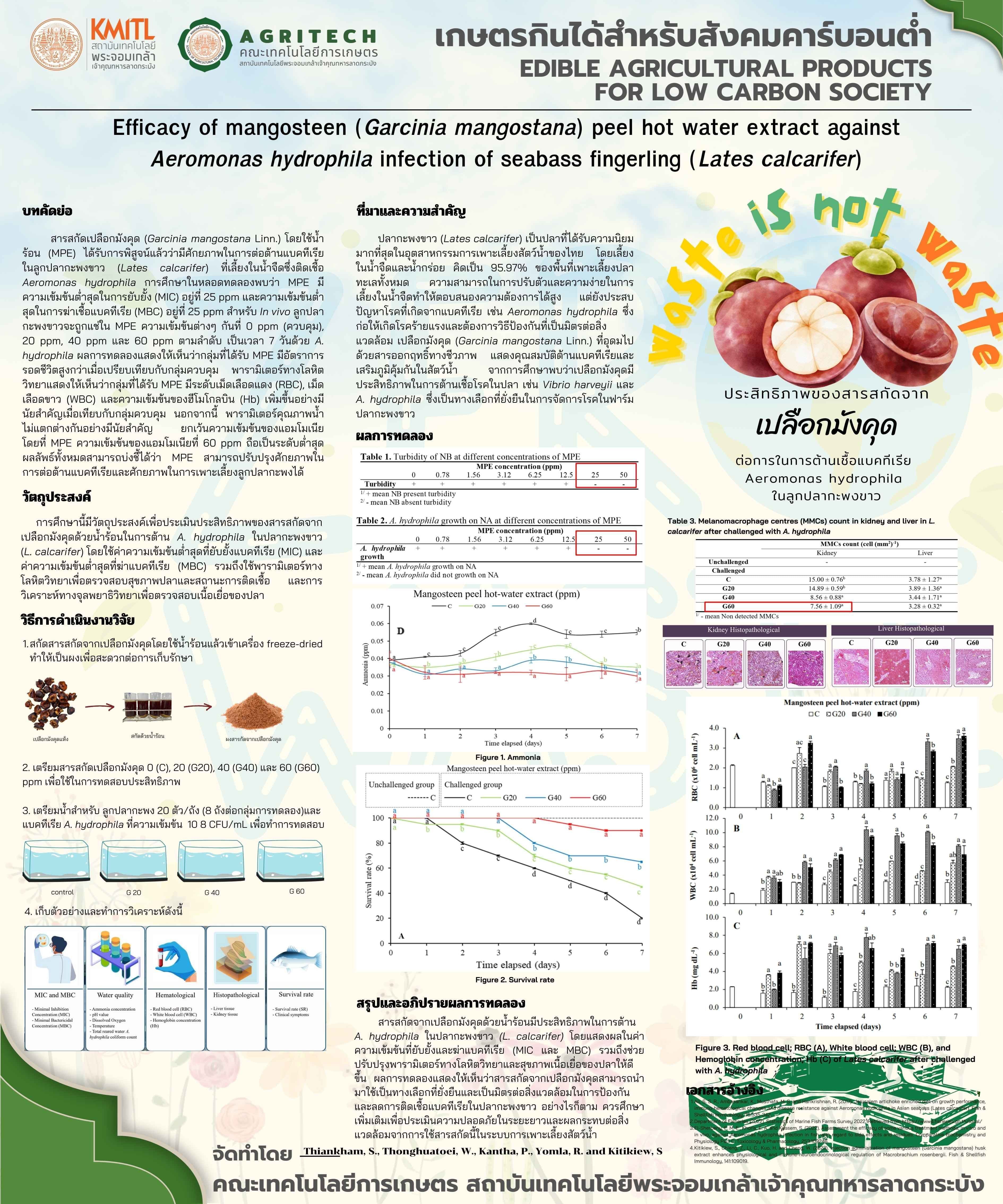
Mangosteen peel (Garcinia mangostana Linn.) extract using hot water (MPE) has been shown to have antibacterial potential in freshwater sea bass (Lates calcarifer) larvae infected with Aeromonas hydrophila. In vitro studies showed that MPE has a minimum inhibitory concentration (MIC) of 25 ppm and a minimum bactericidal concentration (MBC) of 25 ppm. In vivo, sea bass larvae were immersed in various concentrations of MPE at 0 ppm (control), 20 ppm, 40 ppm and 60 ppm, respectively, for 7 days with A. hydrophila. The results showed that the MPE-treated group had a higher survival rate compared to the control group. Hematological parameters showed that the MPE-treated group had significantly increased red blood cell (RBC), white blood cell (WBC) and hemoglobin (Hb) concentrations compared to the control group. In addition, the water quality parameters were not significantly different, except for ammonia concentration, with MPE having an ammonia concentration of 60 ppm being the lowest. All results can indicate that MPE can improve the antibacterial potential and the culture potential of sea bass larvae.

คณะเทคโนโลยีสารสนเทศ
The AfterDay Horizon project is a two-player survival game developed to raise awareness of the impact of climate change. It leverages Virtual Reality (VR) technology and a website as gaming platforms. In the game, players experience a world where civilization has collapsed due to global warming, forcing the remaining population to live in bunkers to avoid environmental dangers. AfterDay Horizon focuses on collaboration between the two players to complete various missions that help the bunker’s inhabitants survive as long as possible. These missions are designed to encourage teamwork and decision-making in challenging scenarios, while also raising awareness of the potential consequences of climate change if left unresolved. Preliminary testing of the game showed that players successfully completed the missions and worked well together. However, some missions were complex and time-consuming, indicating areas for improvement to enhance the overall enjoyment and gameplay experience.
คณะสถาปัตยกรรม ศิลปะและการออกแบบ
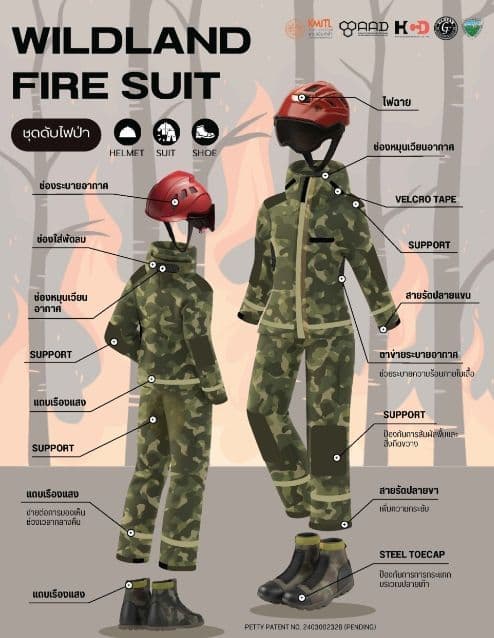
The forest firefighting suit consists of the following components and uses: The forest firefighting suit is designed and developed to be suitable for the behavior of the officers and the conditions of the work area, consisting of a shirt and pants. The material used in the sewing of the suit is aramid fabric, which has the property of being able to prevent the spread of fire, to prevent the officers from burning while performing their duties in the event that the forest fire spreads close to them, which is different from the current suits that cannot prevent fires. The shirt is designed with a mesh on the side of the body to release internal heat so that air can circulate well. The sleeves at the elbows have a support point to prevent contact with the ground or obstacles. The collar has a slot for a portable fan and a fan air circulation channel on the back, which can be turned on while performing forest firefighting duties, helping to prevent the body temperature from getting too hot, reducing the risk of heatstroke. When the fan battery runs out, it can be removed for charging and put back in when needed. The pants are designed with mesh on the inside or in blind spots to release internal heat so that air can circulate well. The pants at the knees have a support point to prevent contact with the ground or obstacles. The forest firefighting suit, consisting of a shirt and pants, has been designed and developed to be able to be produced domestically, reducing imports from abroad