

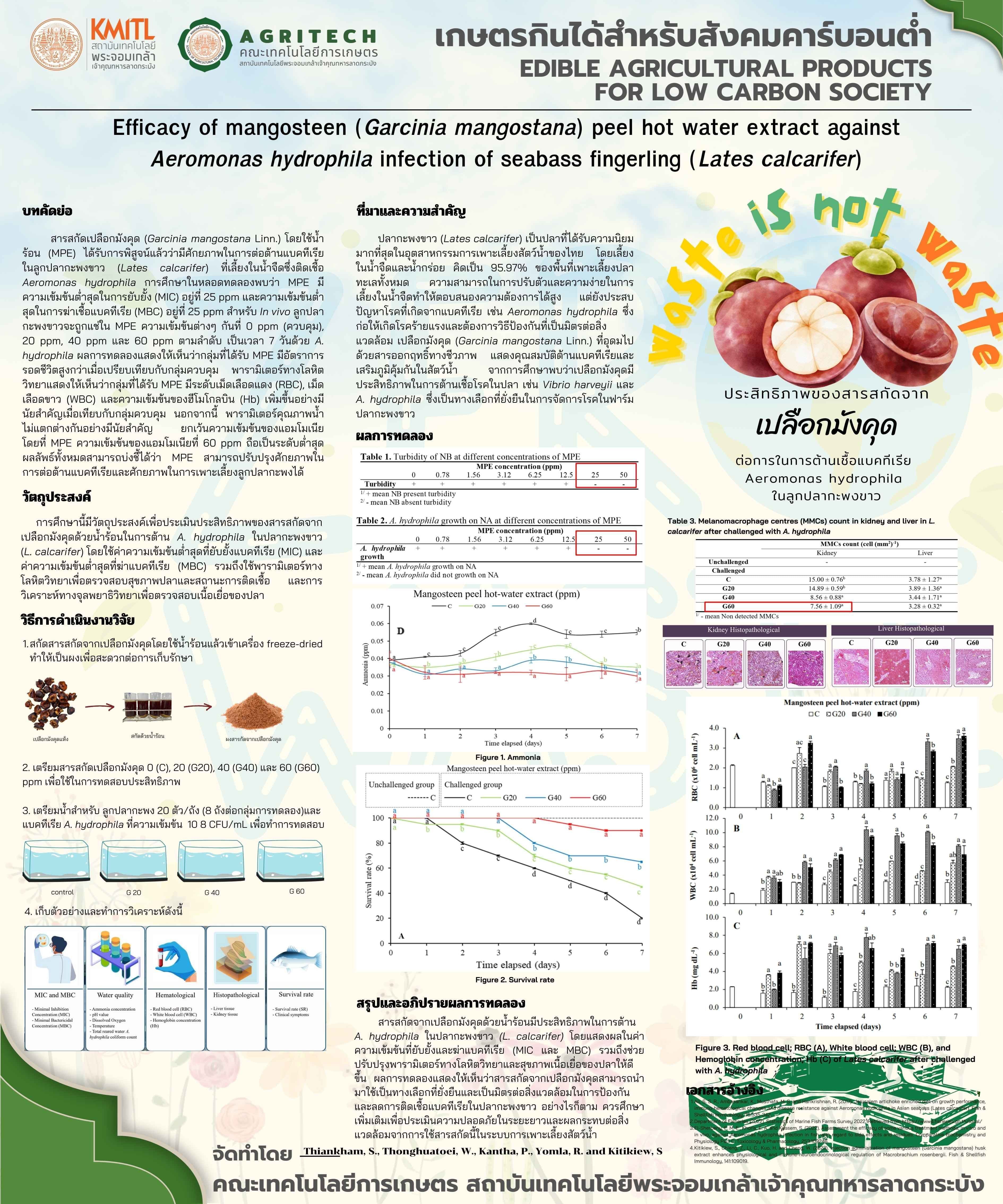
Mangosteen peel (Garcinia mangostana Linn.) extract using hot water (MPE) has been shown to have antibacterial potential in freshwater sea bass (Lates calcarifer) larvae infected with Aeromonas hydrophila. In vitro studies showed that MPE has a minimum inhibitory concentration (MIC) of 25 ppm and a minimum bactericidal concentration (MBC) of 25 ppm. In vivo, sea bass larvae were immersed in various concentrations of MPE at 0 ppm (control), 20 ppm, 40 ppm and 60 ppm, respectively, for 7 days with A. hydrophila. The results showed that the MPE-treated group had a higher survival rate compared to the control group. Hematological parameters showed that the MPE-treated group had significantly increased red blood cell (RBC), white blood cell (WBC) and hemoglobin (Hb) concentrations compared to the control group. In addition, the water quality parameters were not significantly different, except for ammonia concentration, with MPE having an ammonia concentration of 60 ppm being the lowest. All results can indicate that MPE can improve the antibacterial potential and the culture potential of sea bass larvae.
ปลากะพงขาว (Lates calcarifer) เป็นปลาที่ได้รับความนิยมมากที่สุดในอุตสาหกรรมการเพาะเลี้ยงสัตว์น้ำของไทย โดยเลี้ยงในน้ำจืดและน้ำกร่อย คิดเป็น 95.97% ของพื้นที่เพาะเลี้ยงปลาทะเลทั้งหมด ความสามารถในการปรับตัวและความง่ายในการเลี้ยงในน้ำจืดทำให้ตอบสนองความต้องการได้สูง แต่ยังประสบปัญหาโรคที่เกิดจากแบคทีเรีย เช่น Aeromonas hydrophila ซึ่งก่อให้เกิดโรคร้ายแรงและต้องการวิธีป้องกันที่เป็นมิตรต่อสิ่งแวดล้อม เปลือกมังคุด (Garcinia mangostana Linn.) ที่อุดมไปด้วยสารออกฤทธิ์ทางชีวภาพ แสดงคุณสมบัติต้านแบคทีเรียและเสริมภูมิคุ้มกันในสัตว์น้ำ จากการศึกษาพบว่าเปลือกมังคุดมีประสิทธิภาพในการต้านเชื้อโรคในปลา เช่น Vibrio harveyii และ A. hydrophila ซึ่งเป็นทางเลือกที่ยั่งยืนในการจัดการโรคในฟาร์มปลากะพงขาว
คณะเทคโนโลยีการเกษตร
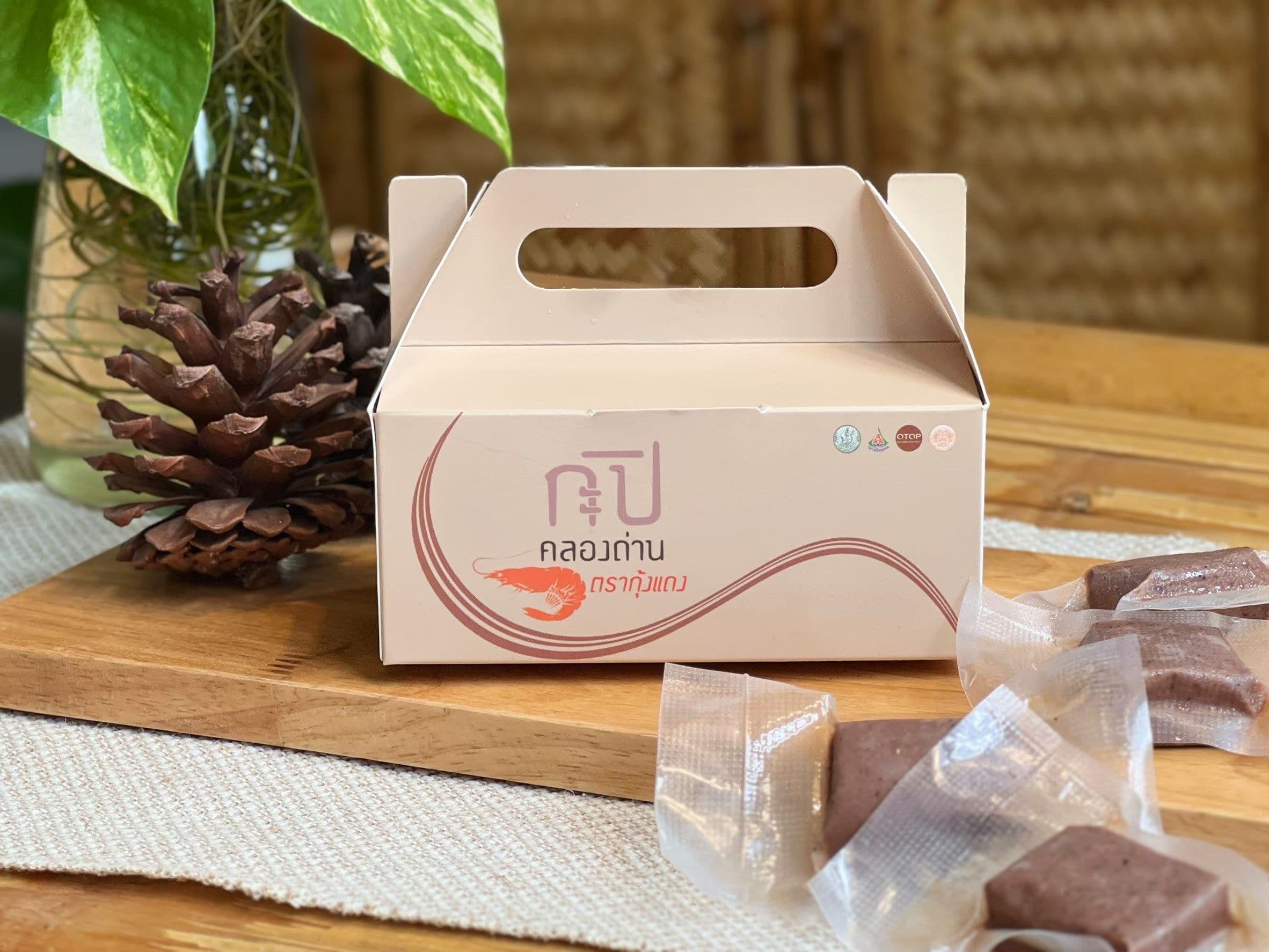
This research aimed 1) to study the problems and needs in the packaging design of the community enterprise group 2) to develop packaging for the community enterprise group 3) to study the satisfaction with the packaging design of the members of the Klong Dan Shrimp Paste Community Enterprise Group 3 Klong Dan Subdistrict, Bang Bo District, Samut Prakan Province, consisting of 9 members The study found that the community enterprise group faced the problem of lacking suitable packaging for souvenirs and had a need to develop packaging that is appropriate for this purpose. The packaging material selected was paper, with a rectangular shape including a handle for portability It can be folded for easy transportation and stacked for storage, while maintaining durability The packaging color used was light brown, and the label color was white The label included the following details: shrimp paste recipe, ingredients, manufacturing and expiration dates, the background of the community enterprise group, a QR code, phone number, a short story, group name, production site, as well as illustrations of the group’s location and red krill. The results of developing packaging for the community enterprise group indicated that the new packaging design increased the credibility of the product, building customer confidence in the product. Regarding the satisfaction with the packaging design among the group members, it was found that Packaging Design 1 had the highest level of satisfaction (x ̅ = 4.57, S.D. = 0.22). Among the aspects, color received the highest satisfaction score (x ̅ = 4.74, S.D. = 0.06), followed by the label (x ̅ = 4.69, S.D. = 0.10), while the lowest was the properties aspect, which was rated at a moderate level of satisfaction (x ̅ = 3.83, S.D. = 1.58), respectively.

คณะวิศวกรรมศาสตร์
This research suggested natural hemp fiber-reinforced ropes (FRR) polymer usage to reinforce recycled aggregate square concrete columns that contain fired-clay solid brick aggregates in order to reduce the high costs associated with synthetic fiber-reinforced polymers (FRPs). A total of 24 square columns of concrete were fabricated to conduct this study. The samples were tested under a monotonic axial compression load. The variables of interest were the strength of unconfined concrete and the number of FRRlayers. According to the results, the strengthened specimens demonstrated an increased compressive strength and ductility. Notably, the specimens with the smallest unconfined strength demonstrated the largest improvement in compressive strength and ductility. Particularly, the compressive strength and strain were enhanced by up to 181% and 564%, respectively. In order to predict the ultimate confined compressive stress and strain, this study investigated a number of analytical stress–strain models. A comparison of experimental and theoretical findings deduced that only a limited number of strength models resulted in close predictions, whereas an even larger scatter was observed for strain prediction. Machine learning was employed by using neural networks to predict the compressive strength. A dataset comprising 142 specimens strengthened with hemp FRP was extracted from the literature. The neural network was trained on the extracted dataset, and its performance was evaluated for the experimental results of this study, which demonstrated a close agreement.
คณะวิศวกรรมศาสตร์
This project focuses on developing a test device for an AC charger for electric vehicles according to the IEC 61851-1 Annex A standard by simulating the test circuit inside an electric vehicle according to the standard to test the operation of the AC charger. The test topic is related to the communication between the electric vehicle and the charger via a Pulse Width Modulation (PWM) control circuit system and creating an operation manual (WI) to prepare for testing in accordance with ISO/IEC 17025 standards, which are general requirements for laboratory capabilities in conducting tests and/or calibrations. The overall picture of this project is to develop test equipment and create an operation manual by collecting knowledge and various devices and then comparing the data to meet the abovementioned standards to test the Type II AC charger in each state. The test equipment consists of a communication part between the test equipment and the AC charger using a PLC S7-1200 and an HMI to control the operation of the switches in the test equipment circuit, including controlling parameters and displaying results. The equipment used to measure values is an oscilloscope and a multimeter that have undergone a calibration process to comply with the specified standards.