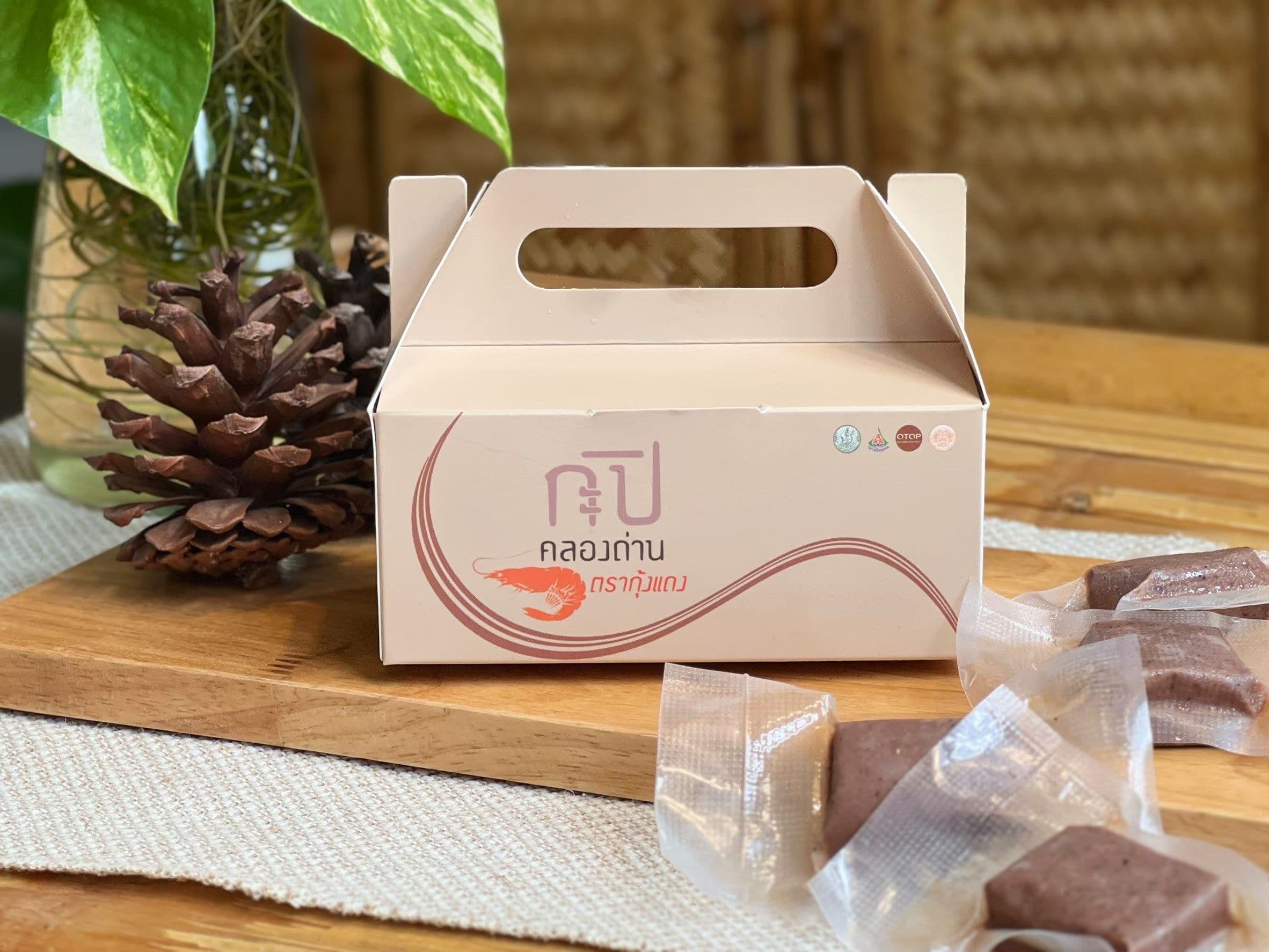
This research aimed 1) to study the problems and needs in the packaging design of the community enterprise group 2) to develop packaging for the community enterprise group 3) to study the satisfaction with the packaging design of the members of the Klong Dan Shrimp Paste Community Enterprise Group 3 Klong Dan Subdistrict, Bang Bo District, Samut Prakan Province, consisting of 9 members The study found that the community enterprise group faced the problem of lacking suitable packaging for souvenirs and had a need to develop packaging that is appropriate for this purpose. The packaging material selected was paper, with a rectangular shape including a handle for portability It can be folded for easy transportation and stacked for storage, while maintaining durability The packaging color used was light brown, and the label color was white The label included the following details: shrimp paste recipe, ingredients, manufacturing and expiration dates, the background of the community enterprise group, a QR code, phone number, a short story, group name, production site, as well as illustrations of the group’s location and red krill. The results of developing packaging for the community enterprise group indicated that the new packaging design increased the credibility of the product, building customer confidence in the product. Regarding the satisfaction with the packaging design among the group members, it was found that Packaging Design 1 had the highest level of satisfaction (x ̅ = 4.57, S.D. = 0.22). Among the aspects, color received the highest satisfaction score (x ̅ = 4.74, S.D. = 0.06), followed by the label (x ̅ = 4.69, S.D. = 0.10), while the lowest was the properties aspect, which was rated at a moderate level of satisfaction (x ̅ = 3.83, S.D. = 1.58), respectively.
ชุมชนคลองด่าน อำเภอบางบ่อ จังหวัดสมุทรปราการ มีพื้นที่ส่วนหนึ่งติดทะเล วิถีชุมชนชาวคลองด่าน มีภูมิปัญญาในการแปรรูปผลิตภัณฑ์จากวัตถุดิบทางทะเล เช่น กะปิสืบทอดมาจากบรรพบุรุษเป็นเวลายาวนานกว่าร้อยปี สร้างอาชีพ สร้างรายได้ให้แก่คนในชุมชน จนเกิดการรวมกลุ่มกันเป็นวิสาหกิจชุมชนคลองด่าน 3 มุ่งเน้นการผลิตกะปิคุณภาพ รสชาติดี แต่ไม่สามารถจำหน่ายนอกชุมชนได้มากนัก ทางสำนักนักงานเกษตรอำเภอบางบ่อ จึงวางแผนการดำเนินการเพื่อเร่งแก้ไขปัญหาดังกล่าวให้กับกลุ่มฯ โดยลงพื้นที่ร่วมกับนักศึกษาสหกิจศึกษา (ญาณวิชญ์ เธียรนาราโรจน์) เพื่อจัดกิจกรรมประชุมหารือ วิเคราะห์ swot analysis ให้กับกลุ่มพบว่าทางกลุ่มประสบปัญหาเรื่องราคาจำหน่าย เนื่องจากบรรจุภัณฑ์ไม่สวยงาม ขาดอัตลักษณ์ ผู้บริโภคภายนอกชุมชนขาดความเชื่อถือในผลิตภัณฑ์ ประกอบกับทางสำนักงานเกษตรอำเภอบางบ่อ ได้รับงบประมาณโครงการพัฒนากลุ่มวิสาหกิจชุมชน ทางพี่เลี้ยงซึ่งเป็นเจ้าหน้าที่ของสำนักงานเกษตรอำเภอบางบ่อ จึงมอบหมายโจทย์โครงงานสหกิจศึกษาให้กับข้าพเจ้าในฐานะนักศึกษาปฏิบัติสหกิจศึกษาได้มีโอกาสในการร่วมพัฒนา ออกแบบบรรจุภัณฑ์ให้แก่กลุ่มฯ และนำโจทย์ที่ได้รับหารือกับอาจารย์ที่ปรึกษาเพื่อพัฒนาโจทย์และจัดทำเครื่องมือ เพื่อแก้ปัญหาให้กับกลุ่มฯ โดยมีพี่เลี้ยงให้คำแนะนำ ช่วยเหลือในการติดต่อลงพื้นที่สัมภาษณ์ปัญหา และความต้องการที่แท้จริงของกลุ่ม เพื่อนำมรรจุภัณฑ์ จำนวน 5 แบบ ไปนำเสนอให้กับทางกลุ่มฯ และสอบถามความพึงพอใจจากผู้บริโภคจนได้บรรจุภัณฑ์ที่เหมาะสม นำไปใช้ได้จริง สร้างมูลค่าเพิ่มให้กับผลิตภัณฑ์ และสร้างรายได้เพิ่มให้กลุ่มฯ

คณะสถาปัตยกรรม ศิลปะและการออกแบบ
The concept for this work came from my curiosity about what would happen if, during interdimensional travel in space, a teleportation system were used. This system involves removing matter from one point and transferring it to another while maintaining its original state. If an error occurs and the matter is recreated or fused together, it could result in an experimental creature merging with the spacecraft. I choose the tardigrade as the first experimental subject for teleportation because the water bear has already been sent into space and survived. Therefore, I thought that if we were to actually test this teleportation system, the tardigrade would likely be one of the creatures chosen for experimentation.
คณะครุศาสตร์อุตสาหกรรมและเทคโนโลยี
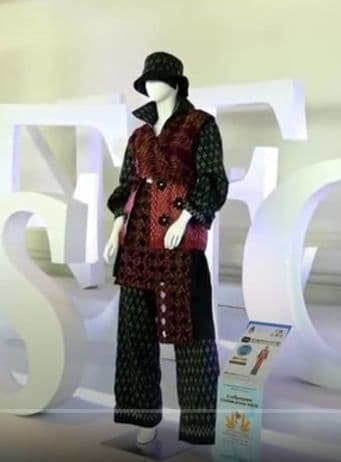
Industrial Education and Technology, King Mongkut's Institute of Technology Ladkrabang has a vision for sustainable excellence. The mission is to develop learners to be ready for the digital world, develop educational innovations using research as a base, strategic management with good governance, and academic services that benefit society. In this activity, the group of students joined with the Embassy of the Russian Federation in the Kingdom of Thailand, the working group of the Thai Silk and Culture Promotion Association, and the working group of the National Research Office (NRCT) to integrate knowledge to design a silk outfit that combines Thai and Russian cultures, create a network of cooperation in arts, culture, technology, innovation, and dissemination of knowledge and the beauty of Thai silk. The objective is to develop the potential of teachers and students in creative design, listen to the work guidelines from the working group of the Thai Silk and Culture Promotion Association, the working group of the National Research Office (NRCT) via an online meeting. The team of teachers and students from King Mongkut's Institute of Technology Ladkrabang under the name of the "Love Silk" group designed a Thai silk outfit that combines cultures with the identity of Thai silk and studying traditions and cultures of the Russian Federation's clothing. They studied related literature and research documents and integrated knowledge into the design process, inspired by the concept of the Rajapataen outfit. Since the reign of King Chulalongkorn (Rama V) in 1872, together with the clothing culture of the Russian Federation, emphasizing Thai silk, this concept has gone through the process of creating and selecting the design concept (Concept Generation and Selection). The concept received from the embassy was first submitted for feedback on July 25, 2024. There was a suggestion to add more uniqueness to Thai silk through a fashion show presentation by the wife and grandson of the Ambassador of the Russian Federation. Therefore, the designed outfits are 1 set of women's clothes and 1 set of boys' clothes. The women's set has an inner shirt adapted from the royal outfit using silk fabric, Kon Ka-ed pattern, with two separate pieces: 1 shirt and 1 skirt. The jacket is a modified long suit style, plain silk, dark pink and red. The boys' set has a long-sleeved shirt adapted from the contemporary royal style, tailored with cream silk, long slacks tailored with raw betel silk, and a collarless coat with blue silk and lotus pattern. Adapted from the Rajapattan suit with a long collar in an international style. On August 2, 2024, the designed suit and the prototype of the raw fabric suit were brought to the ambassador's wife and nephew to try on. On August 30, 2024, the ambassador was met for the 4th time to bring the silk suit that was cut into a real silk suit. The shirt was given to the ambassador's wife and nephew to try on. It was worn to join the fashion show in the 13th "Thai Silk to the World" Silk Festival at the Naval Auditorium, where lecturers and students from the Faculty of Industrial Education and Technology, King Mongkut's Institute of Technology Ladkrabang, joined the fashion show in the finale round, which proceeded smoothly. After the event, the working group of the Thai Silk and Culture Promotion Association brought the clothes designed and tailored by the "Rak Prae Mai" team to exhibit Thai Silk to the World Exhibition from September 1-8, 2024 at the Emsphere Shopping Mall. The team summarized the report and compiled a complete report. In the implementation of this project, the Faculty of Industrial Education and Technology, King Mongkut's Institute of Technology Ladkrabang has received support and facilitation throughout the project. The budget support from the National Research Council of Thailand (NRCT), the support of fabrics for sewing from the Thai Silk and Culture Promotion Association, and the information for designing valuable silk dresses from the Embassy of the Russian Federation in the Kingdom of Thailand are very important factors that made this operation a success. It is a very important experience for the team of teachers and students of Industrial Education and Technology, King Mongkut's Institute of Technology Ladkrabang. We sincerely hope to receive good cooperation in the future.
คณะอุตสาหกรรมอาหาร
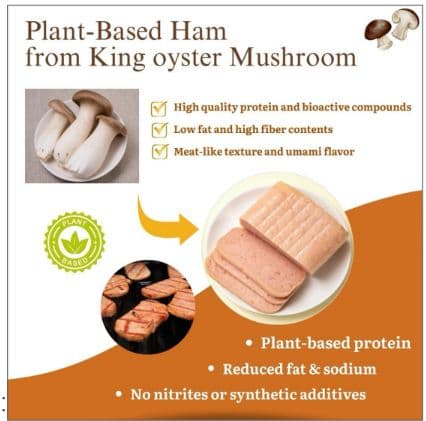
This project therefore aims to develop a "Plant-based Ham Product Prototype" using king oyster mushrooms (Pleurotus eryngii) as the primary ingredient — a natural raw material with strong potential in terms of nutritional value and meat-like texture. The project also seeks to improve the production process to achieve a product with satisfactory textural and flavor characteristics, meeting the needs of a new generation of health- and environmentally-conscious consumers, while providing a foundation for further commercial development within the alternative protein market.