

This research presents a Wilkinson power divider using a common inductor. The lumped topology uses the inherently inductive loss of the inductor as a part of the design, so the conventional resistor for high isolation can be omitted. Therefore, low-loss and high-isolation performances of the compact circuit were achieved. The proposed 2.5-GHz divider was implemented on a silicon-based integrated passive device process. Measurement of the prototype chip had a reflection coefficient below 18 dB at all ports, an insertion loss of 0.5 dB and isolation above 28 dB. The chip size is merely 0.011 wavelength x 0.019 wavelength.
ตัวกระจายสัญญาณวิลกินสัน (WPD) ในรูปแบบวงจรรวมได้รับการศึกษาอย่างกว้างขวางในช่วงความถี่ไมโครเวฟและคลื่นมิลลิเมตร วงจรสายส่งแบบรวมถูกนำมาใช้แทนสายส่งแบบกระจายในการออกแบบตัวแบ่งกำลังไฟฟ้าความถี่เดียว แบนด์คู่ แบนด์กว้าง และแบนด์กว้างพิเศษ [1-12] วงจรสายส่งแบบรวมโดยทั่วไปจะอยู่ในรูปแบบของสายส่งแบบขวามือ (หรือแบบธรรมดา) แต่สายส่งแบบซ้ายมือและแบบผสมขวา/ซ้ายมือก็พบได้ในแอปพลิเคชันต่างๆ มากมายเช่นกัน [13] ในการวิจัยนี้ เราจะเสนอวิธีการออกแบบใหม่โดยใช้ตัวเหนี่ยวนำร่วมตัวเดียวเพื่อนำไปใช้กับตัวแบ่งกำลังไฟฟ้าวิลกินสันแบบกะทัดรัด ตัวต้านทานในตัวแบ่งกำลังไฟฟ้าวิลกินสันถูกละเว้น เนื่องจากการออกแบบใช้การสูญเสียโดยธรรมชาติของตัวเหนี่ยวนำ เพื่อลดกระบวนการปิดบังตัวต้านทานจึงสามารถลดได้ในการผลิตวงจรรวม มีการเพิ่มตัวเก็บประจุเพิ่มเติมเพื่อสร้างวงจรเรโซแนนซ์สำหรับการจับคู่ ดังนั้นแม้จะมีส่วนประกอบจำนวนน้อยและมีตัวเหนี่ยวนำคุณภาพต่ำ แต่วงจรดังกล่าวก็ยังมีประสิทธิภาพดีกว่าวงจรแบบเดิม

คณะสถาปัตยกรรม ศิลปะและการออกแบบ
The concept of building a friendly city for older people by adjusting the physical environment is considered one of the crucial components of promoting older people’s better health and quality of life. Based on this tenet, designing a suitable footpath and considering older people’s needs are vital to the reduction of risks and the increase of safety in travelling, especially for older people living in Wat-Thad and Wat-Klang communities where the proportion of the elderly has continuously, increased. The research aimed to 1) survey the physical environment of footpath, approaching public assistance, 2) observe the elderly’s behavior and satisfaction on footpath in communities, and 3) create the proposal concept in developing the suitable footpath with the elderly’s need in city area. This research used various tools, including the questionnaire on the footpath’s physical environment to analyse problems, limitations, and footpath potentials, the interview of staff in the Engineering Division, Khon Kaen municipality and the questionnaires collecting travelling behaviour, satisfaction and attitude of elderly on the footpath in community. The data analysis the physical environment following six components in the monitoring list showed three used descriptive statistics. Interestingly, from 370 samples, the results of investigating qualified evaluations, namely 1) land utilisation in the communities, 2) linking the transportation network, and 3) beautifully attractive places for walking. However, three unqualified evaluations were 1) safety footpath availability, 2) design for all people, and 3) walking on the footpath to access public assistance and facilities. Moreover, the results from the questionnaire to study older people’s travelling behaviour, indicated that the most travelling objectives were grocery shopping and accessing the recreation sites with frequent visits three to five times per week. Furthermore, older people’s satisfaction with the community footpath was overall at a high level, This research proposed suggestions for developing a safe footpath to ensure safe walking access to facilities and public assistance.
คณะวิทยาศาสตร์
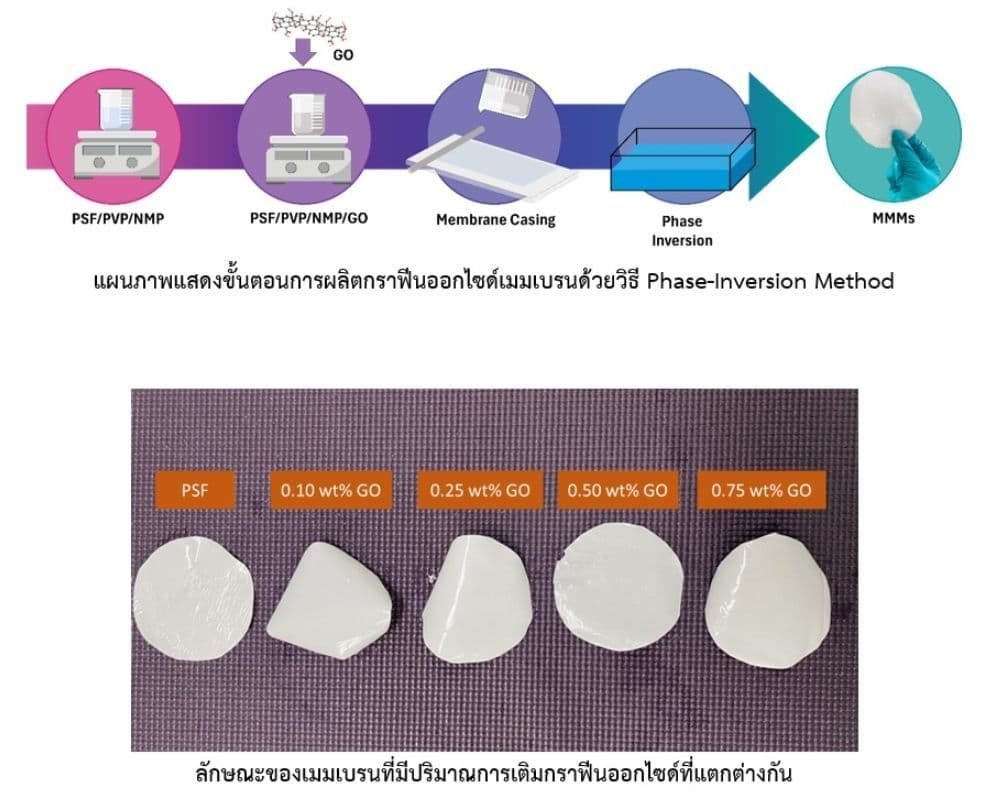
This research focuses on the fabrication of graphene oxide (GO) composite membranes using the Phase-Inversion Method, which transforms polymers from liquid to solid through phase separation. This process creates a porous membrane structure, making it highly adaptable, cost-effective, and suitable for wastewater treatment, separation processes, and industrial filtration applications. Graphene oxide, with its nano-layered structure, offers excellent molecular sieving properties, high water permeability, and chemical and mechanical stability, making it an ideal additive for membrane fabrication. The GO-based membrane demonstrates efficient removal of nanoparticles, heavy metal ions (Pb²⁺, Cr⁶⁺, Hg²⁺), organic pollutants, and microorganisms while exhibiting antifouling properties and high hydrophilicity due to oxygen-functional groups. Applications of this membrane include industrial wastewater treatment, desalination, and the removal of pharmaceutical contaminants, such as antibiotics and hormones. The incorporation of GO enhances membrane performance, providing a sustainable and energy-efficient solution for water purification.
คณะวิทยาศาสตร์
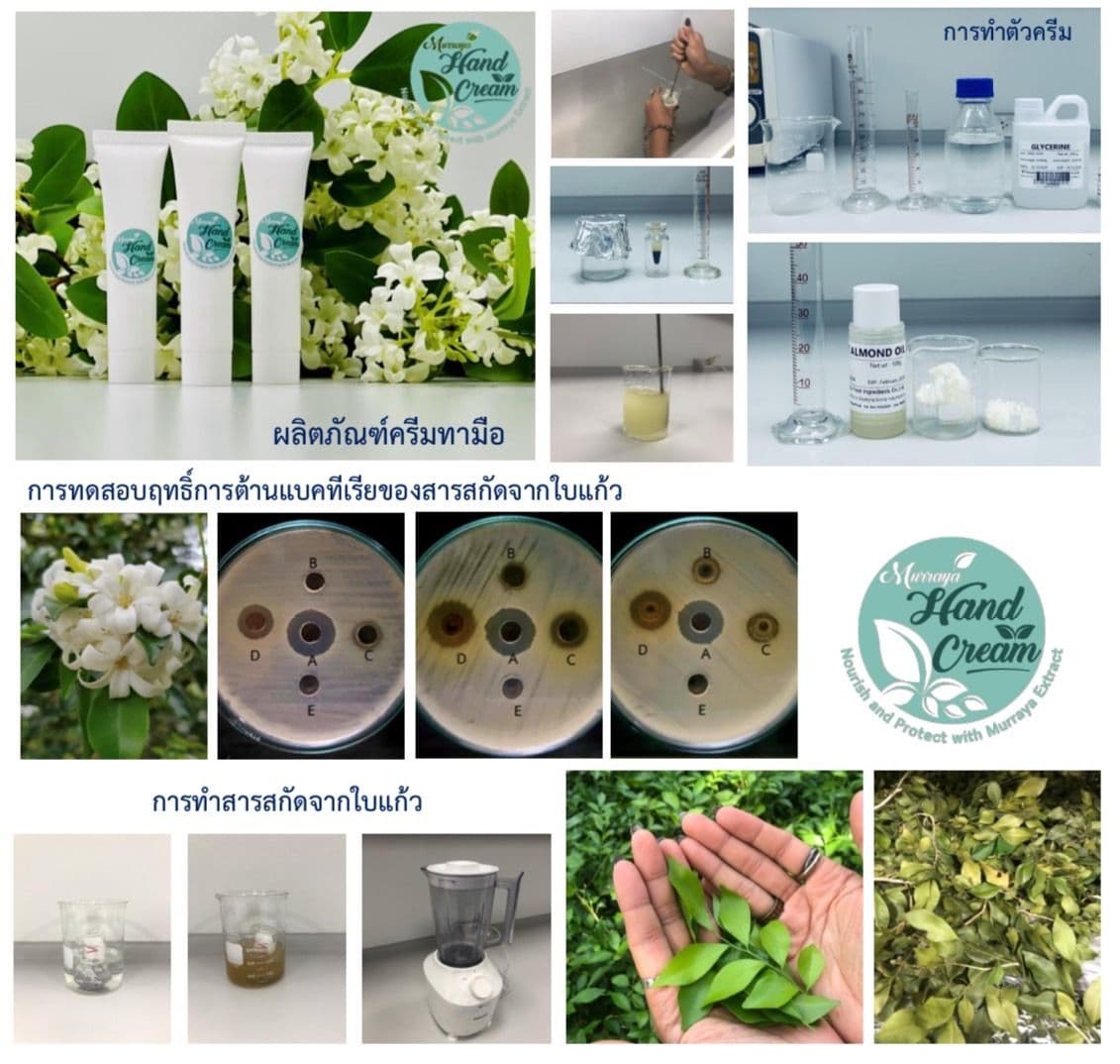
Development of Hand Cream from Murraya Extract Using an Eco-Friendly Extraction Process. This research focuses on extracting active compounds from Murraya paniculata using a water-based, environmentally friendly method. The extract exhibits outstanding antibacterial properties and anti-oxidant. It is incorporated into a hand cream formulation.