

The research on improving the strength of solid electrolytes aims to enhance the properties of solid electrolyte materials produced from cement and additives that help develop the cement structure to generate electricity. The main components include sodium chloride (NaCl) and graphite, which contribute to the material’s ability to generate a weak electrical current. The objective is to develop an electricity-generating flooring material. This study involves preparing a mixture of cement, water, sodium chloride (NaCl), and graphite to enhance the material’s electrical conductivity. It is highly anticipated that this research will lead to the development of concrete flooring capable of generating electricity and can be further expanded for future applications.
ในปัจจุบัน ความต้องการใช้พลังงานไฟฟ้าเพิ่มขึ้นนอย่างต่อเนื่อง ส่งผลให้เกิดการพัฒนาเทคโนโลยีและนวัตกรรมใหม่ ๆ เพื่อเพิ่มแหล่งพลังงานทางเลือกที่มีความยั่งยืนและเป็นมิตรต่อสิ่งแวดล้อม หนึ่งในแนวทางที่ได้รับความสนใจ คือการพัฒนาวัสดุที่สามารถผลิตและกักเก็บพลังงานไฟฟ้าได้ในตัวเอง ซึ่งสามารถนำไปใช้ในโครงสร้างพื้นฐานต่าง ๆเช่น พื้นทางเดิน อาคาร หรือพื้นที่สาธารณะ ดังนั้น งานวิจัยนี้จึงมีเป้าหมายเพื่อพัฒนาและปรับปรุงคุณสมบัติของเซลล์อิเล็กโทรไลต์ชนิดแข็งที่มีโครงสร้างพื้นฐานจากซีเมนต์ โดยมุ่งเน้นการเพิ่มความแข็งแรงของวัสดุควบคู่ไปกับการรักษาคุณสมบัติการนำไฟฟ้า เพื่อให้สามารถนำไปใช้งานเป็นวัสดุปูพื้นที่สามารถผลิตกระแสไฟฟ้าได้ งานวิจัยนี้คาดหวังว่าจะเป็นแนวทางสำคัญในการ พัฒนาวัสดุก่อสร้างสามารถต่อยอดไปสู่การประยุกต์ใช้ในอนาคตได้อย่างมีประสิทธิภาพ
คณะวิศวกรรมศาสตร์
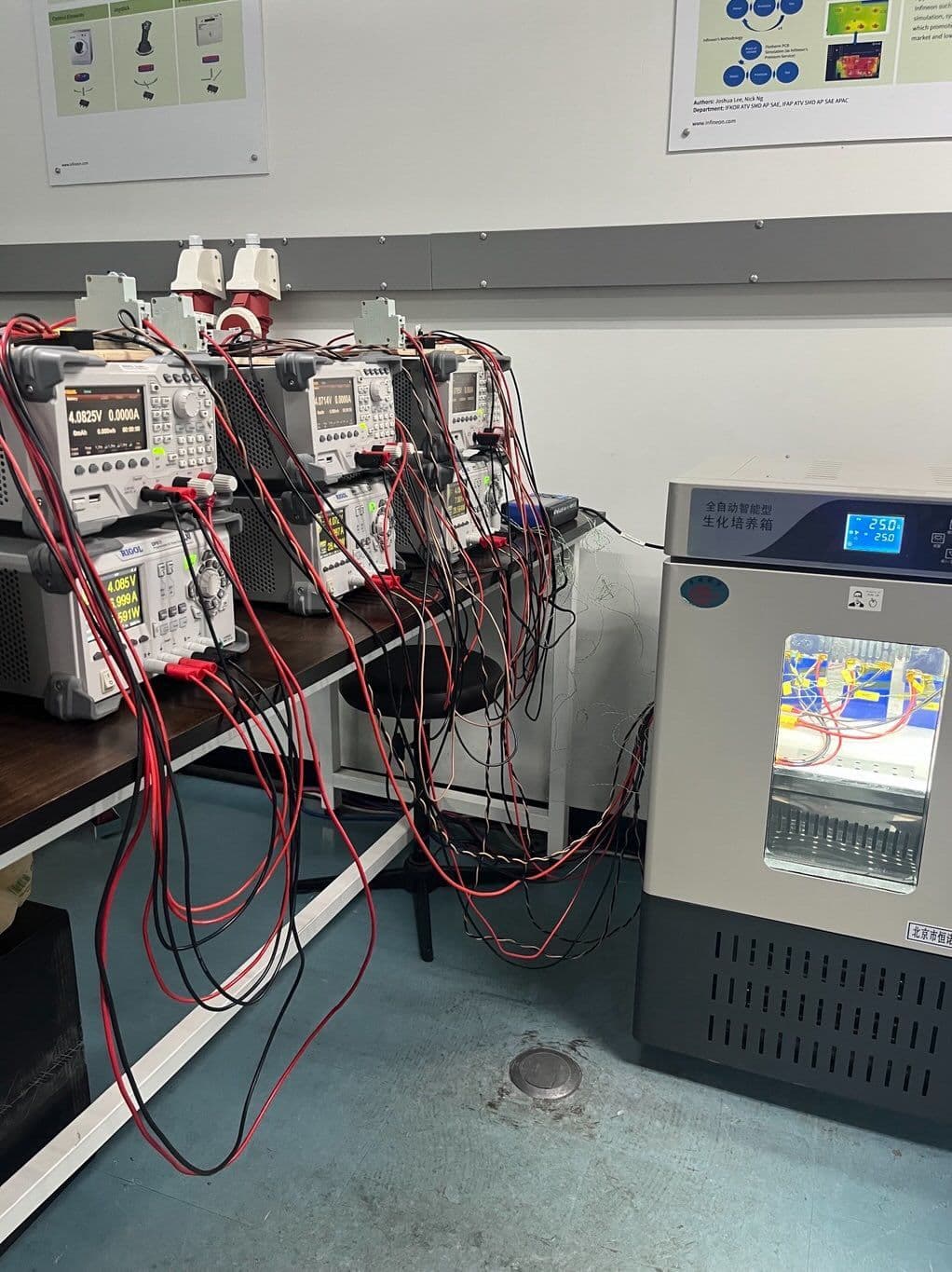
Currently, lithium batteries are widely used in electronic devices and electric vehicles, making the estimation of their State of Health (SOH) crucial. Accurate SOH estimation helps extend battery lifespan, reduce maintenance costs, and prevent safety issues such as overheating or explosions. This project aims to study and analyze mathematical models of batteries and develop SOH estimation techniques using Neural Networks to enhance accuracy and evaluation speed. The experiment involved collecting charge and discharge data from three lithium battery cells under controlled temperature conditions while maintaining a constant current. The current, voltage, and time data were recorded and analyzed to determine the battery capacity for each cycle. These data were then used to train a Neural Network model. The results demonstrated an effective method for predicting battery health status. The outcomes of this project can contribute to the development of a Battery Management System (BMS) that improves battery efficiency and longevity. Additionally, it provides a foundation for applying artificial intelligence techniques in the energy sector effectively.

คณะวิทยาศาสตร์
Agricultural products and by-products are important raw materials in various industries including cosmetics and pharmaceuticals. Agro-based fibers have the composition, properties and structure that make them suitable for uses as composite-cosmetic industry. Upon microwave digestion, cellulose have been successfully synthesized into nanocrystalline cellulose (NCC) with lengths from 50-1000 nm, widths between 5-70 nm. Nanocrystalline cellulose was grafted with cosmetic active ingredients such as glycerin), sodium hyaluronate), glycolic acid, and nicotinamide. The beauty active ingredients attached nanocelluloses can penetrate through the skin to enhance beauty and youth.
คณะเทคโนโลยีการเกษตร
-