

The reason of this project is How to make water system during breeding Golden apple snail&Green caviar with limitation area. Make sure that waterfowl system can work
ต้องการสร้างระบบน้ำและเลี้ยงสัตว์น้ำในพื้นที่ที่มีจำกัด
คณะวิศวกรรมศาสตร์
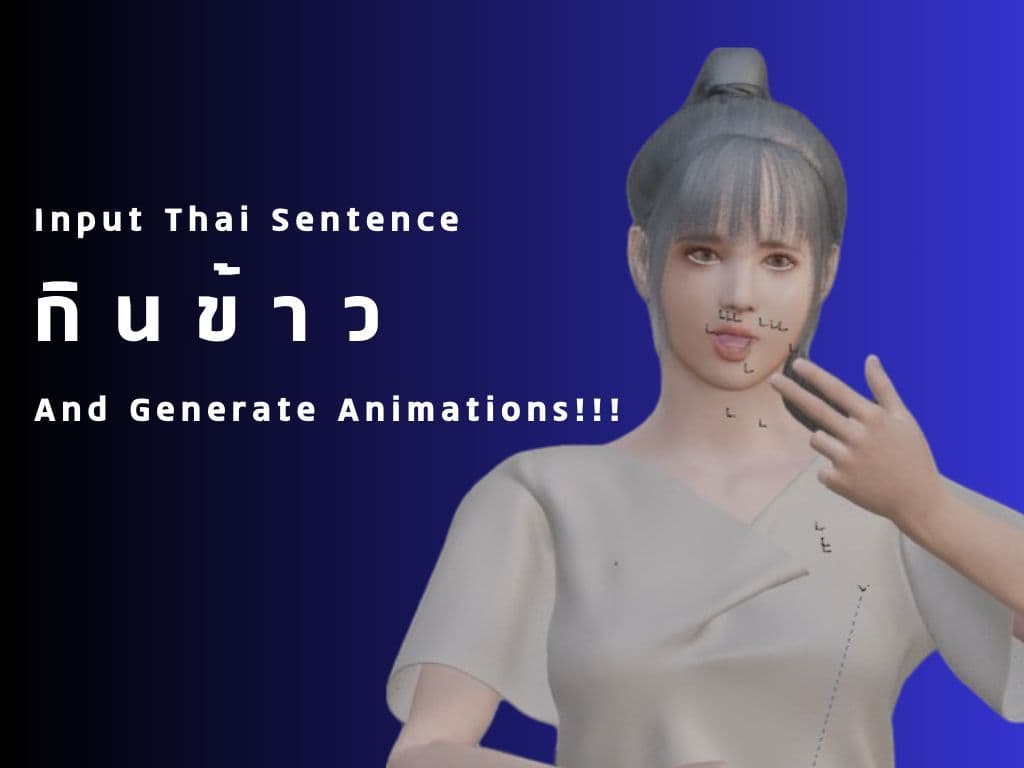
The Thai Sign Language Generation System aims to create a comprehensive 3D modeling and animation platform that translates Thai sentences into dynamic and accurate representations of Thai Sign Language (TSL) gestures. This project enhances communication for the Thai deaf community by leveraging a landmark-based approach using a Vector Quantized Variational Autoencoder (VQVAE) and a Large Language Model (LLM) for sign language generation. The system first trains a VQVAE encoder using landmark data extracted from sign videos, allowing it to learn compact latent representations of TSL gestures. These encoded representations are then used to generate additional landmark-based sign sequences, effectively expanding the training dataset using the BigSign ThaiPBS dataset. Once the dataset is augmented, an LLM is trained to output accurate landmark sequences from Thai text inputs, which are then used to animate a 3D model in Blender, ensuring fluid and natural TSL gestures. The project is implemented using Python, incorporating MediaPipe for landmark extraction, OpenCV for real-time image processing, and Blender’s Python API for 3D animation. By integrating AI, VQVAE-based encoding, and LLM-driven landmark generation, this system aspires to bridge the communication gap between written Thai text and expressive TSL gestures, providing the Thai deaf community with an interactive, real-time sign language animation platform.

วิทยาลัยเทคโนโลยีและนวัตกรรมวัสดุ
The development of skin-on-a-chip models plays a crucial role in research for drug and cosmetic development. Traditional approaches often utilize two-dimensional (2D) methods that rely on culturing cells on flat surfaces, resulting in a lack of complexity in skin structure and realistic cell interactions. Moreover, traditional methods have limitations in mimicking fluid flow and nutrient circulation, which affects the accuracy of pharmaceutical testing and the prediction of drug effects. This has led to the advancement of three-dimensional (3D) skin models using new microfluidic technology, enhancing the realism of skin structure by replicating both the epidermis and dermis layers, as well as simulating fluid flow similar to physiological conditions in the human body. The design of 3D systems allows for more realistic cell arrangement and interactions, enabling better simulation of skin functions and increasing the accuracy in evaluating the effects of various substances on cell responses, including absorption, inflammation, and wound healing. Therefore, the development of three-dimensional (3D) skin models not only addresses the limitations of traditional methods but also represents a significant step forward in creating models that can be effectively applied in drug testing and pharmaceutical product development.
คณะเทคโนโลยีการเกษตร
Dwarf whipray (Brevitrygon heterura) is a common species found in a local market in the Gulf of Thailand. However, like many other species of stingrays, it is threatened by overfishing and habitat destruction. Therefore, an accurate species identification is crucial because conservation efforts may vary depending on the species. This study aims to understand morphological variation of B. heterura in the Gulf of Thailand by morphometric study and genetic analysis. During October 2022 and February 2023, we obtained 49 samples from research vessels fish landing ports and local fish markets. We observed two distinct groups based on 43 morphological variables/ratios. B. heterura samples from Chanthaburi, Rayong, Chonburi, Samut Sakhon, Nakhon Si Thammarat and Songkla provinces, called “group A," typically have longer snout length than those from Prachuap Khiri Khan provinces, called “group B" according to external morphological characters for species identification. Three morphological variables/ratios were significantly different between groups A and B. Main characters to explain intraspecific variations between group A and group B are further discussed. DNA barcoding based on a fragment of the cytochrome c oxidase subunit I (COI) gene were obtain from eight samples of group A and eight samples from group B. Pairwise percent sequence divergence (p-distance) for COI between group A and group B were 0.0-2.5. This study contributes to the understanding of variations of morphology and genetics of B. heterura in the Gulf of Thailand.