

The development of skin-on-a-chip models plays a crucial role in research for drug and cosmetic development. Traditional approaches often utilize two-dimensional (2D) methods that rely on culturing cells on flat surfaces, resulting in a lack of complexity in skin structure and realistic cell interactions. Moreover, traditional methods have limitations in mimicking fluid flow and nutrient circulation, which affects the accuracy of pharmaceutical testing and the prediction of drug effects. This has led to the advancement of three-dimensional (3D) skin models using new microfluidic technology, enhancing the realism of skin structure by replicating both the epidermis and dermis layers, as well as simulating fluid flow similar to physiological conditions in the human body. The design of 3D systems allows for more realistic cell arrangement and interactions, enabling better simulation of skin functions and increasing the accuracy in evaluating the effects of various substances on cell responses, including absorption, inflammation, and wound healing. Therefore, the development of three-dimensional (3D) skin models not only addresses the limitations of traditional methods but also represents a significant step forward in creating models that can be effectively applied in drug testing and pharmaceutical product development.
ในปัจจุบัน โรคผิวหนังเป็นปัญหาทางสุขภาพที่พบได้อย่างแพร่หลายทั่วโลก ทั้งโรคผิวหนังอักเสบ โรค สะเก็ดเงิน และมะเร็งผิวหนัง โดยเฉพาะอย่างยิ่งเมื่ออายุของประชากรโลกเพิ่มมากขึ้น ทำให้จำนวนผู้ป่วยโรคผิวหนังที่ต้องได้รับการรักษาเพิ่มขึ้นอย่างต่อเนื่อง ทำให้ตลาดโลกในการนำส่งยาเติบโต ส่งผลให้เกิดความต้องการพัฒนาผลิตภัณฑ์ทางเภสัชกรรมที่สามารถรักษาและบำรุงผิวหนังได้อย่างมีประสิทธิภาพ รวมถึงการพัฒนาระบบการส่งยาเข้าสู่ผิวหนัง (Transdermal Drug Delivery System) ที่สามารถตอบสนองต่อการรักษาโรคเฉพาะทางหรือการใช้ในเครื่องสำอางได้อย่างมีประสิทธิภาพ อย่างไรก็ตาม กระบวนการทดสอบยาและเครื่องสำอางในปัจจุบันยังคงพึ่งพาการทดลองในสัตว์ (Animal Testing) ซึ่งนอกจากจะเป็นที่ถกเถียงในด้านจริยธรรมแล้ว ยังอาจไม่สามารถสะท้อนการตอบสนองที่เกิดขึ้นในร่างกายมนุษย์ได้อย่างแม่นยำ ดังนั้น การพัฒนาระบบที่สามารถจำลองสภาพแวดล้อมของผิวหนังมนุษย์ในห้องปฏิบัติการจึงกลายเป็นที่ต้องการอย่างมาก ซึ่งจะช่วยให้สามารถทดสอบประสิทธิภาพและความปลอดภัยของยาและผลิตภัณฑ์ทางเครื่องสำอางได้โดยไม่ต้องพึ่งพาการทดสอบในสัตว์ โดยระบบไมโครฟลูอิดิก (Microfluidic System) เป็นหนึ่งในเทคโนโลยีที่มีศักยภาพสูงในการจำลอง ระบบเซลล์ผิวหนัง เนื่องจากมีความสามารถในการเลียนแบบสภาพแวดล้อมทางสรีรวิทยาได้อย่างแม่นยำ โดยการควบคุมการไหลของของเหลวในระดับไมโครเมตร ซึ่งช่วยให้สามารถจำลองการทำงานของชั้นต่าง ๆ ของผิวหนังได้อย่างใกล้เคียงกับสภาพแวดล้อมภายในร่างกายจริง นอกจากนี้ยังสามารถใช้ในการศึกษาการแทรก ซึมของสารเข้าสู่ผิวหนัง การปลดปล่อยยา และการโต้ตอบระหว่างเซลล์ผิวหนังกับสารเคมีได้ในระดับที่ ละเอียดและแม่นยำ การสร้างระบบไมโครฟลูอิดิกเพื่อจำลองระบบเซลล์ผิวหนัง จึงมีความสำคัญอย่างยิ่งต่อการพัฒนาทางเภสัชกรรม โดยเฉพาะในการพัฒนายาที่มีการนำส่งผ่านผิวหนัง รวมถึงการพัฒนาผลิตภัณฑ์เครื่องสำอางที่มีประสิทธิภาพและปลอดภัย นอกจากนี้ การสร้างระบบดังกล่าวยังมีศักยภาพในการลดการพึ่งพาการทดสอบในสัตว์ ซึ่งสอดคล้องกับแนวทางการวิจัยและพัฒนาผลิตภัณฑ์ที่เป็นมิตรต่อสิ่งแวดล้อมและมนุษย์ ดังนั้น โครงงานพิเศษนี้จึงได้นำเทคโนโลยีของไหลจุลภาคมาประยุกต์เพื่อสร้างและพัฒนาระบบไมโครฟลูอิดิก โดยทำงานออกแบบและสร้างลวดลายด้วยวิธีการแม่พิมพ์แบบอ่อน (Soft lithography) และใช้ Polydimethylsiloxane (PDMS) เป็นวัสดุที่ทำการเพาะเลี้ยงเซลล์ภายใน ที่สามารถจำลองสภาพแวดล้อมของผิวหนังมนุษย์ได้อย่างมีประสิทธิภาพ รวมถึงการบูรณาการเซลล์ผิวหนังชนิดต่าง ๆ เช่น เคราติโนไซต์ (Keratinocytes) และไฟโบรบลาสต์ (Fibroblasts) เพื่อจะศึกษาการทำงานและการตอบสนองของผิวหนังต่อยาหรือสารเคมี โดยหวังว่างานวิจัยนี้จะช่วยส่งเสริมการพัฒนาผลิตภัณฑ์ทางเภสัชกรรมและเครื่องสำอางในอนาคต

คณะวิทยาศาสตร์
In today’s rapidly expanding e-commerce environment, the massive volume of product reviews makes it crucial to summarize user opinions in a way that is both comprehensible and practically applicable. This research presents a system for analyzing product reviews using Aspect-Based Sentiment Analysis (ABSA), a Natural Language Processing (NLP) technique that identifies key aspects of a review (such as shipping, product quality, and packaging) and evaluates the sentiment (positive, negative, or neutral) associated with each aspect, allowing both consumers and merchants to gain more efficient access to in-depth insights. This project focuses on developing AI for Thai-language ABSA by utilizing WangchanBERTa, a model trained on Thai data, and comparing it with various standard approaches such as TF-IDF + Logistic Regression, Word2Vec + BiLSTM, and Multilingual BERT (mBERT/XLM-R) to assess their performance in terms of accuracy, speed, and resource usage. Additionally, a dashboard visualization is provided to help users quickly grasp review trends. The expected outcome is to create an AI tool that can be practically employed in the e-commerce industry, enabling consumers to make easier purchasing decisions and assisting merchants in effectively improving their products and services.

คณะวิศวกรรมศาสตร์
The purpose of this invention is to develop a forest fire prevention agent that has the ability to prevent long-term forest fires, not only to suppress forest fires or prevent forest fires from spreading widely, but to prevent them from starting to catch fire from the beginning. It can prevent forest fires comprehensively and can be prevented for a long time during the peak forest fire period or the dry season, which is about 3-4 months. There are no residues or minimal residues without causing harm to the surrounding environment under the specified standards. Emphasis is placed on the use of raw materials, equipment, and chemicals that can be easily found in Thailand. This includes using the value of production costs as low as possible. This makes it suitable for use in large quantities for spraying and protecting forest areas in forest areas that are prone to fire. Estimated average for pollution caused by forest fires include particulate matter (PM), including PM2.5, PM10, carbon monoxide (CO), carbon dioxide, carbon dioxide, and carbon dioxide, Nitrogendioxide, VOC etc.
คณะวิศวกรรมศาสตร์
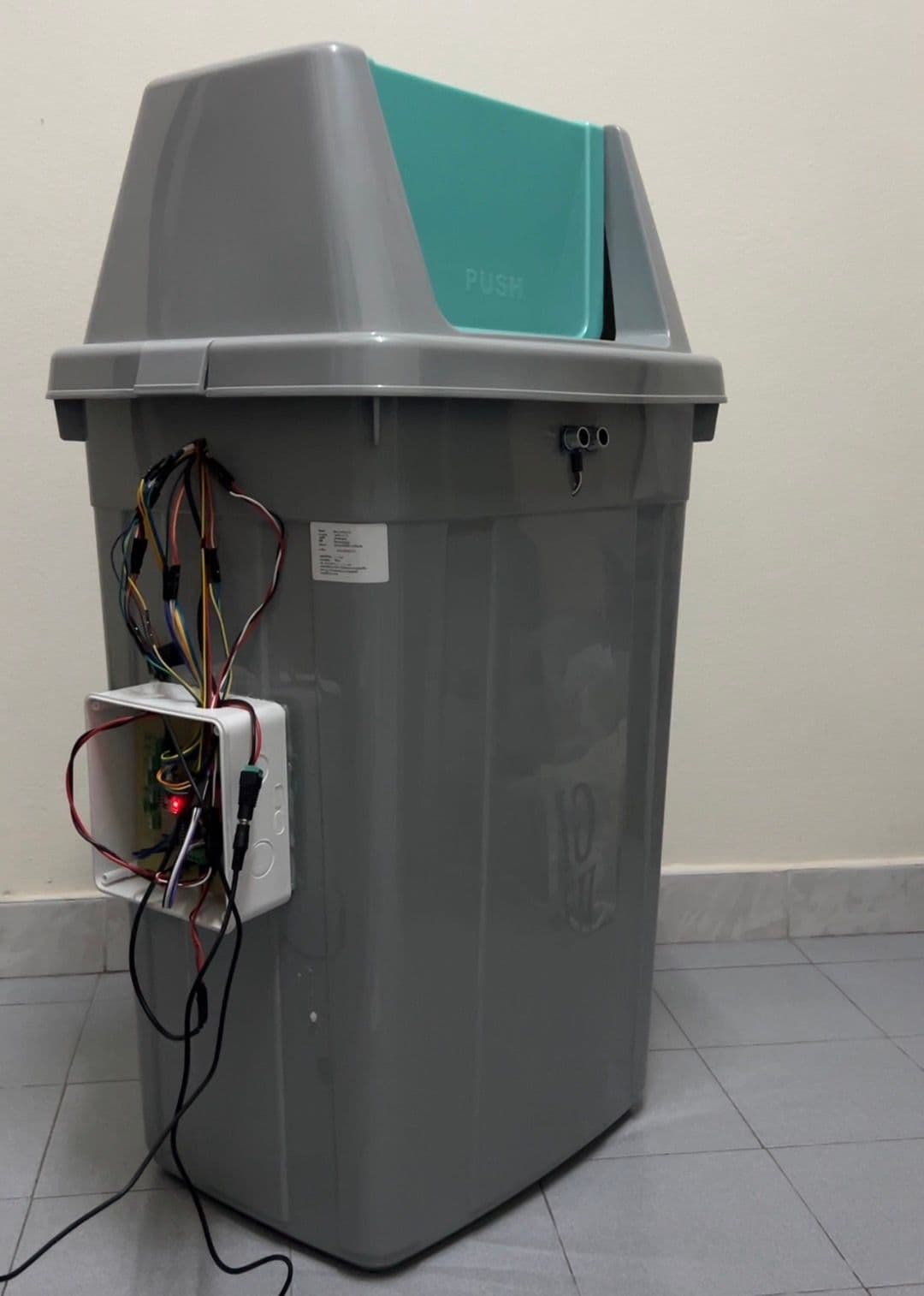
The presented project topic is Garbage Sorting Systems. The purpose is to study the operation and develop a waste sorting system that can automatically detect the type of waste using a proximity sensor to separate the types of metal and non-metal waste, as well as an ultrasonic sensor to check the amount of waste in the bin. If the amount of waste exceeds the specified amount, the system will send a notification to the communication device connected to the system, such as a smartphone or computer. The operation of the system is designed to increase the efficiency of waste management, reduce the burden of manual waste sorting, and promote recycling. This system can be applied in various places, such as educational institutions or public places, to help reduce the amount of waste that is not properly separated and increase the opportunity to reuse waste.