


Layla, the hotel robot, is responsible for carrying guests’ luggage and guiding them to their accommodations. It is equipped with an internal map of the hotel, allowing it to navigate various locations efficiently. Additionally, it features an AI-powered system that enables interactive conversations in three major languages: Thai, English, and Chinese.
เนื่องจากปัญหาการขาดแคลนพนักงานโรงแรมในปัจจุบัน พนักงานจึงต้องทำหน้าที่หลายอย่างในเวลาเดียวกัน ทำให้ลูกค้าอาจต้องรอคิวนาน ดังนั้นเพื่อเพิ่มประสิทธิภาพการทำงานให้สะดวกและรวดเร็วยิ่งขึ้น จึงสร้างนวัตกรรมชิ้นนี้มาเพื่อช่วยลดภาระหน้าที่ของพนักงาน เช่น Bellboy, Concierge และ Receptionist เป็นต้น
คณะวิศวกรรมศาสตร์
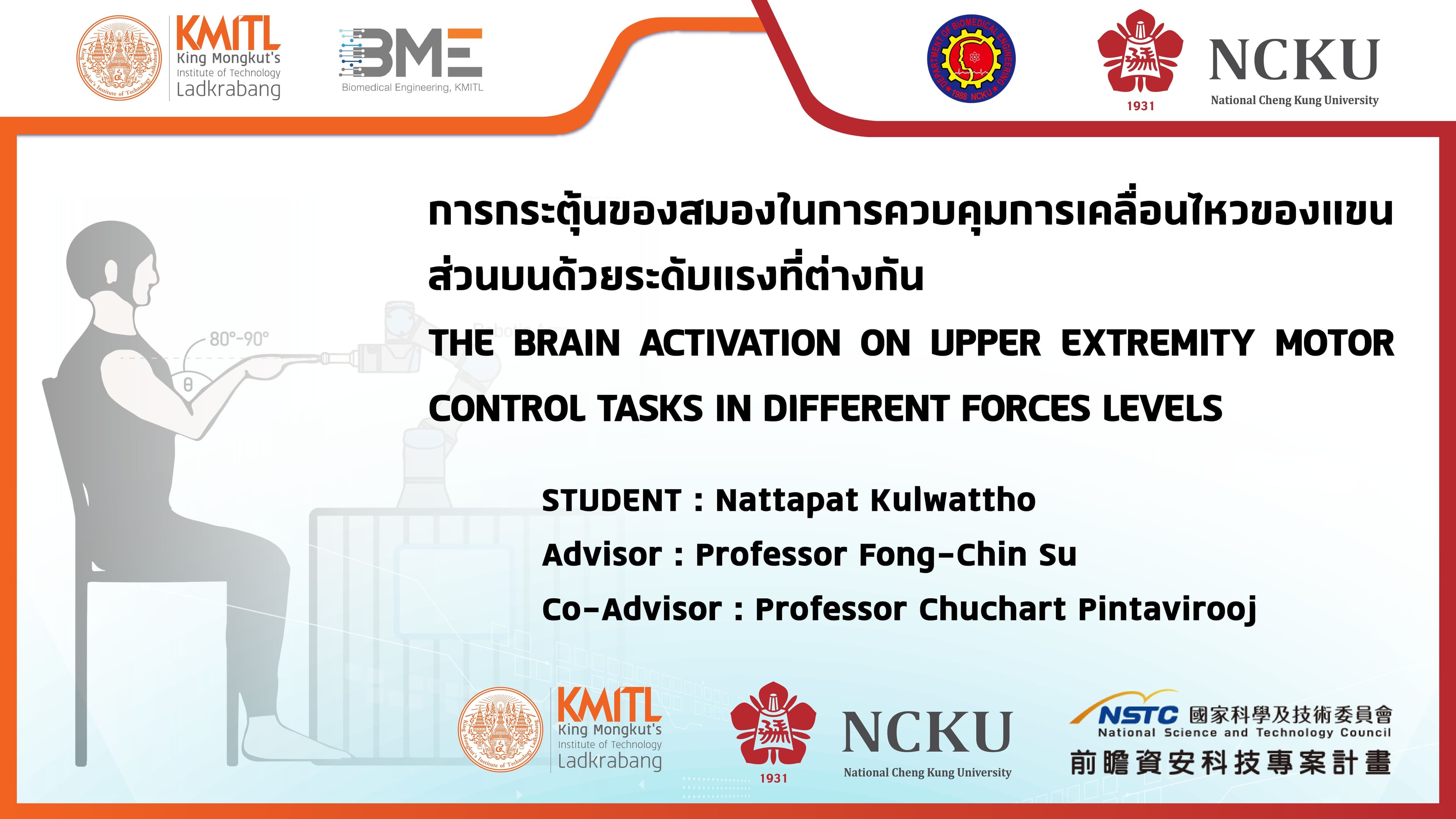
Motor control is a critical process for muscle contraction, which is initiated by nerve impulses governed by the motor cortex. This process is vital for performing activities of daily living (ADLs). Consequently, a disruption in communication between the brain and muscles, as seen in various chronic conditions and diseases, can impair bodily movement and ADLs. Evaluating the interaction between brain function and motor control is significant for the diagnosis and treatment of motor control disorders; moreover, it can contribute to the development of brain-computer interfaces (BCIs). The purpose of this study is to investigate brain activation in designed upper extremity motor control tasks in regulating the pushing force in different brain regions; and develop investigation methods to assess motor control tasks and brain activation using a robotic arm to guide upper extremity force and motor control. Eighteen healthy young adults were asked to perform upper extremity motor control tasks and recorded the hemodynamic signals. Functional Near-Infrared Spectroscopy (fNIRs) and robotic arms were used to assess brain activation and the regulation of pushing force and extremity motor control. Two types of motion, static and dynamic, move along a designated trajectory in both forward and backward directions, and three different force levels selected from a range of ADLs, including 4, 12, and 20 N, were used as force-regulating upper extremity motor control tasks. The hemodynamic responses were measured in specific regions of interest, namely the primary motor cortex (M1), premotor cortex (PMC), supplementary motor area (SMA), and prefrontal cortex (PFC). Utilizing a two-way repeated measures ANOVA with Bonferroni correction (p < 0.00625) across all regions, we observed no significant interaction effect between force levels and movement types on oxygenated hemoglobin (HbO) levels. However, in both contralateral (c) and ipsilateral (i) PFC, movement type—static versus dynamic—significantly affected brain activation. Additionally, cM1, iPFC, and PMC showed a significant effect of force level on brain activation.

คณะเทคโนโลยีการเกษตร
This project involves the development of a plant care system for dormitories using IoT (Internet of Things). The system is implemented through programming on an ESP-32 board and controlled via sensors for automated watering. The commands are operated through smartphones, supporting both iOS and Android. It is expected that this project will make plant care in dormitories easier and more convenient.

คณะวิศวกรรมศาสตร์
The evaluation of mango yield and consumer behavior reflects an increasing awareness of product origins, with a growing demand for traceability to understand how the produce has been cultivated and managed. This study explores the relationship between mango characteristics and cultivation practices before harvest, using location identification to provide insights into these processes. To achieve this, a model was developed to detect and locate mangoes using 2D images via a Deep Learning approach. The study also investigates techniques to determine the real-world coordinates of mangoes from 2D images. The YOLOv8 model was employed for object detection, integrated with camera calibration and triangulation techniques to estimate the 3D positions of detected mangoes. Experiments involved 125 trials with randomized mango positions and camera placements at varying yaw and pitch angles. Parameters extracted from sequential images were compared to derive the actual 3D positions of the mangoes. The YOLOv8 model demonstrated high performance with prediction metrics of Precision (0.928), Recall (0.901), mAP50 (0.965), mAP50-95 (0.785), and F1-Score (0.914). These results indicate sufficient accuracy for predicting mango positions, with an average positional error of approximately 38 centimeters.