
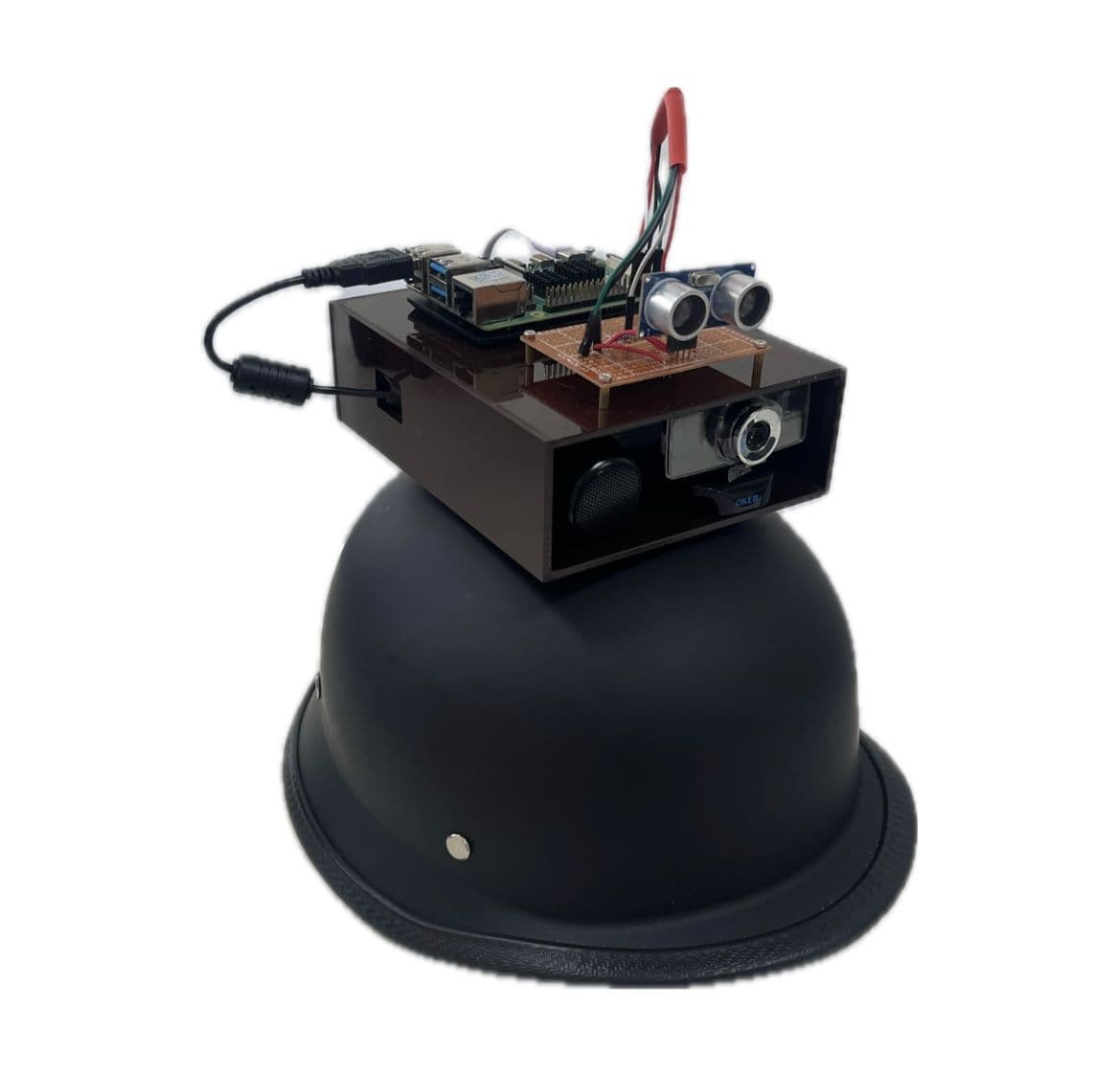
This thesis presents the application of deep learning for object classification. The selected deep learning architectures studied include Convolutional Neural Networks (CNN) and ResNet18. It covers data preparation, feature extraction, parameter tuning for accuracy comparison, and performance evaluation of the selected models. The aim is to propose an efficient model for use in devices that assist visually impaired individuals in classifying indoor objects and providing sound alerts.
ในปัจจุบันปัญหาในการเคลื่อนที่และการรับรู้สภาพแวดล้อมรอบตัวสำหรับผู้บกพร่องทางสายตายังคงเป็นอุปสรรคสำคัญในสังคมส่งผลให้เกิดความเสี่ยงต่อการเดินชนสิ่งกีดขวางและได้รับอันตราย ด้วยการนำเทคโนโลยีปัญญาประดิษฐ์เข้ามาใช้ในการเรียนรู้ การวิเคราะห์ และประมวลผลข้อมูลได้อย่างรวดเร็วเพื่อจำแนกวัตถุ ปริญญานิพนธ์นี้จึงมีจุดประสงค์เพื่อสร้างอุปกรณ์สำหรับช่วยเหลือผู้บกพร่องทางสายตาที่ใช้อัลกอริทึมการเรียนรู้เชิงลึกแบบต่างๆ เพื่อนำไปจำแนกวัตถุที่เป็นอุปสรรคสำหรับผู้บกพร่องทางสายตาในการทำกิจวัตรประจำวันภายในอาคารและส่งสัญญาณเตือนให้ผู้ใช้งานทราบให้เคลื่อนที่อย่างปลอดภัย
คณะวิศวกรรมศาสตร์
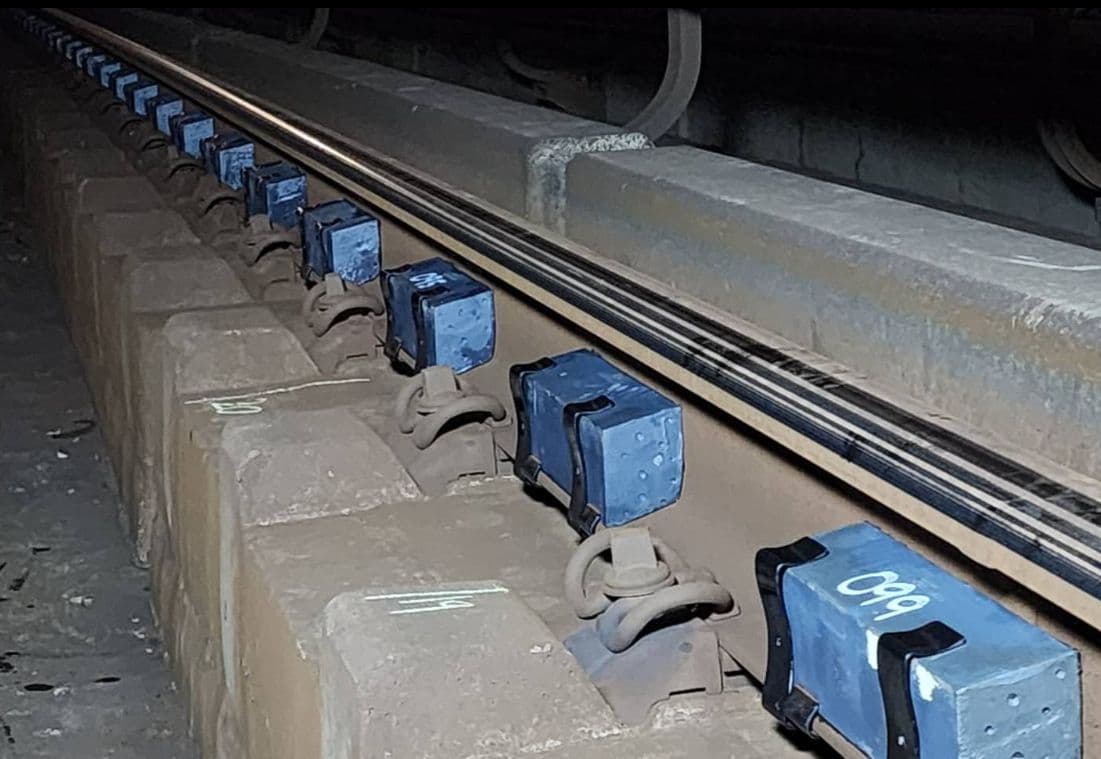
Nowadays, rail transportation has a significant impact on people's lives and economic growth. Consequently, the number of rail systems being built around our country has dramatically increased. This process causes various types of pollution, such as noise and rail-way vibration, which can badly affect the life of citizens who live nearby. The most popular way to solve this problem recently is to decrease the noise from the sound source or to adjust the vibration by attaching a Track Damper to the railway. This technique is being used in many countries especially in Europe and Australia because it is cheap and has high efficiency. The key piece called Track Dampers are made by AUT company’s Thailand for a period of time. The company produces Track Dampers for the owner of the technology so as to sell more than 300,000 pieces of it overseas. Furthermore, the demand of Track Dampers grows as the railway systems expand. Unfortunately, the imported synthetic materials, which are used to create Track Dampers, are made from environmentally unfriendly sources. As a result, this research aims to develop the product to be environmentally-safe by replacing some imported materials with Thai’s local content; which are natural rubber and rubber crumbs. Furthermore, the product will be added value by mounting with embedded sensors for real-time monitoring of track vibration, noise, and rail temperature. All embedded devices developed will sense, collect, and automatically send to cloud by wireless technology platform. The AI and IOT platform will also be developed for safety, security, and maintenance proposed of railway track system. However, in conducting research, there will be close collaboration with AUT company through design, production, and testing. The outcome of this research is to upgrade AUT company from tier 2 manufacturer (TRL 8-9) to tier 1 manufacturer (TRL 7-8) which will be served the Thailand competitiveness enhancing strategic goal.

คณะอุตสาหกรรมอาหาร
The consumption of plant-based products has been gaining popularity as consumers become more health-conscious and aware of environmental impacts. The food industry has been developing meat analogs with properties similar to conventional meat. This study investigates the chemical and physical properties of chickpea-based meat analog burgers and hybrid burgers containing both chickpeas and pork, using the sous-vide cooking method. This technique helps maintain food quality in terms of texture, moisture retention, and nutritional value. The experiment examined various properties of both types of burgers, including cooking loss, water holding capacity, shear force, pH value, and color analysis. Additionally, sensory evaluation was conducted to assess taste, texture, and overall consumer preference. The findings will provide insights into the optimal sous-vide conditions for producing plant-based and hybrid burgers with desirable quality characteristics that meet the needs of health-conscious consumers. This study serves as a valuable guideline for the food industry in developing high-nutritional-value alternative protein products while reducing meat consumption. By incorporating plant-based ingredients, it helps minimize environmental impact and promotes sustainability in food production. The research is significant in both food science and the development of healthier, competitive food products for the future market.
คณะวิศวกรรมศาสตร์
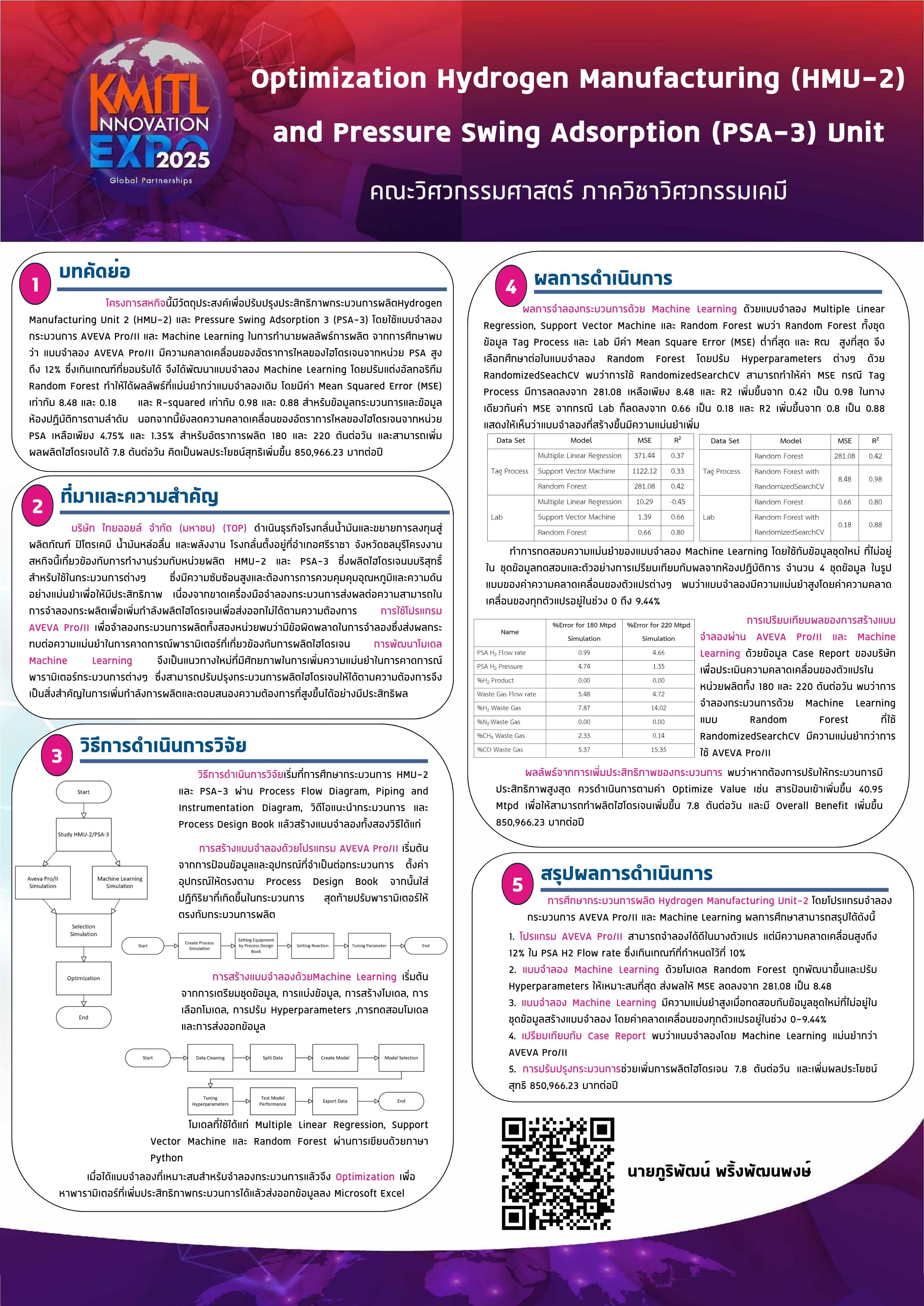
This cooperative education project aims to enhance the efficiency of Hydrogen Manufacturing Unit 2 (HMU-2) and Pressure Swing Adsorption 3 (PSA-3) by using AVEVA Pro/II process modeling and a Machine Learning model for process simulation. The study found that the AVEVA Pro/II model predicted outcomes with deviations ranging from 0–35%, including a hydrogen flow rate deviation from the PSA unit of 12%, exceeding the company’s acceptable limit of 10%. To address this, a Machine Learning model based on the Random Forest algorithm was developed with hyperparameter tuning. The Machine Learning model demonstrated high accuracy, achieving Mean Squared Errors (MSE) of 8.48 and 0.18 for process and laboratory data, respectively, and R-squared values of 0.98 and 0.88 for the same datasets. It outperformed the AVEVA Pro/II model in predicting all variables and reduced the hydrogen flow rate deviation to 4.75% and 1.35% for production rates of 180 and 220 tons per day, respectively. Optimization using the model provided recommendations for process adjustments, increasing hydrogen production by 7.8 tons per day and generating an additional annual profit of 850,966.23 Baht.