

KMITL Expo 2026 LogoKMITL 66th Anniversary Logo

Virtual Reality Based Underwater of Thai Marine Fishes Museum

Virtual Reality Based Underwater of Thai Marine Fishes Museum

Abstract

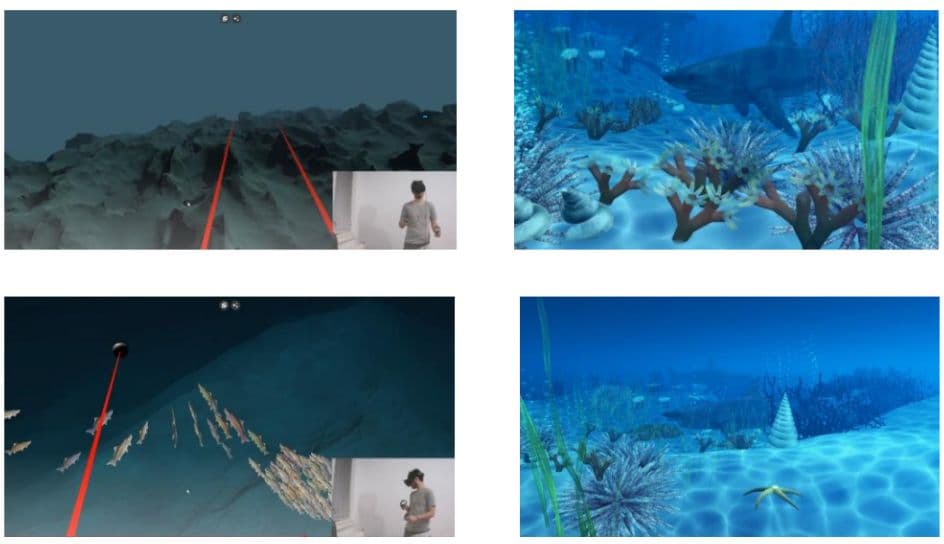
This research aims to design and develop a prototype Virtual Reality Based Underwater Thai Marine Fishes Museum using computer animation and VR technology to simulate Thailand's marine ecosystems across both the Gulf of Thailand and the Andaman Sea. The museum is divided into three zones covering brackish water, coastal, and deep-sea environments, allowing visitors to experience an immersive and interactive underwater world through a VR application. The project promotes marine ecology education and supports the conservation of Thailand's aquatic biodiversity in a sustainable and engaging manner.

Objective

ปัจจุบันเทคโนโลยีความจริงเสมือน (Virtual Reality) ได้กลายเป็นเครื่องมือสำคัญในการศึกษาสัณฐานวิทยาของปลาและระบบนิเวศทางทะเล ช่วยสร้างประสบการณ์แบบดื่มด่ำและโต้ตอบได้ที่ตัวอย่างทางกายภาพไม่สามารถทดแทนได้ พิพิธภัณฑ์ปลาแบบดั้งเดิมมักใช้ตัวอย่างที่แช่สารเคมีซึ่งสีและรูปลักษณ์ไม่น่าสนใจ โดยเฉพาะสำหรับเด็กและเยาวชน การนำ VR มาพัฒนาพิพิธภัณฑ์จึงเปิดมิติใหม่ในการศึกษาชนิดและระบบนิเวศของปลาทะเลไทยทั้งฝั่งอ่าวไทยและอันดามัน ซึ่งจะช่วยกระตุ้นความสนใจในการเรียนรู้วิทยาศาสตร์ทางทะเลและสนับสนุนการอนุรักษ์ระบบนิเวศทางทะเลของประเทศได้อย่างมีประสิทธิภาพ
Other Innovations

Selection of landrace rice varieties resistant to saline soil

คณะเทคโนโลยีการเกษตร

Selection of landrace rice varieties resistant to saline soil

Rice is a salt-sensitive crop. The objective of this study was to evaluate the effect of salinity at flowering stage on physiological traits and yield of landrace rice. The experiment design was 4*10 Factorial in RCBD with 4 replications. Factor A was four salinity levels: control, 6, 12 and 16 dS/m; Factor B was 10 rice varieties. Data were collected on physiological traits and grain yield. The results showed that increasing salinity level decreased rice yield. The highest yield reduction was found when the rice received salt stress at 16 dS/m. In addition, rice varieties showed different yield performance when exposed to salt stress. In this found that Hom Yai variety had the lowest yield reduction when grown at 16 dS/m salinity level and did not differ from salt tolerant check variety.

Read more
Application of Machine Learning, Stochastic Process, and Game Theory in Short-Term Financial Asset Investment Strategies

คณะวิทยาศาสตร์

Application of Machine Learning, Stochastic Process, and Game Theory in Short-Term Financial Asset Investment Strategies

This project focuses on the study and development of a short-term investment framework via gold trading in the foreign exchange market. Machine learning techniques are applied to analyze and forecast pricing trends. Moreover, we develop the system using a stochastic process to determine optimal stop-loss points, with the aim of maximizing expected returns. Additionally, we apply game theory to guide the decision-making process regarding order holding or closure. The system is implemented and tested on the MetaTrader 5 (MT5) platform. This project outlined the clear process that includes data preparation, machine learning model training, probabilistic modeling of gold price movements, stop-loss strategy formulation, strategic decision modeling based on game theory, the development of an automated trading program, and backtesting to evaluate system performance.

Read more
Characteristics and nutrition values of cereal bar fortified with Asian sea bass bone bio-calcium powder.

คณะอุตสาหกรรมอาหาร

Characteristics and nutrition values of cereal bar fortified with Asian sea bass bone bio-calcium powder.

Bio-calcium powders were extracted from Asian sea bass bone by heat-treated alkaline with fat removal and bleaching supplementary method. Cereal bars (CBs) were fortified with produced bio-calcium at 3 levels: (1) increased calcium (IS-Ca; calcium ≥10% Thai RDI), (2) good source of calcium (GS-Ca; calcium ≥15% Thai RDI), and (3) high calcium (H-Ca; calcium ≥30% Thai RDI) which were consistent with the notification of the Ministry of Public Health, Thailand: No. 445; Nutrition claim issued in B.E. 2023. Moisture content, water activity, color, calcium content and FTIR analysis of bio-calcium powders were measured. Dimension, color, water activity, pH and texture of fortified CBs were determined. Produced bio-calcium could be classified as a dried food with light yellow-white color. Calcium contents in bio-calcium powder was 23.4% (w/w). Dimension, weight and color except b* and ΔE* values of fortified CBs were not different (P > 0.05) from those of the control. Fortifying of bio-calcium resulted in harder texture CBs. An increase of fortified bio-calcium amounts decreased carbohydrate and fat but increased of protein, ash and calcium in the fortified CBs. Shelf life of CBs was to be shorten by fortification of bio-calcium powder because of the increment of moisture, water activity and pH. Yield of bio-calcium production was 40.30%. Production cost of bio-calcium was approximately 7,416 Bth/kg while cost of fortified CBs increased almost 2-3 times compared to the control. Calcium contents in IS-Ca (921.12 mg/100g), GS-Ca (1,287.10 mg/100g) and H-Ca (2,639.70 mg/100g) cereal bars could be claimed as increased calcium, good source of calcium and high calcium, respectively. In conclusion, production of cereal bar fortified with Asian sea bass bone bio-calcium powder as a fortified food was possible. However, checking the remained hazardous reagents in bio-calcium powder must be carried out before using in food products and analysis of calcium bioavailability, sensory acceptance and shelf life of the developed products should be determined in further studies.

Read more