
KMITL Expo 2026 LogoKMITL 66th Anniversary Logo

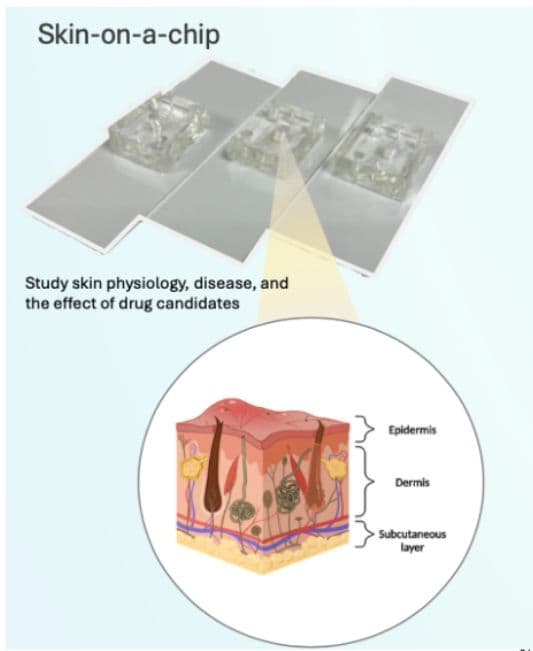
Development and Testing of Skin-on-a-Chip Device for Pharmaceutical and Cosmeceutical Applications

Development and Testing of Skin-on-a-Chip Device for Pharmaceutical and Cosmeceutical Applications

Abstract

This research aims to develop and test a Skin-on-a-Chip (SoC) device that integrates skin cells and endothelial cells within a microfluidic system to closely simulate the biological environment of human skin. The device reduces reliance on animal testing while lowering research costs and time, and improves the accuracy of pharmaceutical and cosmeceutical ingredient testing. The project targets TRL 5 prototype development alongside patent filing and pilot-scale manufacturing process development, with a clear pathway toward commercial readiness within two years.

Objective

อุตสาหกรรมเภสัชกรรมและเครื่องสำอางในปัจจุบันเผชิญกับความท้าทายด้านการพัฒนาผลิตภัณฑ์ที่ใช้เวลาและทรัพยากรสูง โดยข้อมูลจากการทดลองในสัตว์หรือการเพาะเลี้ยงเซลล์แบบสองมิติมักไม่สะท้อนการตอบสนองของร่างกายมนุษย์อย่างแท้จริง เทคโนโลยีอวัยวะบนชิป (Organ-on-a-Chip) จึงถูกพัฒนาขึ้นเพื่อจำลองสภาวะเนื้อเยื่อมนุษย์ในระดับไมโคร ช่วยลดการพึ่งพาการทดลองในสัตว์และเพิ่มความแม่นยำในการทดสอบ ประเทศไทยยังอยู่ในช่วงเริ่มต้นของการพัฒนาเทคโนโลยีนี้ โครงการจึงมีความสำคัญทั้งในมิติการพัฒนาองค์ความรู้ การสร้างนวัตกรรม และการเสริมสร้างความสามารถในการแข่งขันของอุตสาหกรรมการแพทย์และเครื่องสำอางของไทยอย่างยั่งยืน

Other Innovations

Development of alginate hydrogel/carrageenan/gellan gum based composited material and their application as oral delivery carriers.

คณะอุตสาหกรรมอาหาร

Development of alginate hydrogel/carrageenan/gellan gum based composited material and their application as oral delivery carriers.

This study aims to develop alginate-based hydrogels reinforced with carrageenan and gellan gum as composite materials for oral drug delivery. Alginate, a naturally derived polymer from brown algae, forms a gel upon exposure to cations such as calcium ions, enhancing the hydrogel’s structural integrity. Carrageenan and gellan gum, both polysaccharides, further improve stability and encapsulation efficiency. This research investigates the physical properties, mechanical strength, encapsulation capacity, and swelling behavior of hydrogel beads under simulated gastrointestinal conditions. The findings are expected to demonstrate that incorporating carrageenan and gellan gum enhances the durability and stability of hydrogel beads while enabling controlled release of active compounds in the gastrointestinal tract. These advanced hydrogel beads hold significant potential for applications in the food and pharmaceutical industries as effective oral delivery systems for bioactive substances.

Read more
Urban Farming Innovation Learning Center

คณะสถาปัตยกรรม ศิลปะและการออกแบบ

Urban Farming Innovation Learning Center

From the current situation and uncertainty; leads to the concept of food security. It is the application of innovation and technology to create high productivity in a limited area. The unused buildings in urban areas were renovated for planting, created as a learning area for planting in urban area. The different methods of growing plants were presented. There are 35 planting innovations for disseminating knowledge, to create food security, self-reliant, supports sustainable living.

Read more
CFD—Assisted Expert System for N2-Controlled Atmosphere Process of Rice Storage Silos

วิทยาลัยนวัตกรรมการผลิตขั้นสูง

CFD—Assisted Expert System for N2-Controlled Atmosphere Process of Rice Storage Silos

Since organic rice storage silos were faced with an insect problem, an owner solved this problem using the expert system (ES) in the controlled atmosphere process (CAP) under the required standard, fumigating insects with an N2, reducing O2 concentration to less than 2% for 21 days. This article presents the computational fluid dynamics (CFD) assisted ES successfully solved this problem. First, CFD was employed to determine the gas flow pattern, O2 concentration, proper operating conditions, and a correction factor (K) of silos. As expected, CFD results were consistent with the experimental results and theory, assuring the CFD’s credibility. Significantly, CFD results revealed that the ES controlled N2 distribution throughout the silos and effectively reduced O2 concentration to meet the requirement. Next, the ES was developed based on the inference engine assisted by CFD results and the sweep-through purging principle, and it was implemented in the CAP. Last, the experiments evaluated CAP’s efficacy in controlling O2 concentration and insect extermination in the actual silos. The experimental results and owner’s feedback confirmed the excellent efficacy of ES implementation; therefore, the CAP is effective and practical. The novel aspect of this research is a CFD methodology to create the inference engine and the ES.

Read more