

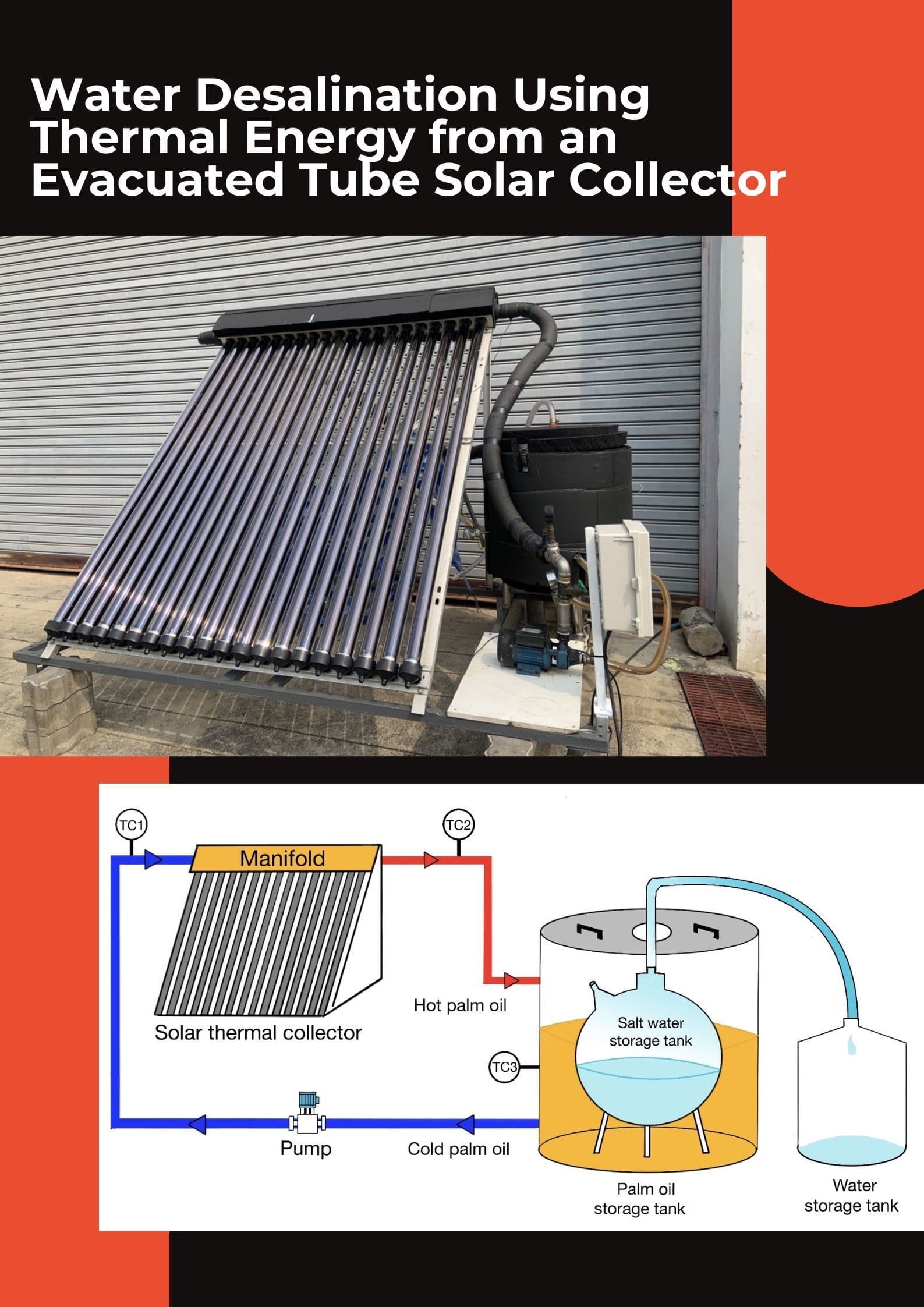
Freshwater scarcity is a global crisis due to limited accessible freshwater resources and rising demand. Seawater desalination is a key solution but is energy-intensive and reliant on fossil fuels, leading to high costs and environmental impacts. This study aims to investigate the use of solar thermal energy from an evacuated tube collector for freshwater production via evaporation and condensation. The focus is on analyzing system efficiency by comparing freshwater yield with energy input. The findings may contribute to the development of sustainable desalination technologies suitable for freshwater-scarce regions.
ปัจจุบันโลกปกคลุมด้วยน้ำถึง 70% ของพื้นที่ทั้งหมด แต่มีทรัพยากรน้ำที่เป็นน้ำจืด (fresh water) ที่สามารถใช้อุปโภค บริโภคได้เพียง 3% ประกอบกับจำนวนประชากรที่เพิ่มสูงขึ้นอย่างต่อเนื่อง จึงเกิดวิกฤตการขาดแคลนน้ำ การแยกเกลือออกจากน้ำทะเลเป็นแนวทางสำคัญในการแก้ไขปัญหานี้ โดยงานวิจัยของเรามุ่งพัฒนาเทคโนโลยีแยกเกลือออกจากน้ำทะเลโดยใช้พลังงานแสงอาทิตย์ ผ่านระบบท่อสุญญากาศ (ETSC) เพื่อลดต้นทุน พึ่งพาพลังงานสะอาด และเพิ่มประสิทธิภาพการผลิตน้ำจืด โดยเฉพาะในพื้นที่แห้งแล้งที่ขาดแคลนน้ำ

คณะวิทยาศาสตร์
Air pollution, particularly PM2.5, is a major environmental and public health concern in Bangkok. Instead of predicting PM2.5 levels, this project aims to identify the most significant factors influencing PM2.5 concentration. By analyzing historical air quality, weather, and other environmental data, we will determine which variables—such as temperature, humidity, wind speed, or other pollutants—have the greatest impact on PM2.5 fluctuations.
คณะอุตสาหกรรมอาหาร
The consumption of plant-based products has been gaining popularity as consumers become more health-conscious and aware of environmental impacts. The food industry has been developing meat analogs with properties similar to conventional meat. This study investigates the chemical and physical properties of chickpea-based meat analog burgers and hybrid burgers containing both chickpeas and pork, using the sous-vide cooking method. This technique helps maintain food quality in terms of texture, moisture retention, and nutritional value. The experiment examined various properties of both types of burgers, including cooking loss, water holding capacity, shear force, pH value, and color analysis. Additionally, sensory evaluation was conducted to assess taste, texture, and overall consumer preference. The findings will provide insights into the optimal sous-vide conditions for producing plant-based and hybrid burgers with desirable quality characteristics that meet the needs of health-conscious consumers. This study serves as a valuable guideline for the food industry in developing high-nutritional-value alternative protein products while reducing meat consumption. By incorporating plant-based ingredients, it helps minimize environmental impact and promotes sustainability in food production. The research is significant in both food science and the development of healthier, competitive food products for the future market.
คณะวิทยาศาสตร์
Metallic nanoparticles embedded in cellulose nanocrystal (MNPs/CNC) films were prepared by solution casting for antimicrobial and fungus in edible peel fruit. MNPs/CNC was synthesized by ultrasonic waves. The as-synthesized was characterized by the chemical characteristics by the transmission electron microscope (TEM), X-ray photoelectron spectroscopy (XPS), X-ray diffraction analysis (XRD), Fourier transform infrared spectrometer (FT-IR), zeta potential analyzer, and UV-visible spectrophotometer. MNPs/CNC films had high potential in antimicrobial and fungus. Therefore, MNPs/CNC can be used to wrap edible peeled fruit to inhibit the growth of microorganisms, which can effectively extend the shelf life of fruits.