


Study on Parasites in Blackchin Tilapia and Value-Added Processing Parasites play a crucial role in affecting fish health and the balance of marine ecosystems. The study of parasites in fish is essential for assessing fish population status and their impact on the ecosystem. This research focuses on a preliminary survey of parasites in Blackchin Tilapia (Sarotherodon melanotheron) found in the waters of Chumphon Province to determine whether this species carries parasitic infections. The findings will provide valuable insights for managing marine resources and developing strategies for processing Blackchin Tilapia into food products to help control its population in the ecosystem. One of the value-added processing approaches for Blackchin Tilapia is the "Nai Hoi Hua Fu" product. This product involves deep-frying the fish to achieve a crispy and fluffy texture before mixing it with mango salad to enhance its flavor and make it more appealing. This processing method not only adds value to the fish but also serves as a practical solution for managing the Blackchin Tilapia population, which may impact the ecosystem. The study results indicate that no parasitic infections were found in either the internal or external organs of the sampled fish, suggesting that the marine environment in the study area is favorable for fish health. However, continuous research is recommended to monitor long-term ecological changes and evaluate the impact of Blackchin Tilapia on ecosystem balance to ensure sustainable resource management.
มีการแพร่ระบาดปลาหมอคางดำ ในพื้นที่จังหวัดชุมพร โดยเฉพาะปากแม่น้ำ ดังนั้น จึงมีความสนใจว่าปลาชนิดนี้แพร่กระจายลงสู่ทะเลหรือไม จึงสำรวจพร้มอศึกาาาการติดเชื้อปรสิต เนื่องจากอยากทราบว่าทำไมถึงแพร่กระจายในระบบนิเวศเร็วมาก และสามารถนำมารับประทานได้หรือไม่

คณะวิทยาศาสตร์
Eco Grow Pellets are high-porosity plant-growing clay pellets made from ceramic industrial sediment, blended with ground chicken bone to enhance calcium and essential minerals, promoting strong and healthy plant growth. They are suitable for all types of plants, especially those requiring well-aerated soil with good water drainage. Eco Grow Pellets are an innovative clay-based growing medium designed to optimize plant cultivation efficiency. Their high porosity structure allows for excellent air and water circulation, reducing soil compaction and waterlogging—common causes of root rot and stunted growth. Additionally, the pellets are enriched with calcium and essential minerals from ground chicken bones, reinforcing plant structure and enhancing root strength, enabling better nutrient absorption. This product is made from 100% recycled ceramic industrial sediment, aligning with the principles of Zero Waste and the BCG Economy Model. It helps minimize industrial waste while transforming discarded materials into high-value, eco-friendly growing media. Eco Grow Pellets are ideal for vegetables, flowers, and potted plants, offering ease of use, cleanliness, and safety. They contribute to sustainable agriculture by improving both crop productivity and environmental health.

คณะวิศวกรรมศาสตร์
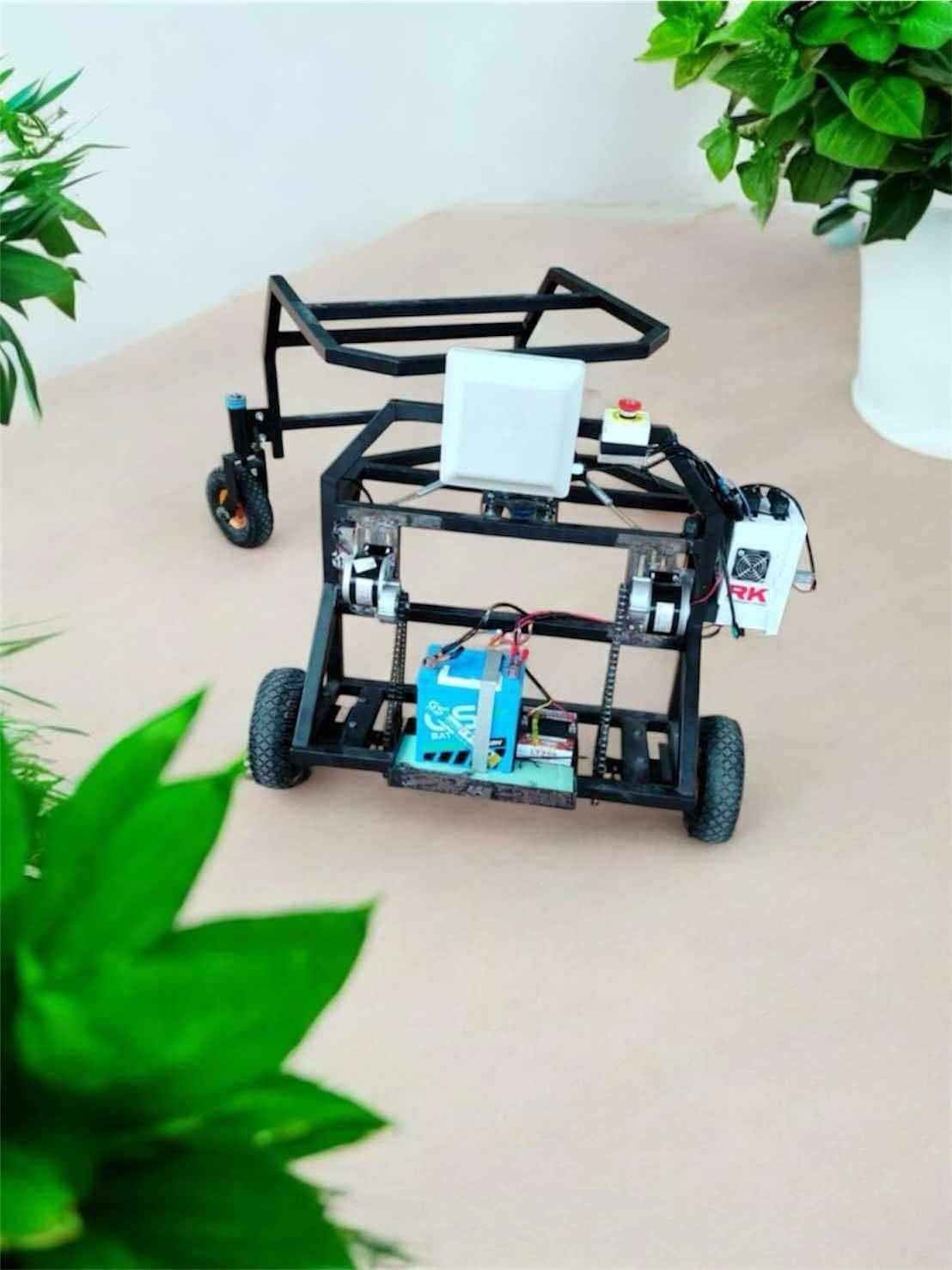
ยานยนต์ไฟฟ้าดัดแปลง
วิทยาเขตชุมพรเขตรอุดมศักดิ์
This project aims to design and develop a propulsion system for agricultural equipment using RFID technology and evaluate its movement performance on different surfaces, including concrete and grass. The experiment focuses on examining the tag detection range under transmission power levels of 20 dBm, 23 dBm, and 26 dBm, as well as the impact of antenna angles on detection efficiency. Additionally, the system was tested in three movement scenarios: straight path, left turn, and right turn, at distances of 2 meters, 4 meters, and 6 meters. The results indicate that the system achieved the highest average speed of 0.4736 m/s and an average turning angle of 91.6° when moving in a straight path on a concrete surface at a distance of 4 meters. On a grass surface at the same distance, the average speed was 0.4483 m/s, with an average turning angle of 91.1°. For left and right turns, the movement on the concrete surface generally exhibited a higher average speed than on grass, particularly at a distance of 4 meters, where differences in turning angles were observed. This study provides insights into the factors affecting the movement of agricultural mowing equipment and serves as a foundation for enhancing the efficiency of propulsion systems in future developments.