

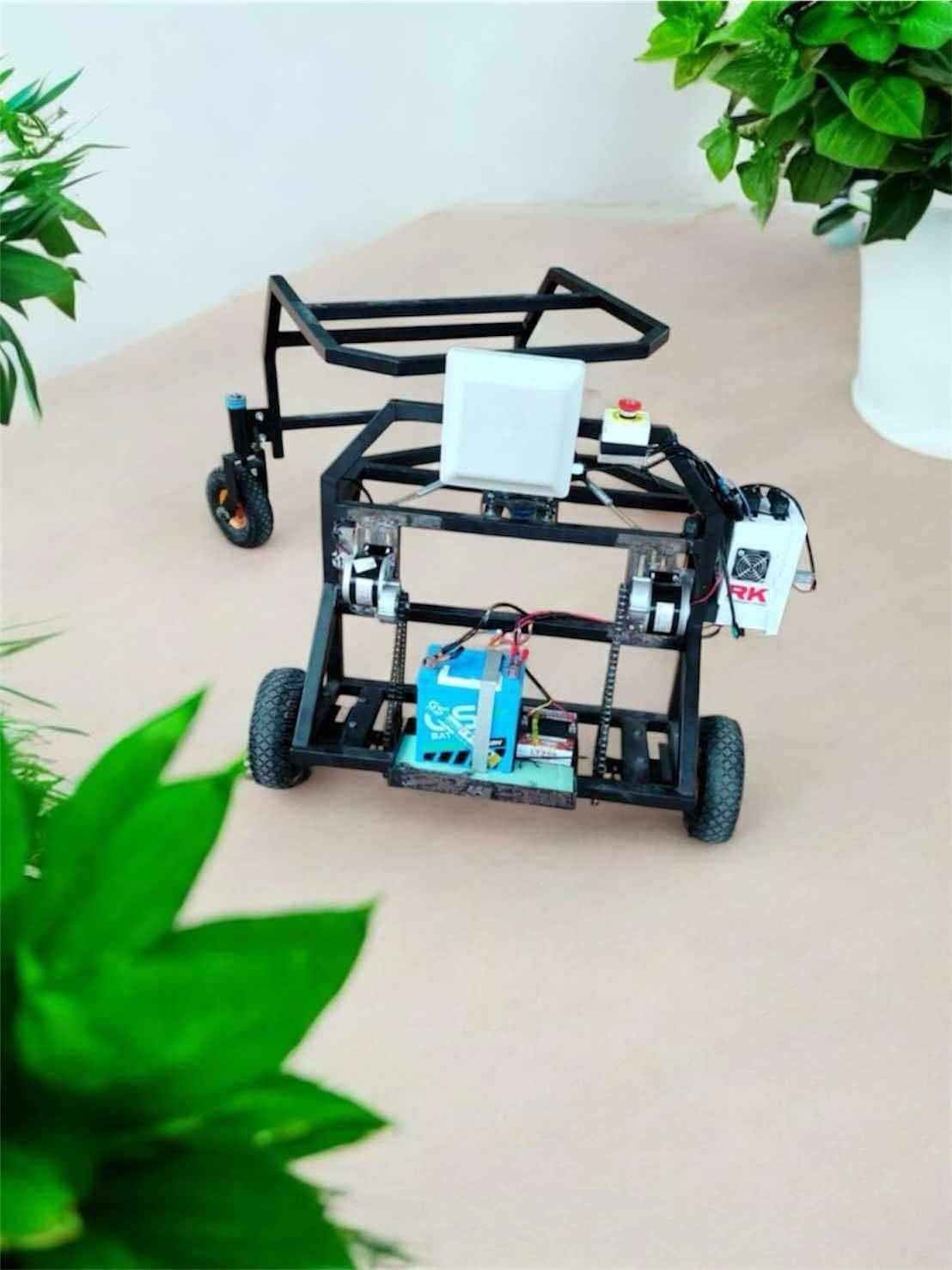
This project aims to design and develop a propulsion system for agricultural equipment using RFID technology and evaluate its movement performance on different surfaces, including concrete and grass. The experiment focuses on examining the tag detection range under transmission power levels of 20 dBm, 23 dBm, and 26 dBm, as well as the impact of antenna angles on detection efficiency. Additionally, the system was tested in three movement scenarios: straight path, left turn, and right turn, at distances of 2 meters, 4 meters, and 6 meters. The results indicate that the system achieved the highest average speed of 0.4736 m/s and an average turning angle of 91.6° when moving in a straight path on a concrete surface at a distance of 4 meters. On a grass surface at the same distance, the average speed was 0.4483 m/s, with an average turning angle of 91.1°. For left and right turns, the movement on the concrete surface generally exhibited a higher average speed than on grass, particularly at a distance of 4 meters, where differences in turning angles were observed. This study provides insights into the factors affecting the movement of agricultural mowing equipment and serves as a foundation for enhancing the efficiency of propulsion systems in future developments.
ปัจจุบัน เทคโนโลยี RFID (Radio Frequency Identification) ได้รับการใช้งานอย่างแพร่หลายในหลากหลายอุตสาหกรรมและแอปพลิเคชันที่เติบโตอย่างรวดเร็ว เทคโนโลยีนี้ใช้คลื่นวิทยุในการระบุวัตถุที่ติดแท็กโดยไม่จำเป็นต้องมองเห็นหรือสัมผัสโดยตรง ทำให้การติดตามและระบุตำแหน่งมีความแม่นยำ คุ้มค่าทางเศรษฐกิจ และสามารถทำงานได้อย่างมีประสิทธิภาพในสภาพแวดล้อมที่หลากหลาย เช่น ภาคอุตสาหกรรมและการเกษตร ในภาคการเกษตร การใช้ RFID มีข้อดีหลายประการ เช่น ความสามารถในการทำงานกลางแจ้งโดยไม่ต้องพึ่งพาเซ็นเซอร์ราคาแพงหรือระบบสะท้อนสัญญาณที่ซับซ้อน ซึ่งช่วยลดต้นทุนและเพิ่มความแม่นยำในการควบคุมอุปกรณ์ทางการเกษตร งานวิจัยนี้มุ่งเน้น การออกแบบและพัฒนาระบบขับเคลื่อนต่อพ่วงอุปกรณ์ทางการเกษตรโดยใช้เทคโนโลยี RFID เพื่อศึกษาการเคลื่อนที่ของระบบบนพื้นผิวที่แตกต่างกัน ได้แก่ พื้นปูนคอนกรีตและสนามหญ้า โดยมีการติดตั้งแท็ก RFID บนเสาของแต่ละแถวเพื่อช่วยระบุตำแหน่งและทิศทางการเคลื่อนที่ของระบบ ผลการศึกษานี้จะช่วยให้เข้าใจข้อดีและข้อจำกัดของการใช้ RFID ในภาคการเกษตร ซึ่งสามารถนำไปต่อยอดเพื่อพัฒนาเทคโนโลยีการเกษตรให้มีประสิทธิภาพและลดต้นทุนในอนาคต

คณะเทคโนโลยีสารสนเทศ
Nowadays, assembling a computer is considered something close to many people. Everyone has a chance to catch it. which knowledge of various components of computers and skills in assembling computers. These 2 things mentioned above are things that the general public should have basic knowledge and understanding about. For the self-assembly of computers, We therefore would like to provide knowledge to the general public who wants to learn how to assemble a computer, including information about its components. Through presentation in the form of learning media using VR technology, which will help reduce the problem of errors. and resources used in assembly Ready to create excitement for users by simulating computer assembly for users to interact within the virtual world. experience and provide knowledge before actually putting it into practice with real equipment This project was therefore created for those interested in assembling computers. Especially for people who have no experience in computer assembly. Including people who would like to have the opportunity to try building a computer by themselves.
คณะครุศาสตร์อุตสาหกรรมและเทคโนโลยี
The Department of Engineering Education at KMITL offers courses in power electronics laboratory practices, which require the use of expensive imported training kits. This results in a loss of national revenue due to the purchase of these imported kits. Therefore, the developers propose a power electronics training kit that offers equivalent or superior functionality to the imported ones while being more cost-effective, making it suitable for student experiments.
คณะวิศวกรรมศาสตร์
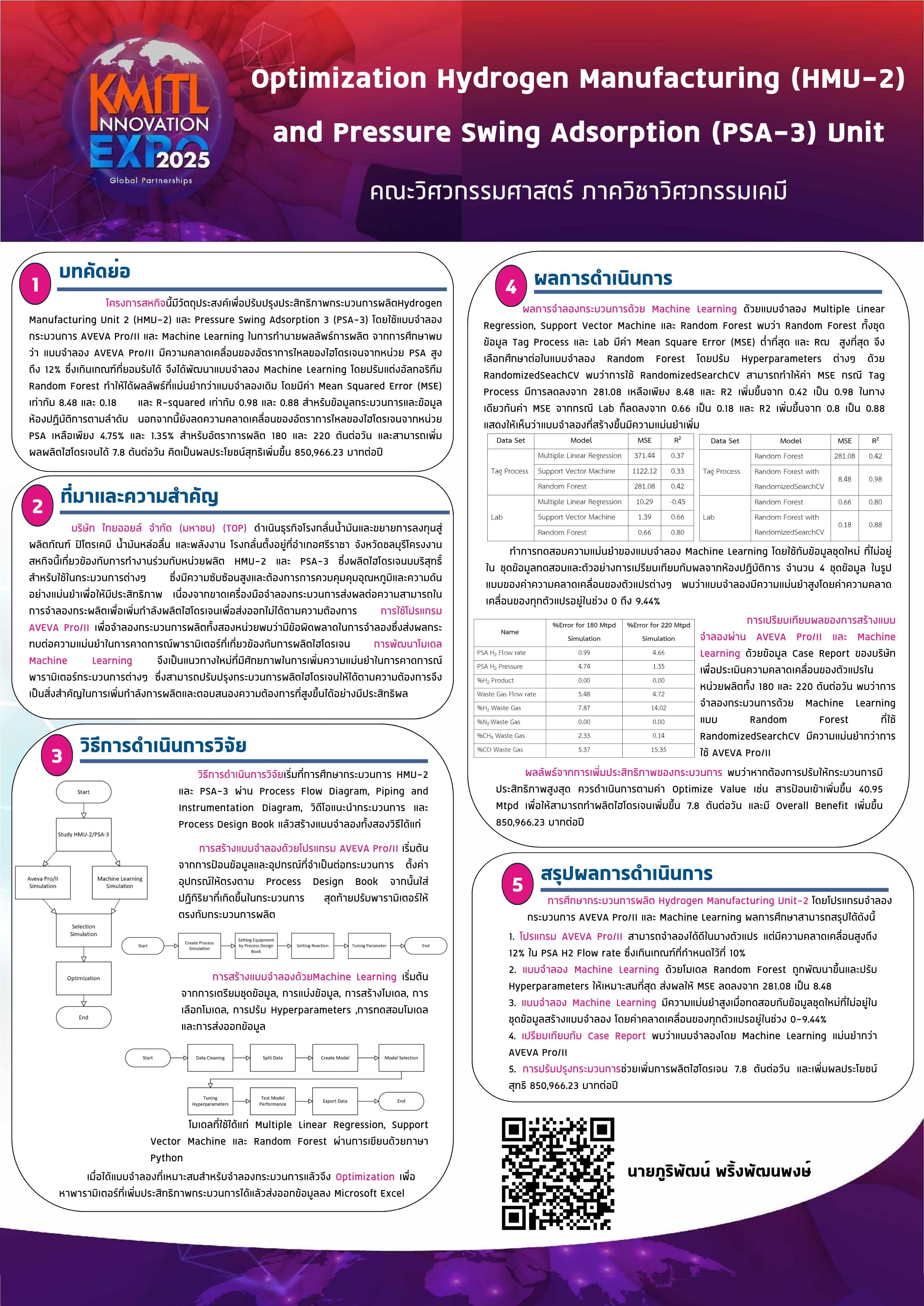
This cooperative education project aims to enhance the efficiency of Hydrogen Manufacturing Unit 2 (HMU-2) and Pressure Swing Adsorption 3 (PSA-3) by using AVEVA Pro/II process modeling and a Machine Learning model for process simulation. The study found that the AVEVA Pro/II model predicted outcomes with deviations ranging from 0–35%, including a hydrogen flow rate deviation from the PSA unit of 12%, exceeding the company’s acceptable limit of 10%. To address this, a Machine Learning model based on the Random Forest algorithm was developed with hyperparameter tuning. The Machine Learning model demonstrated high accuracy, achieving Mean Squared Errors (MSE) of 8.48 and 0.18 for process and laboratory data, respectively, and R-squared values of 0.98 and 0.88 for the same datasets. It outperformed the AVEVA Pro/II model in predicting all variables and reduced the hydrogen flow rate deviation to 4.75% and 1.35% for production rates of 180 and 220 tons per day, respectively. Optimization using the model provided recommendations for process adjustments, increasing hydrogen production by 7.8 tons per day and generating an additional annual profit of 850,966.23 Baht.