Here, We Luckier in Love Everyday". Introducing you a Lakshmi 2025 Edition. Amidst the buzz of the mall, take charge of your love destiny—because fate is so last season.
พระแม่ลักษมี เทพีเเห่งความเจริญรุ่งเรืองในศาสนาฮินดู โดยนอกจากจะเป็นเทพีเเห่งความรุ่งเรืองแล้ว ในไทยยังนับถือพระแม่ในฐานะเทพเจ้าเเห่งความรักจนเกิดปรากฏการรณ์ I Told พระแม่ หรือ I Told Lakshmi จากเหตุผลดังกล่าว จึงนำมาสู่การประยุกษ์ใช้ลักษณะดังกล่าวมาออกแบบ และผลิตเป็นเครื่องทำนายโชคชะตาเพื่อเสริมสร้างความพึงพอใจของลูกค้า รวมไปถึงการสร้างพฤติกรรมผู้บริโภคของลุกค้า
คณะวิทยาศาสตร์
This research aims to select the location of the beverage distribution center of Thai Spirit Industry Co., Ltd. with the lowest total cost of transportation. using a mathematical model by considering the Muang districts of all 76 provinces, excluding Chachoengsao Province, where the factory is located. In the present study, four scenarios were divided: 1) when only one distribution center was required; 2) when more than one distribution center was established; 3) when it was divided into 4 regions. There can only be one distribution center in one region, and 4) when it is divided into four regions, where more than one distribution center can be established in one region. When processed with the program IBM ILOG CPLEX Optimization Studio, the results are summarized as follows: Scenario 1, when only one distribution center is assigned. The total transportation cost is 786,107.75 baht/month. Scenario 2, when more than one distribution center can be established. The total transportation cost is 252,338.98 baht/month. Scenario 3, when divided into 4 regions by requiring only one distribution center in one region. The total transportation cost is 401,499.61 baht/month. Scenario 4, when divided into 4 regions by requiring that there is more than one distribution center in each region. The total transportation cost is 258,666.22 baht/month.

คณะวิศวกรรมศาสตร์
SecurionSphere is the penetration testing learning platform that focuses on web application exploitation. This platform is intended to address concerns seen in existing penetration testing platforms, such as resource sharing that may affect other users and the constant environment configuration the permits the same response leading to copy the answer from others. Supervisors can use templates to address various forms of web application vulnerability threats. Users can generate the instance of supervisor's templates machine. The platform also randomly generates the environment configuration for each machine has the difference environment and the answer. This allows the users get more realistic learning experiences without affecting the resources of others.
คณะเทคโนโลยีการเกษตร
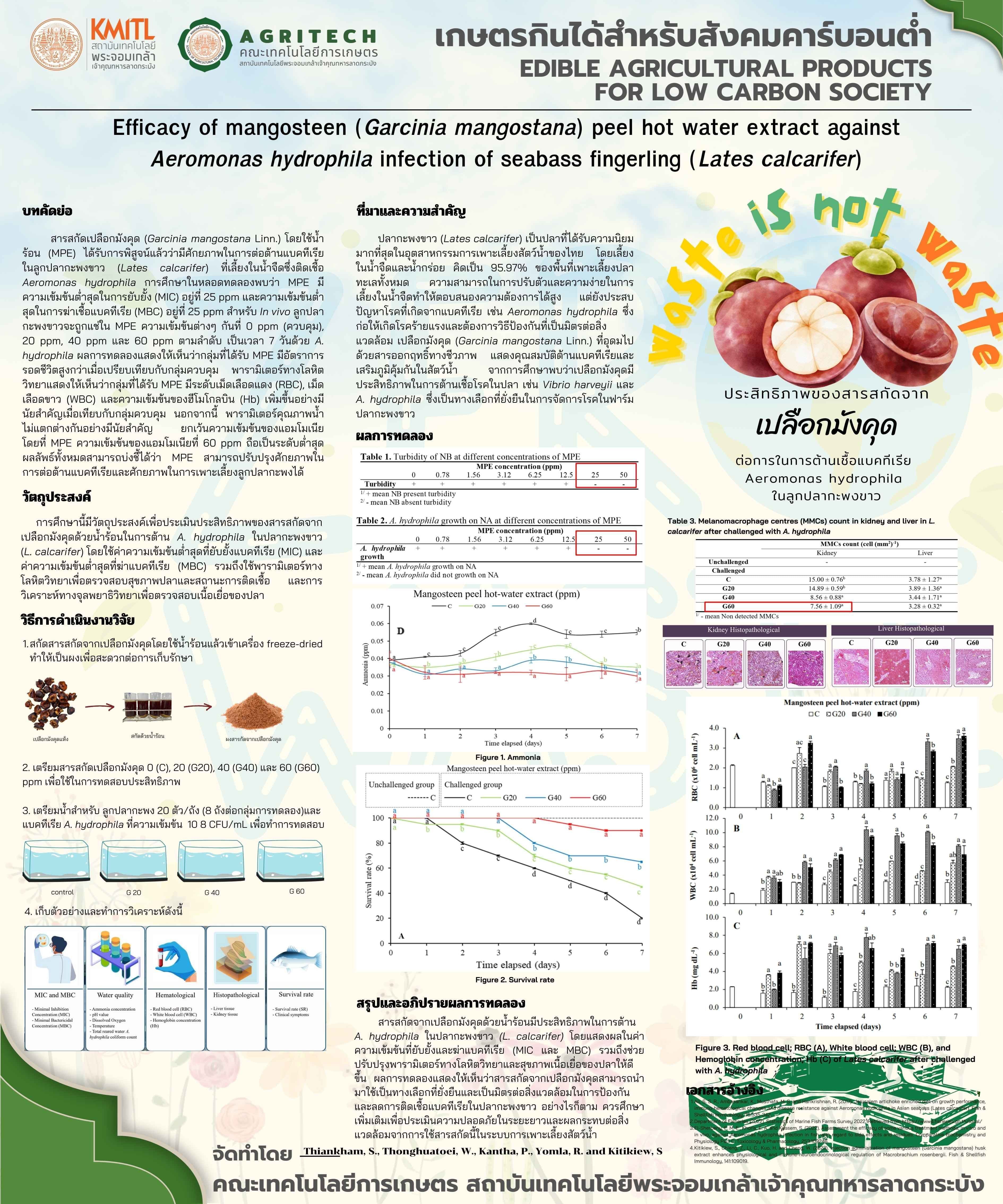
Mangosteen peel (Garcinia mangostana Linn.) extract using hot water (MPE) has been shown to have antibacterial potential in freshwater sea bass (Lates calcarifer) larvae infected with Aeromonas hydrophila. In vitro studies showed that MPE has a minimum inhibitory concentration (MIC) of 25 ppm and a minimum bactericidal concentration (MBC) of 25 ppm. In vivo, sea bass larvae were immersed in various concentrations of MPE at 0 ppm (control), 20 ppm, 40 ppm and 60 ppm, respectively, for 7 days with A. hydrophila. The results showed that the MPE-treated group had a higher survival rate compared to the control group. Hematological parameters showed that the MPE-treated group had significantly increased red blood cell (RBC), white blood cell (WBC) and hemoglobin (Hb) concentrations compared to the control group. In addition, the water quality parameters were not significantly different, except for ammonia concentration, with MPE having an ammonia concentration of 60 ppm being the lowest. All results can indicate that MPE can improve the antibacterial potential and the culture potential of sea bass larvae.