

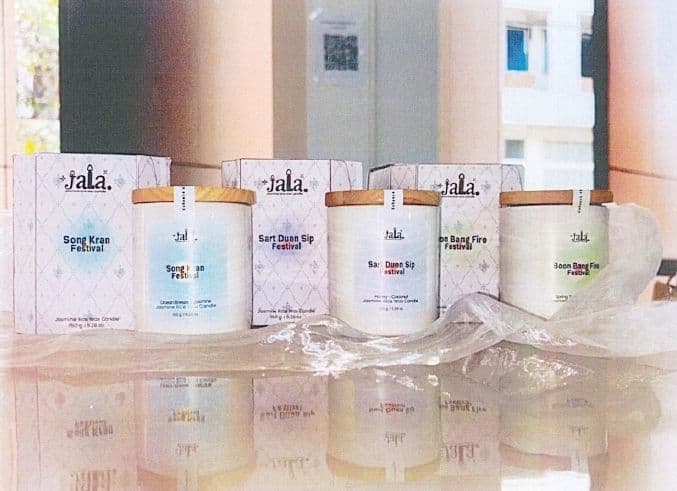
JALA is a brand that established a business around jasmine rice wax scented candles with the aim of addressing the stress people face in everyday life. The brand utilizes "Aromatherapy" to help relax the mind and alleviate stress. The scented candles made from jasmine rice wax are an innovative product, distinguished by their clean burn, safety for users and the environment, and high vitamin E content that nourishes the skin. They also retain a unique fragrance that provides true relaxation. JALA aims to offer products that blend traditional Thai elements with modern design, making their scented candles not only therapeutic but also a reflection of Thai culture and modern identity. The brand caters to health-conscious and environmentally aware consumers.
ผู้คนในยุคปัจจุบันเจอกับสภาวะที่กดดันจากการเรียน การทํางาน ซึ่งทําให้เกิดการเหนื่อยล้าในแต่ละวัน จนเกิดเป็นความเครียดสะสม ทางแบรนด์ได้เล็งเห็นถึงปัญหานี้ จึงหยิบยกการบําบัดความเครียดด้วยกลิ่น ซึ่งเป็นศาสตร์ของ “สุคนธบําบัด” หรือที่รู้จักกันอย่างแพร่หลายในชื่อ อโรมาเธอราพี (Aromatherapy) ซึ่งเป็นการบําบัดจากความรู้สึกของการรับกลิ่น การได้รับกลิ่นที่ผ่อนคลายสามารถเยียวยาทางจิตใจ และปรับปรุงอารมณ์ให้ดียิ่งขึ้นอีกทั้งทางแบรนด์ได้ใช้ผลิตภัณฑ์ที่เป็นธรรมชาติ โดยเทียนหอมที่วางจำหน่ายทั่วไปมักทำจากพาราฟิน ซึ่งมีสารเคมีอันตราย และเทียนหอมที่มีราคาอยู่ในระดับกลางถึงสูงมักนิยมใช้ไขถั่วเหลืองที่เป็นสินค้านำเข้าจากต่างประเทศ ทั้งนี้ทั้งนั้นเพื่อสร้างความแตกต่างจากสินค้าประเภทเดียวกันในตลาด ทางแบรนด์จึงเลือกใช้ไขข้าวหอมมะลิ ซึ่งเป็นวัตถุดิบที่ไม่เพียงแต่หาได้จากธรรมชาติ แต่ยังเป็นนวัตกรรมจากฝีมือคนไทย วัตถุดิบนี้นอกจากจะช่วยลดการพึ่งพาวัตถุดิบนำเข้าแล้วยังเป็นการยกระดับคุณค่าและเอกลักษณ์ของสินค้า นอกจากการเลือกใช้วัตถุดิบที่มีคุณภาพแล้ว ทางแบรนด์ยังมุ่งเน้นการเพิ่มมูลค่าสินค้าด้วยการนำเสนอความเป็นไทยในรูปแบบใหม่ที่ทันสมัยและเข้าถึงได้ง่ายในสไตล์ "ไทยโมเดิร์น" ให้ความสำคัญกับการออกแบบที่มีความสวยงามและแฝงไปด้วยความเป็นไทยอย่างมีสไตล์

คณะสถาปัตยกรรม ศิลปะและการออกแบบ
-
คณะทันตแพทยศาสตร์
Objective or Background: Dental caries is still one of the most significant dental problems worldwide, with prevalence rates up to 90% among children and adults. Cariogenic bacteria, especially Streptococcus mutans, is the primary microorganism involved in the pathogenesis through carbohydrate metabolism and biofilm formation, which are challenging to eradicate. Histatin-5 (HST-5), a human salivary antimicrobial peptide, has demonstrated antimicrobial activity against various fungal and bacterial pathogens. Phytosphingosine (PHS), an endogenous bioactive sphingolipid found in fungi, plants, and humans, also shows antimicrobial properties. This study aimed to evaluate the killing activity of HST-5 alone and in combination with PHS against S. mutans under biofilm-stimulating conditions. Materials and Methods: Antimicrobial activity against a planktonic culture of S. mutans was evaluated using a time-kill assay, and biofilm-forming capacity was confirmed by crystal violet staining assay. The killing ability against 24h pre-formed biofilm was determined using Transferable Solid Phase (TSP) pin lid model. Synergistic activity between HST-5 and PHS was evaluated using the checkerboard technique. Additionally, the cytotoxicity of the tested agent on human gingival fibroblast cells (hGFs) was assessed after 1 h of incubation using an MTT assay. Results: A time-kill assay revealed that both HST-5 and PHS exhibit time- and concentration-dependent activity against the planktonic form of S. mutans. PHS achieved over 90% killing activity within 15 min at 5 μg/ml, whereas HST-5 required 30 min to reach 90% killing at 20 μM. The biofilm formation capacity of S. mutans was confirmed. The inhibitory concentrations (IC50) of HST-5 and PHS against S. mutans biofilm were 25 μM and 13.5 μg/ml, respectively. A synergistic interaction between HST-5 and PHS, with IC50 values reduced by 8-fold and 16-fold, respectively. No cytotoxic effects were observed in hGFs cells at the concentration of the synergistic interaction. Conclusions: Therefore, the combination of HST-5 and PHS may enhance the effectiveness of anti-infective agents against S. mutans biofilm, potentially preventing the development of dental caries.
คณะอุตสาหกรรมอาหาร
This study aims to investigate the co-encapsulation technique of vitamin C and coenzyme Q10 within liposomes to enhance their stability and encapsulation efficiency and evaluate their antioxidant activity and release behavior under simulated gastrointestinal conditions. Liposomes were prepared using the High-Speed Homogenization Method, and their characteristics, including particle size, zeta potential, encapsulation efficiency, and antioxidant activity, were analyzed using DPPH, ABTS, and FRAP assays. The results demonstrated that co-encapsulation significantly improved the stability of vitamin C and coenzyme Q10 compared to single encapsulation. The liposomes exhibited high encapsulation efficiency and maintained strong antioxidant activity. The release profile under simulated gastrointestinal conditions also indicated a sustained and controlled release. These findings highlight the potential of the co-encapsulation technique in enhancing the efficacy of functional bioactive compounds, making it applicable to the food and nutraceutical industries.