

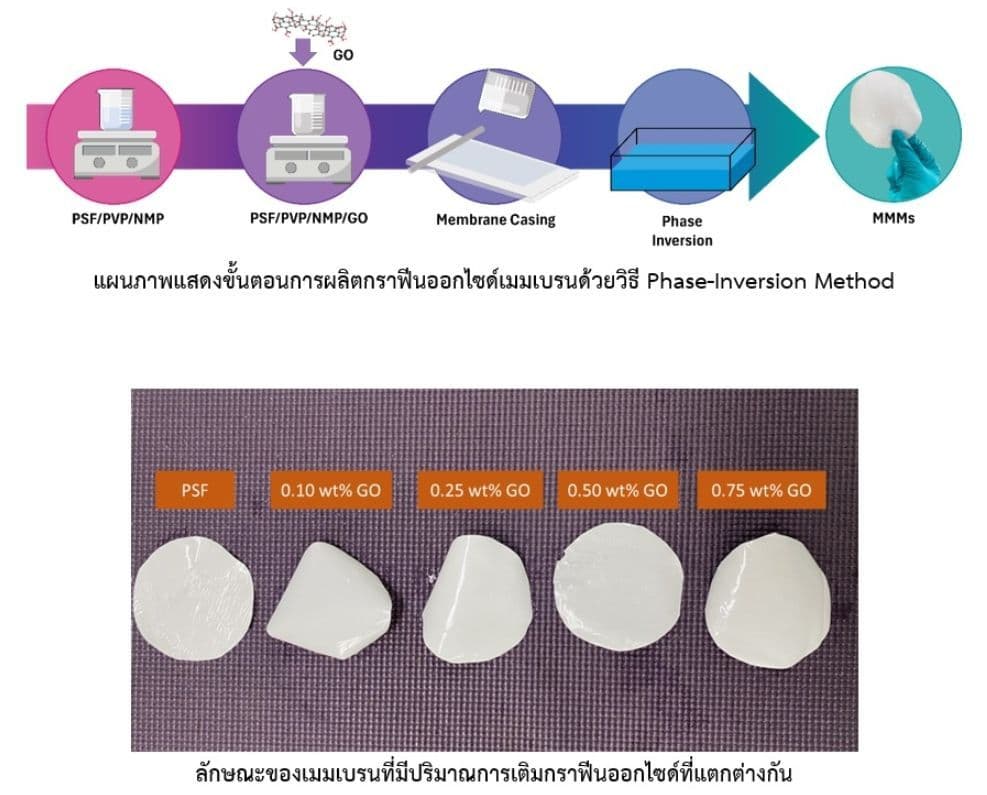
This research focuses on the fabrication of graphene oxide (GO) composite membranes using the Phase-Inversion Method, which transforms polymers from liquid to solid through phase separation. This process creates a porous membrane structure, making it highly adaptable, cost-effective, and suitable for wastewater treatment, separation processes, and industrial filtration applications. Graphene oxide, with its nano-layered structure, offers excellent molecular sieving properties, high water permeability, and chemical and mechanical stability, making it an ideal additive for membrane fabrication. The GO-based membrane demonstrates efficient removal of nanoparticles, heavy metal ions (Pb²⁺, Cr⁶⁺, Hg²⁺), organic pollutants, and microorganisms while exhibiting antifouling properties and high hydrophilicity due to oxygen-functional groups. Applications of this membrane include industrial wastewater treatment, desalination, and the removal of pharmaceutical contaminants, such as antibiotics and hormones. The incorporation of GO enhances membrane performance, providing a sustainable and energy-efficient solution for water purification.
ปัญหามลพิษทางน้ำจากโลหะหนัก สารอินทรีย์ และจุลินทรีย์ในน้ำเสียอุตสาหกรรมและน้ำธรรมชาติกำลังเป็นปัญหาระดับโลก เทคโนโลยีเมมเบรน ได้รับความสนใจเนื่องจากมีประสิทธิภาพสูงในการกรองและบำบัดน้ำ กราฟีนออกไซด์ (GO) เป็นวัสดุที่มีโครงสร้างระดับนาโนและคุณสมบัติพิเศษ เช่น การซึมผ่านน้ำสูง ความทนทานทางเคมี และการคัดแยกสารปนเปื้อนอย่างมีประสิทธิภาพ ดังนั้น การพัฒนาเมมเบรนกราฟีนออกไซด์ผ่านกระบวนการ Phase-Inversion Method จึงเป็นแนวทางสำคัญในการสร้าง เมมเบรนคุณภาพสูง ราคาประหยัด และเหมาะสำหรับการใช้งานด้านสิ่งแวดล้อม

คณะบริหารธุรกิจ
The goal of the processed pineapple study is to reduce the number of pineapples wasted as a result of climate change and to determine the best way for processing different pineapple species. The drying method, also known as dehydration, is chosen for processing because it is appropriate for the variety's features and will provide the maximum benefit while reducing waste, resulting in the most value for the product. This study was carried out to develop the processing of new kinds, use various processing principles to adapt to this pineapple variety, raise the value of agricultural goods, significantly reduce waste, and provide marketing potential in the future.
คณะวิทยาศาสตร์
Cancer remains a major global health challenge as the second-leading cause of human death worldwide. The traditional treatments for cancer beyond surgical resection include radiation and chemotherapy; however, these therapies can cause serious adverse side effects due to their high killing potency but low tumor selectivity. The FDA approved monoclonal antibodies (mAbs) that target TIGIT/PVR (T-cell immunoglobulin and ITIM domain/poliovirus receptor) which is an emerging immune checkpoint molecules has been developed; however, the clinical translation of immune checkpoint inhibitors based on antibodies is hampered due to immunogenicity, immunological-related side effects, and high costs, even though these mAbs show promising therapeutic efficacy in clinical trials. To overcome these bottlenecks, small-molecule inhibitors may offer advantages such as better oral bioavailability and tumor penetration compared to mAbs due to their smaller size. Here, we performed structure-based virtual screening of FDA-approved drug repertoires. The 100 screened candidates were further narrowed down to 10 compounds using molecular docking, with binding affinities ranging from -9.152 to -7.643 kcal/mol. These compounds were subsequently evaluated for their pharmacokinetic properties using ADMET (Absorption, Distribution, Metabolism, Excretion, and Toxicity) analysis, which demonstrated favorable drug-like characteristics. The lead compounds will be further analyzed for conformational changes and binding stability against TIGIT through molecular dynamics (MD) simulations to ensure that no significant conformational changes occur in the protein structure. Collectively, this study represents the potential of computational methods and drug repurposing as effective strategies for drug discovery, facilitating the accelerated development of novel cancer treatments.
วิทยาลัยนวัตกรรมการผลิตขั้นสูง
Smart Agriculture has rapidly developed in recent years, particularly with the integration of robotics and automation technologies to improve production efficiency and reduce costs, thereby enhancing the quality of current agricultural practices. A key innovation in this area is the rail-based robotic arm, designed to enhance work efficiency using a rail system with high precision and effectiveness. The application of this robotic arm covers various processes, such as planting, sorting, maintenance, harvesting, and resource management, allowing continuous operation and reducing human labor in repetitive and high-risk tasks. Studies have shown that the use of rail-based robotic arms in agriculture can significantly improve work efficiency, reduce production costs, and effectively mitigate environmental impact. By using robots in agricultural processes, it is possible to reduce contamination, lower the risk of crop damage, and make agriculture more sustainable. Additionally, it can increase accuracy in operations on limited spaces or farms with diverse crops. From these findings, it can be concluded that adopting rail-based robotic arm technology in agriculture not only enhances long-term production efficiency but also promotes sustainable agriculture and maximizes resource use, meeting future agricultural demands