

Smart Agriculture has rapidly developed in recent years, particularly with the integration of robotics and automation technologies to improve production efficiency and reduce costs, thereby enhancing the quality of current agricultural practices. A key innovation in this area is the rail-based robotic arm, designed to enhance work efficiency using a rail system with high precision and effectiveness. The application of this robotic arm covers various processes, such as planting, sorting, maintenance, harvesting, and resource management, allowing continuous operation and reducing human labor in repetitive and high-risk tasks. Studies have shown that the use of rail-based robotic arms in agriculture can significantly improve work efficiency, reduce production costs, and effectively mitigate environmental impact. By using robots in agricultural processes, it is possible to reduce contamination, lower the risk of crop damage, and make agriculture more sustainable. Additionally, it can increase accuracy in operations on limited spaces or farms with diverse crops. From these findings, it can be concluded that adopting rail-based robotic arm technology in agriculture not only enhances long-term production efficiency but also promotes sustainable agriculture and maximizes resource use, meeting future agricultural demands
ประเทศไทยเป็นประเทศเกษตรกรรม การที่จะนำเทคโนโลยีเข้ามาช่วยพัฒนาระบบการเกษตรกรรม ให้มีความทันสมัย มีประสิทธิภาพ เพื่อช่วยยกระดับอุตสาหกรรมการเกษตรของไทยนั้น เป็นสิ่งที่มีความสำคัญมาก เราจึงได้พัฒนา “เเขนกลระบบรางเพื่อการเกษตรอัฉริยะ” โดยเทคโนโลยีนี้ช่วยลดการใช้แรงงานคน เพิ่มความแม่นยำในการทำงาน และสามารถทำงานได้ตลอดเวลาไม่หยุดพัก นอกจากนี้ยังช่วยลดต้นทุนการผลิตและเพิ่มผลผลิต ทำให้เกษตรกรสามารถแข่งขันในตลาดโลกได้ดียิ่งขึ้น และช่วยพัฒนาความยั่งยืนในภาคการเกษตรของประเทศไทย
คณะสถาปัตยกรรม ศิลปะและการออกแบบ
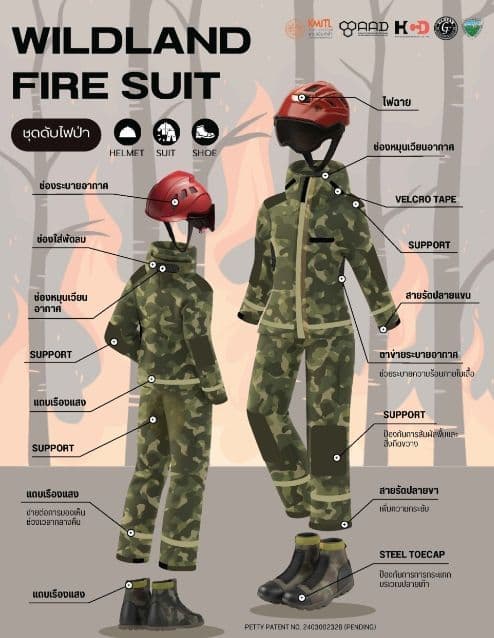
The forest firefighting suit consists of the following components and uses: The forest firefighting suit is designed and developed to be suitable for the behavior of the officers and the conditions of the work area, consisting of a shirt and pants. The material used in the sewing of the suit is aramid fabric, which has the property of being able to prevent the spread of fire, to prevent the officers from burning while performing their duties in the event that the forest fire spreads close to them, which is different from the current suits that cannot prevent fires. The shirt is designed with a mesh on the side of the body to release internal heat so that air can circulate well. The sleeves at the elbows have a support point to prevent contact with the ground or obstacles. The collar has a slot for a portable fan and a fan air circulation channel on the back, which can be turned on while performing forest firefighting duties, helping to prevent the body temperature from getting too hot, reducing the risk of heatstroke. When the fan battery runs out, it can be removed for charging and put back in when needed. The pants are designed with mesh on the inside or in blind spots to release internal heat so that air can circulate well. The pants at the knees have a support point to prevent contact with the ground or obstacles. The forest firefighting suit, consisting of a shirt and pants, has been designed and developed to be able to be produced domestically, reducing imports from abroad

คณะวิศวกรรมศาสตร์
-

คณะสถาปัตยกรรม ศิลปะและการออกแบบ
-