

Cancer remains a major global health challenge as the second-leading cause of human death worldwide. The traditional treatments for cancer beyond surgical resection include radiation and chemotherapy; however, these therapies can cause serious adverse side effects due to their high killing potency but low tumor selectivity. The FDA approved monoclonal antibodies (mAbs) that target TIGIT/PVR (T-cell immunoglobulin and ITIM domain/poliovirus receptor) which is an emerging immune checkpoint molecules has been developed; however, the clinical translation of immune checkpoint inhibitors based on antibodies is hampered due to immunogenicity, immunological-related side effects, and high costs, even though these mAbs show promising therapeutic efficacy in clinical trials. To overcome these bottlenecks, small-molecule inhibitors may offer advantages such as better oral bioavailability and tumor penetration compared to mAbs due to their smaller size. Here, we performed structure-based virtual screening of FDA-approved drug repertoires. The 100 screened candidates were further narrowed down to 10 compounds using molecular docking, with binding affinities ranging from -9.152 to -7.643 kcal/mol. These compounds were subsequently evaluated for their pharmacokinetic properties using ADMET (Absorption, Distribution, Metabolism, Excretion, and Toxicity) analysis, which demonstrated favorable drug-like characteristics. The lead compounds will be further analyzed for conformational changes and binding stability against TIGIT through molecular dynamics (MD) simulations to ensure that no significant conformational changes occur in the protein structure. Collectively, this study represents the potential of computational methods and drug repurposing as effective strategies for drug discovery, facilitating the accelerated development of novel cancer treatments.
Cancer remains one of the leading causes of mortality worldwide, driven by its complex and multifactorial origins. The numerous factors contributing to cancer onset complicate the identification of specific triggers, posing significant challenges for treatment. Despite advancements in therapeutic options, no cure guarantees complete remission, and treatment strategies vary depending on the individual and disease stage. Current modalities, including radiation therapy, chemotherapy, and surgery, are often limited by efficacy and adverse side effects. Cancer immunotherapy has emerged as a promising alternative, targeting immune checkpoints—key regulators of immune cell activity. Immune checkpoint molecules such as programmed cell death protein 1 (PD-1), lymphocyte-activation gene 3 (LAG-3), T-cell immunoglobulin and mucin-domain containing-3 (TIM-3), and T-cell immunoreceptor with Ig and ITIM domains (TIGIT) have become critical therapeutic targets. Monoclonal antibody-based drugs designed to block these pathways have demonstrated significant clinical success. However, the clinical translation of antibody-based immune checkpoint inhibitors remains limited due to immunogenicity, immune-related side effects, and high production costs. Additionally, their large molecular size restricts tumor tissue penetration, and their relatively long half-life can cause serious side effects by prolonging drug retention and complicating elimination. To overcome these limitations, advancements in computational drug discovery—including virtual screening, molecular docking, and molecular dynamics simulations—enable the efficient identification of potential small-molecule inhibitors that can bind to immune checkpoint targets and disrupt their interactions. These in silico techniques have become essential tools in modern drug development, offering rapid, cost-effective, and high-throughput screening methods for identifying promising drug candidates. In this study, we utilized in silico drug screening using FDA-approved drug libraries which were selected against a next-generation immune checkpoint TIGIT through structure-based virtual screening and molecular docking analysis. Additionally, the screened compounds demonstrated favorable drug-like properties, as assessed by ADMET (Absorption, Distribution, Metabolism, Excretion, and Toxicity) analysis. Collectively, this study represents the potential of computational approaches to accelerate drug screening process. Using these approaches, we identified the lead compounds that can target TIGIT molecule which can be potentially used for cancer treatment.
คณะสถาปัตยกรรม ศิลปะและการออกแบบ
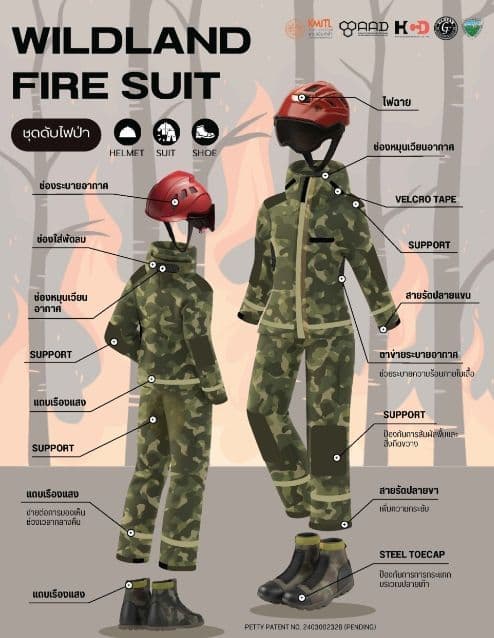
The forest firefighting suit consists of the following components and uses: The forest firefighting suit is designed and developed to be suitable for the behavior of the officers and the conditions of the work area, consisting of a shirt and pants. The material used in the sewing of the suit is aramid fabric, which has the property of being able to prevent the spread of fire, to prevent the officers from burning while performing their duties in the event that the forest fire spreads close to them, which is different from the current suits that cannot prevent fires. The shirt is designed with a mesh on the side of the body to release internal heat so that air can circulate well. The sleeves at the elbows have a support point to prevent contact with the ground or obstacles. The collar has a slot for a portable fan and a fan air circulation channel on the back, which can be turned on while performing forest firefighting duties, helping to prevent the body temperature from getting too hot, reducing the risk of heatstroke. When the fan battery runs out, it can be removed for charging and put back in when needed. The pants are designed with mesh on the inside or in blind spots to release internal heat so that air can circulate well. The pants at the knees have a support point to prevent contact with the ground or obstacles. The forest firefighting suit, consisting of a shirt and pants, has been designed and developed to be able to be produced domestically, reducing imports from abroad
คณะเทคโนโลยีการเกษตร
-

คณะวิทยาศาสตร์
Microalgae are rich in bioactive compounds that may contribute to the growth of probiotics, which require appropriate nutrients, known as prebiotics, to thrive. This study aims to evaluate the effectiveness of crude extracts from intracellular components residues of the microalga Chlorella sp. KLSc61 in promoting the growth of the probiotic bacterium Lactiplantibacillus plantarum JCM1149 under simulated gastrointestinal conditions. The intracellular extracts were obtained using 70% (v/v) ethanol, and their effects on probiotic growth were tested at concentrations of 0.1%, 0.75% and 1.5%. The growth of Lactiplantibacillus plantarum JCM1149 was assessed using the drop plate method. The findings of this study will provide insights into the potential of Chlorella sp. KLSc61 extracts in enhancing probiotic growth, which could lead to the development of synbiotic dietary supplements containing both probiotics and prebiotics. Additionally, this study may serve as a foundation for further research on the role of microalgal extracts in gut health and immune system modulation.