

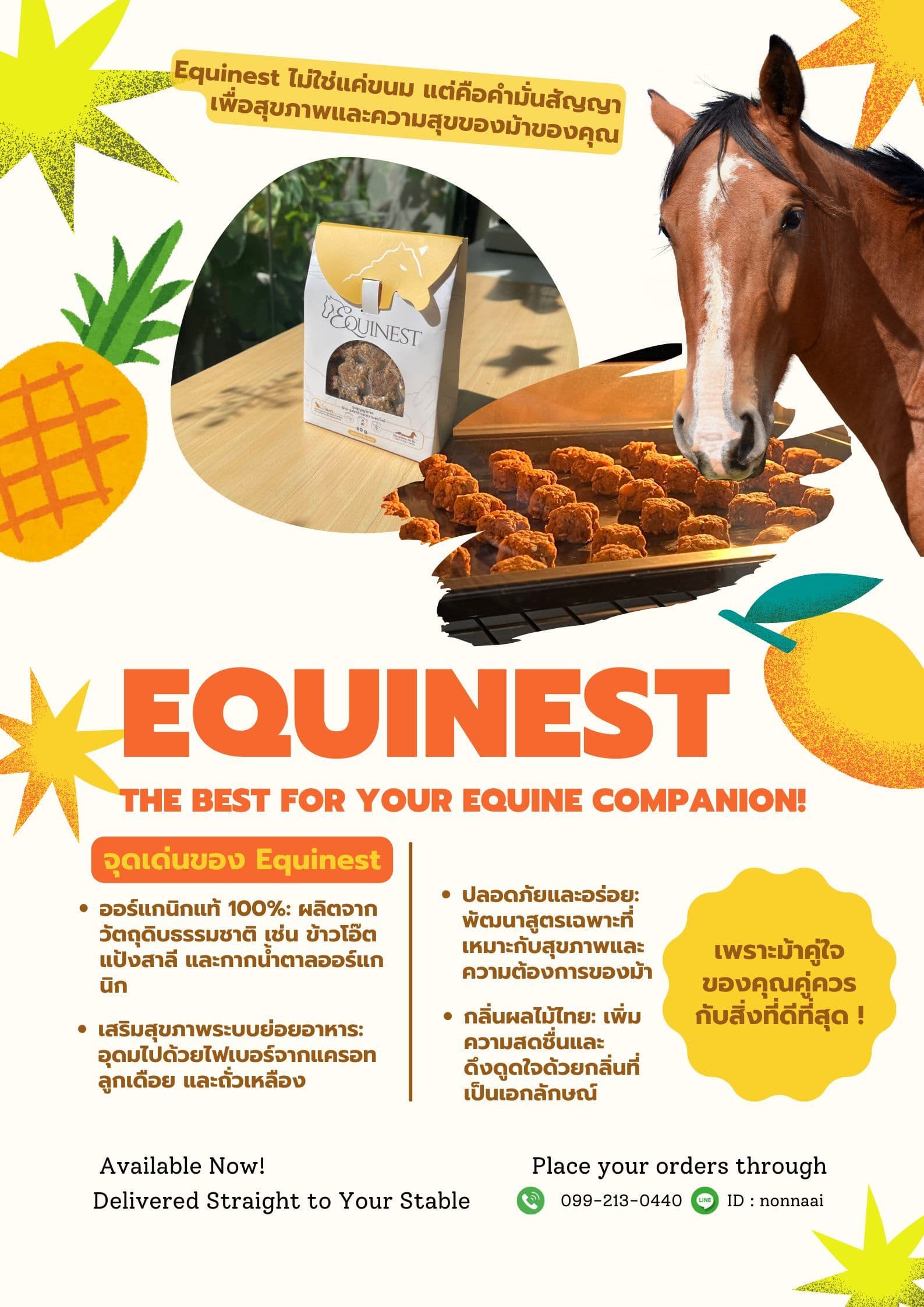
This research aims to develop a horse treat product that meets the nutritional and health needs of horses by using natural ingredients with beneficial properties, such as oats, wheat flour, corn flour, and organic molasses. These ingredients are rich in fiber, vitamins, and essential minerals for horses, while also enhancing digestive efficiency, reducing the risk of colic, and providing an appropriate energy source. The treat is designed with a shape suitable for a horse’s chewing behavior and is infused with Thai fruit flavors, such as pineapple and ripe mango, to attract horses and make consumption easier. The production process emphasizes cleanliness and safety by selecting organic ingredients and avoiding harmful preservatives. The packaging is designed to maintain product quality for an extended period, prevent moisture, and be convenient for horse owners to use. Additionally, the treat can be used as a reward during horse training, helping to strengthen the bond between the horse and its owner while reducing equine stress. This product serves as both a health-boosting snack and an effective training tool, making it suitable for horses that require highly nutritious supplements. It also provides a new option for horse owners seeking a safe and beneficial product for their horse’s overall well-being.
ปัจจุบันการเลี้ยงม้าในประเทศไทยได้รับความนิยมเพิ่มขึ้น แต่การขาดความรู้ที่ถูกต้องในการดูแล ส่งผลให้เกิดปัญหาสุขภาพ โดยเฉพาะอาการเสียดท้อง ซึ่งเป็นสาเหตุสำคัญที่อาจทำให้ม้าเสียชีวิต หากไม่ได้รับการรักษาอย่างทันท่วงที ระบบการให้อาหารที่เหมาะสมจึงเป็นปัจจัยสำคัญในการป้องกันปัญหาดังกล่าว การให้ขนมสำหรับม้านั้นเปรียบเสมือนกับการให้รางวัลกับม้า ซึ่งช่วยเสริมสุขภาพกายและจิตใจของม้า โดยเฉพาะการเสริมสร้างความสัมพันธ์ระหว่างผู้เลี้ยงและม้า อีกทั้งยังเป็นเครื่องมือที่ช่วยฝึกพฤติกรรมม้าให้ตอบสนองต่อคำสั่งได้ดีขึ้น การเลือกขนมที่มีคุณค่าทางโภชนาการสูง ช่วยเสริมระบบทางเดินอาหาร ลดความเสี่ยงของอาการเสียดท้อง ท้องอืด และปัญหาทางลำไส้ นอกจากนี้ ขนมที่มีกลิ่นหอมและรสชาติดียังช่วยกระตุ้นความอยากอาหาร ลดความเครียด และทำให้ม้ามีความสุขมากขึ้น จากปัญหาดังกล่าว ผู้วิจัยจึงมุ่งเน้นพัฒนาผลิตภัณฑ์ขนมสำหรับม้าแต่งกลิ่นผลไม้ไทย โดยใช้วัตถุดิบธรรมชาติที่ช่วยเพิ่มประสิทธิภาพในการย่อยอาหาร พร้อมทั้งทดสอบและประเมินความปลอดภัยของผลิตภัณฑ์ เพื่อเป็นทางเลือกให้แก่ผู้เลี้ยงม้าในการดูแลสุขภาพม้า และเพิ่มโอกาสทางการตลาดให้ผลิตภัณฑ์ขนมม้าเป็นที่ยอมรับในวงการขี่ม้าไทย

คณะวิทยาศาสตร์
This study aimed to investigate the effectiveness of extracts from moringa seeds, roselle seeds, and tamarind seeds as coagulants to improve water quality in surface water sources. Extracts from these seeds serve as environmentally friendly coagulants and provide alternative options for enhancing surface water quality. The turbidity of surface water sources ranged between 14 and 24 NTU. The coagulation process used the Jar Test method, where the moringa seed, roselle seed, and tamarind seed extracts functioned as both primary coagulants and coagulant aids. In the preparation process, the seeds were finely ground and extracted using a 0.5-M sodium chloride (NaCl) solution. These extracts were then applied as coagulants to reduce turbidity and enhance water quality, with each concentration tested in 300 ml of water. The results indicated that the most effective way to remove turbidity using 2,000 mg/L of moringa seed extract, achieving a turbidity reduction of approximately 73.19% at a cost of 0.0309 baht per 300 ml of water. Followed by Tamarind seed extract, with a concentration of 4,000 mg/L, followed with a turbidity reduction of approximately 56.75% at a cost of 0.0933 baht per 300 ml. Lastly, roselle seed extract at 6,000 mg/L achieved a turbidity reduction of approximately 32.67% at a cost of 0.0567 baht per 300 ml of water.
คณะเทคโนโลยีการเกษตร
The development of a board game to enhance cooking skills focuses on a popular and well-known dish—burgers. This study integrates learning with interactive gameplay, allowing players to gain knowledge about burgers, including their ingredients, preparation methods, and even the basics of running a burger business. Through hands-on activities and engaging game mechanics, players can develop both their culinary skills and entrepreneurial mindset while enjoying the fun and immersive experience of the board game.
คณะวิทยาศาสตร์
The species Enterococcus lactis is closely related to E. faecium and is known for its beneficial and probiotic effects. In this study, strain RRS4 was isolated from Raphanus sativus Linn. and identified based on both phenotypic and genotypic characteristics. Strain RRS4 exhibited cell viability in environments with 2-8% NaCl, pH ranging from 4 to 9, and temperatures between 4°C and 45°C. Through comprehensive genomic analysis, strain RRS4 was confirmed to be E. lactis. E. lactis RRS4 demonstrated inhibitory effects against Vancomycin-resistant E. faecalis JCM 5803. Safety assessments via in silico methods, including KEGG annotation, indicated the absence of virulent and undesirable genes in E. lactis RRS4. VirulenceFinder analysis aligned virulence-related genes with those from three strains of E. lactis and four strains of E. faecium. While antibiotic resistance genes were found to be conserved, they did not correlate with key pathogenicity traits. Furthermore, safety evaluations highlighted that E. lactis RRS4 is generally safe, despite the presence of genes associated with antibiotic resistance. Lastly, we propose guidelines for assessing the safety of microbial strains using whole-genome analysis. These findings represent advancements in probiotic research.