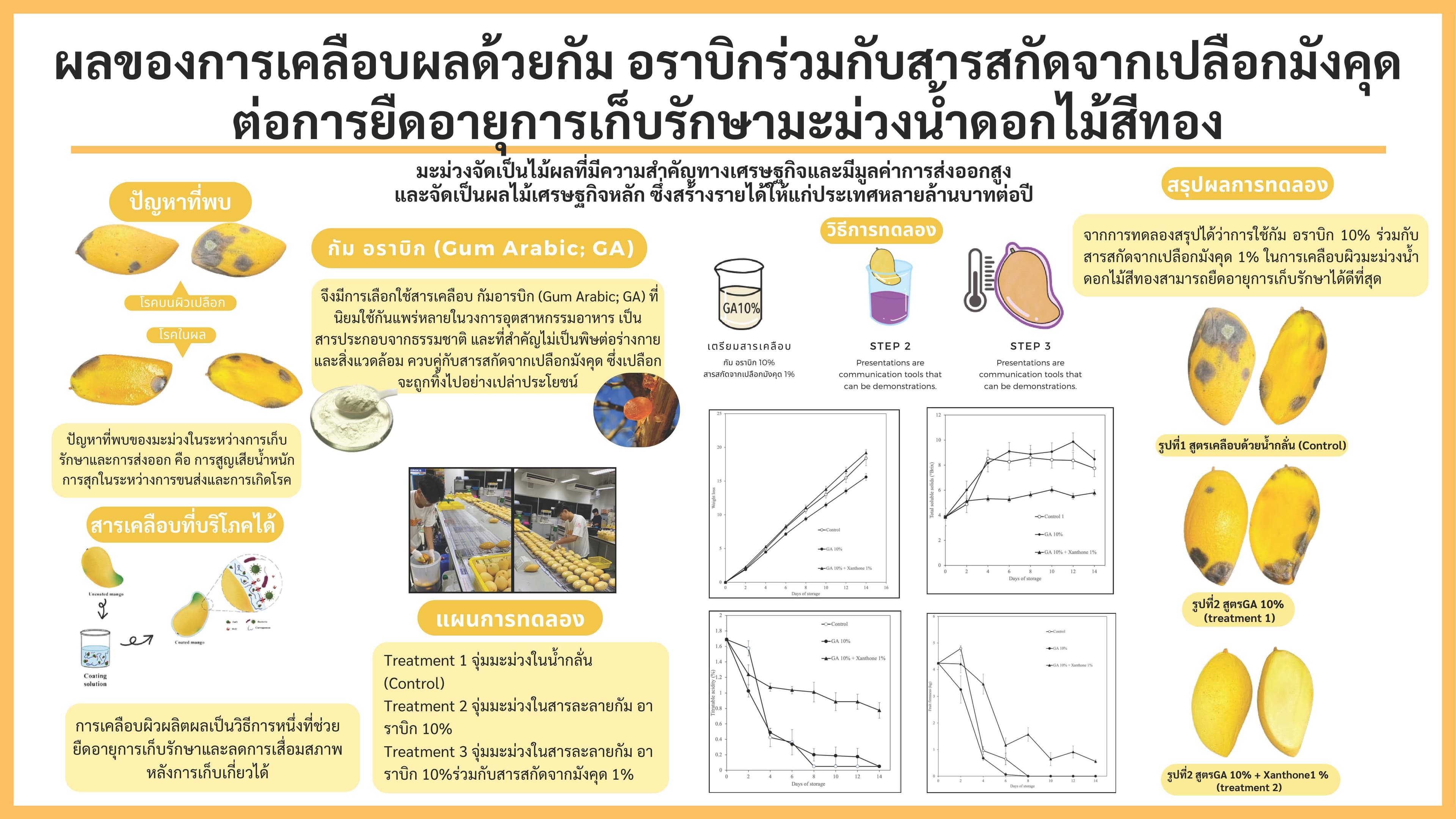
This study aimed to evaluate the optimal edible coating formulation for 'Namdokmai Sithong' mangoes by incorporating 10% gum arabic (GA) with mangosteen peel extract (MPE) at varying concentrations (1%, 3%, and 5%), compared to a control treatment (distilled water). The coated fruits were stored at room temperature for 14 days, and their physicochemical properties were assessed. The findings indicate that the application of GA (10%) combined with MPE effectively mitigated color changes in mango flesh, suppressed disease incidence, and preserved fruit firmness. Additionally, the coating significantly delayed alterations in total soluble solids (TSS), titratable acidity (TA), vitamin C content, carotenoid levels, and phenolic compounds. Among the tested formulations, GA (10%) + MPE (1%) exhibited the highest efficacy in extending shelf life, maintaining fruit quality, and enhancing surface gloss.
มะม่วงน้ำดอกไม้สีทองเป็นพืชเศรษฐกิจของไทยที่มีความสำคัญอย่างมากเนื่องจากเป็นผลไม้ที่มีรสชาติและกลิ่นที่ได้รับความนิยมและมีความต้องการในตลาดในประเทศและนอกประเทศ โดยเราจะพบว่าการส่งออกมะม่วงในไทยมีการส่งออกมากเป็นอันดับ 1 ในประเทศประเทศไทยเป็นอันดับ 1 ด้านการส่งออกและเป็นอันดับ 3 ด้านการผลิตมะม่วงโดยความสำคัญในด้านส่งออกมีการให้ความสำคัญในด้านคุณภาพด้านสี กลิ่นและคุณภาพด้านระยะเวลาการเก็บ แต่ปัญหาที่สำคัญของมะม่วงในระหว่างการเก็บรักษาและการ ส่งออก คือ การสูญเสียน้ำหนัก การสุกในระหว่างการขนส่งและการเกิดโรค ทําให้ผลิตผลไม่เป็นที่ต้องการของผู้บริโภคและทําให้ผลมะม่วงที่ผลิตได้มีมูลค้าลดลง (อนุธิดา, 2549) การเคลือบผิวผลิตผลเป็นวิธีการหนึ่งที่ช่วยยืดอายุการเก็บรักษาและลดการเสื่อมคุณภาพหลังการเก็บเกี่ยวได้ ทั้งนี้การเลือกใช้สารเคลือบผิวควรเลือกชนิด และความเข้มข้นให้เหมาะสมกับผลิตผลแต่ละชนิด ที่สําคัญคือควรคํานึงถึงประสิทธิภาพและความปลอดภัยของผู้บริโภคให้มากที่สุด (จรัญญา และคณะ, 2550) โดยการเลือกใช้สารเคลือบ กัมอารบิก (Gum Arabic) เป็นสารประกอบธรรมชาติชนิดหนึ่งที่อยู่ในกลุ่มสารไฮโดรคอลลอยด์ (Hydrocolloids) ที่นิยมใช้กันแพร่หลายในวงการอุตสาหกรรมอาหาร เป็นสารประกอบจากธรรมชาติที่ไม่มีกลิ่น ไม่มีสี ไม่มีรส ที่สำคัญไม่เป็นพิษต่อร่างกายและ มลภาวะ ปัจจุบันได้ผ่านการรับรองระบบมาตรฐาน ของอาหารโลก และได้รับกำหนดในตำรับ GRAS (Generally Recognized as Safe) และมาตรฐานของ United State pharmacopeia, Food Chemical Codex และ EU Number E414 รวมทั้งผ่านการรับรองจาก สำนักงานคณะกรรมการอาหารและยา ประเทศไทย (มูทาดา, 2543) ควบคู่กับสารสกัดจากเปลือกมังคุด ซึ่งล่าสุดมีการนำแนวคิดดังกล่าวไปประยุกต์กับ ‘มังคุด’ ในบ้านเรา ซึ่งแต่ละปีมีผลผลิตกว่า 3 แสนตัน จำนวนนี้เป็นมังคุดเพื่อการส่งออกถึง 70% และขายในประเทศอีก 30% และเมื่อรับประทานเสร็จแล้วเปลือกจะถูกทิ้งไปอย่างเปล่าประโยชน์ ดังนั้นจึงควรมีการนำมังคุดไปใช้ให้คุ้มค่ามากที่สุด โดยจากการศึกษามีรายงานว่าในส่วนของเปลือกมังคุดมีสารสําคัญที่สามารถนำมาใช้เป็นยาสมุนไพรกันอย่างแพร่หลาย เปลือกมังคุดมีคุณสมบัติใช้เป็นยา ฤทธิ์ทางเภสัชวิทยาของสารสำคัญจากการสกัดเปลือกผลมังคุด ได้แก่ฤทธิ์ต้านเชื้อจุลชีพ อนุมูลอิสระ ฤทธิ์ต้านออกซิเดชั่น (สังกัดสำนักวิจัยและพัฒนาวิทยาการหลังการเก็บเกี่ยวและแปรรูปผลิตผลเกษตร, 2452) การใช้สารสกัดจากเปลือกมังคุดจะเป็นการนำของที่เป็นขยะเหลือใช้ที่ไม่มีราคาให้มีประโยชน์เพิ่มมากขึ้นในการเลือกใช้เป็นสารสกัดที่ใช้ร่วมกับสารเคลือบเพื่อช่วยในการเก็บรักษามะม่วงหลักการเก็บเกี่ยวได้
คณะสถาปัตยกรรม ศิลปะและการออกแบบ
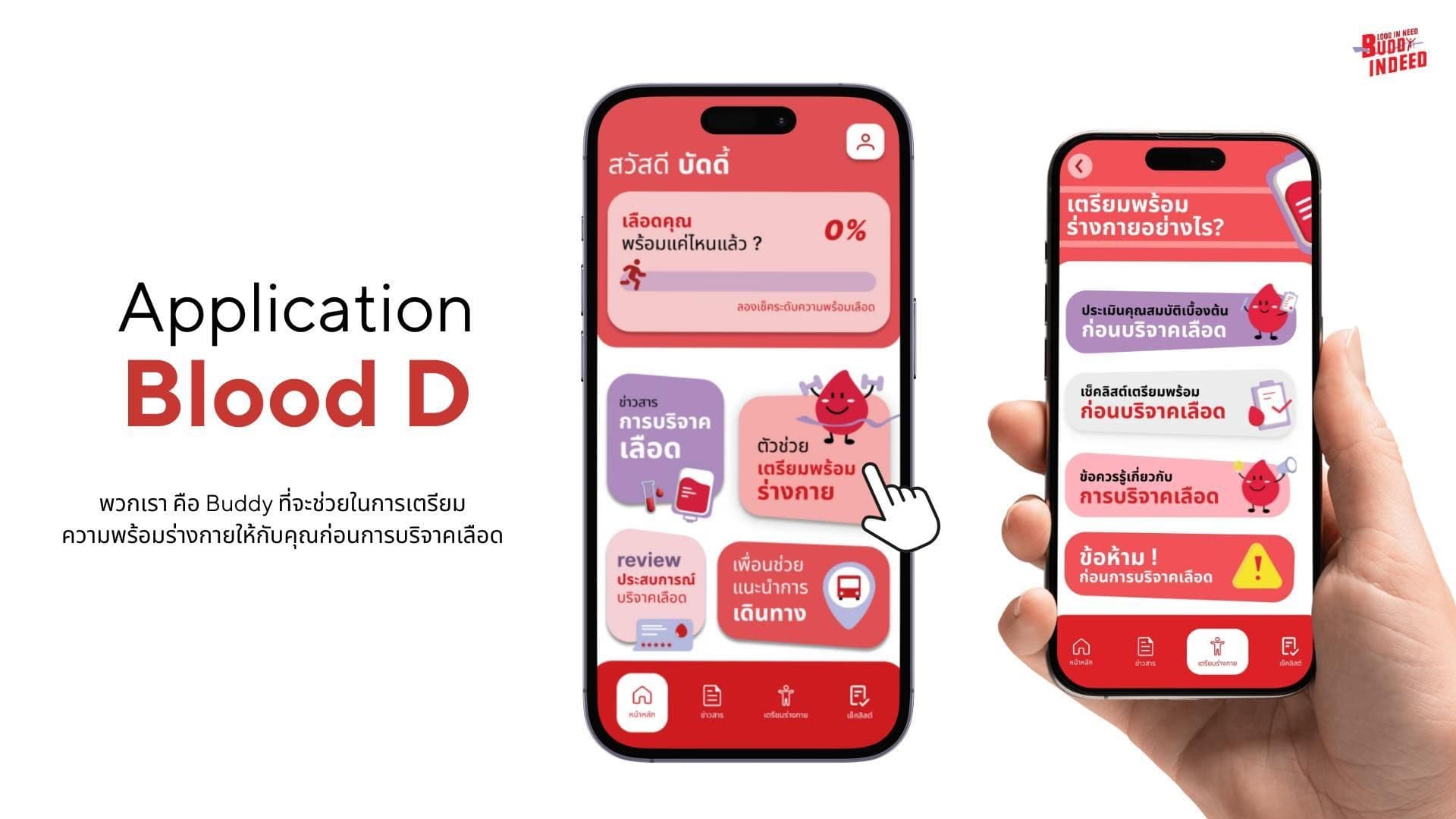
In the world of blood donation, there are 2 types of people: those who donate blood and those who don't. Most campaigners emphasize how to persuade more people to donate blood and recruit more new blood donors. We believe that even though such focus is important, there're more critical aspects that might have been neglected, which is: for those who have already made up their minds to be blood doners, will they be successful in donating when the time comes? According to our studies, only 63 % of attempted doners are successful. Regrettably, 37 % has to go home disappointed as their bodies are not fit for the conditions required by Red Cross medical staff at blood donation centers (which include some most basic preparations such as low-fat food intake and 8-hours sleep on the night before). Our campaign, ‘Blood in Need, Buddy Indeed’, focuses on 2 aspects. Firstly, to persuade more people to donate blood. Secondly, for those who have made up their minds to donate blood, we will provide necessary support (both body and mind) so that they are fully prepared and successful in donating blood when the time comes via networks of systems, staffs and the newly designed and prototype of the application ‘Blood D’. Our campaign covers the whole ‘before/during/after’ experience of users (as blood doners). Support includes assessment of their current condition whether they are within the requirement of Red Cross Blood Bank. ‘Blood D’ will also provide relevant information on blood donating events, such as locations, and time booking. Once sign-up, the application “Blood D” will sent friendly reminder and clear infographic on how to prepare their bodies as daily notifications during the 7 days countdown. This is to ensure that the users’ blood will be ‘D’ (homophone of the Thai word ‘ดี’ which mean ‘good’ and at the same time playing on the word ‘ Buddy’) or be the ‘good blood’ that can save lives for those in need. After organizing 4 blood donation events both within and outside the KMITL. The numbers of successful blood doners have increased from 63 % to 78 % (this number is the average of 4 events, with the most successful event of 89%). The campaign has won the first runner up in national blood donation campaign competition. It is highly anticipated that once the application “Blood D” is fully launched, it will help increase the amount of blood collected up to 15% with the same numbers of existing doners.
วิทยาเขตชุมพรเขตรอุดมศักดิ์
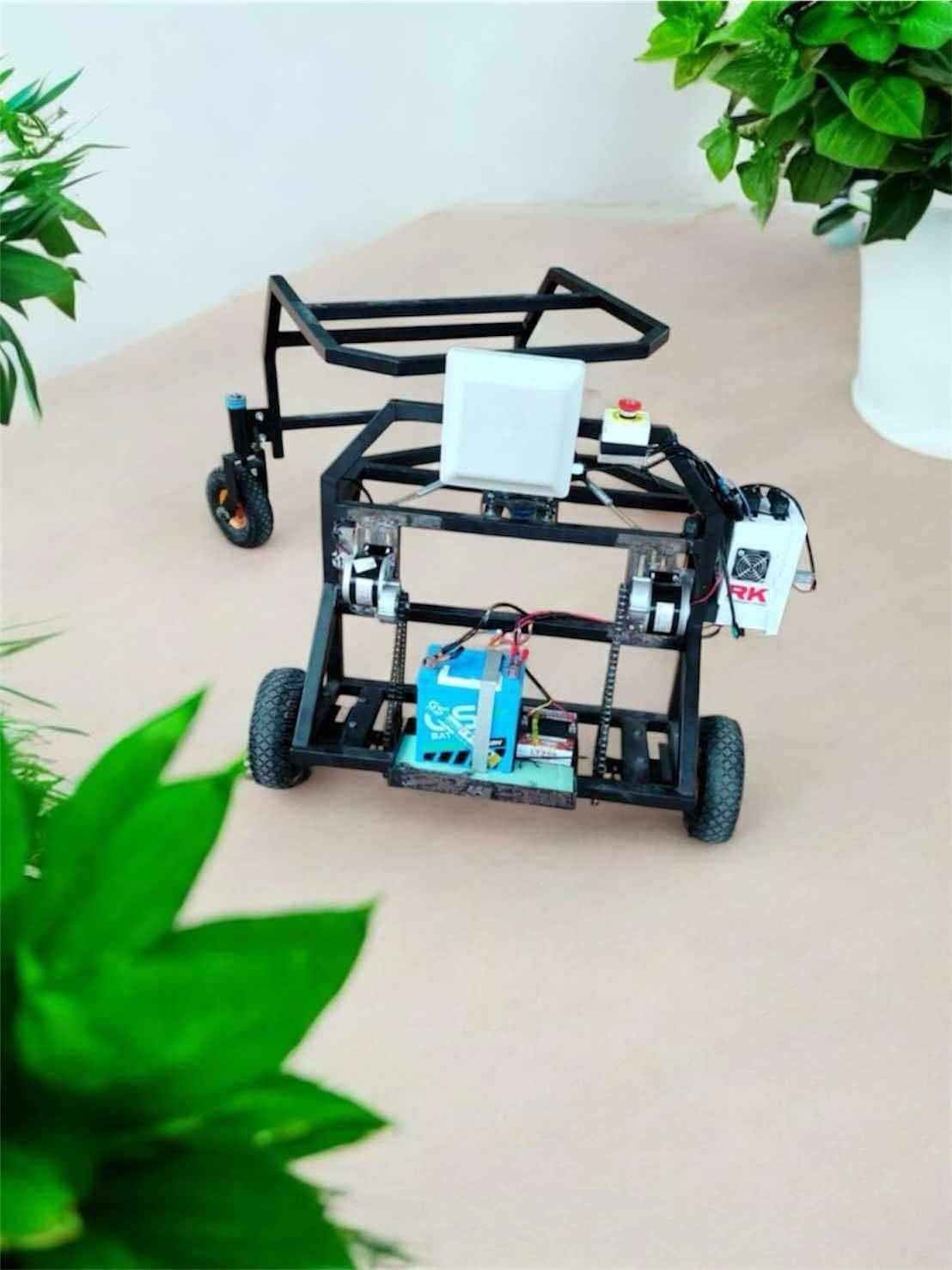
This project aims to design and develop a propulsion system for agricultural equipment using RFID technology and evaluate its movement performance on different surfaces, including concrete and grass. The experiment focuses on examining the tag detection range under transmission power levels of 20 dBm, 23 dBm, and 26 dBm, as well as the impact of antenna angles on detection efficiency. Additionally, the system was tested in three movement scenarios: straight path, left turn, and right turn, at distances of 2 meters, 4 meters, and 6 meters. The results indicate that the system achieved the highest average speed of 0.4736 m/s and an average turning angle of 91.6° when moving in a straight path on a concrete surface at a distance of 4 meters. On a grass surface at the same distance, the average speed was 0.4483 m/s, with an average turning angle of 91.1°. For left and right turns, the movement on the concrete surface generally exhibited a higher average speed than on grass, particularly at a distance of 4 meters, where differences in turning angles were observed. This study provides insights into the factors affecting the movement of agricultural mowing equipment and serves as a foundation for enhancing the efficiency of propulsion systems in future developments.
คณะสถาปัตยกรรม ศิลปะและการออกแบบ
The Kachatthai Project in Surin Province has been developed as a space to promote and generate income for farmers, incorporating a design concept that reflects the unique identity of Surin Province as its main guideline.