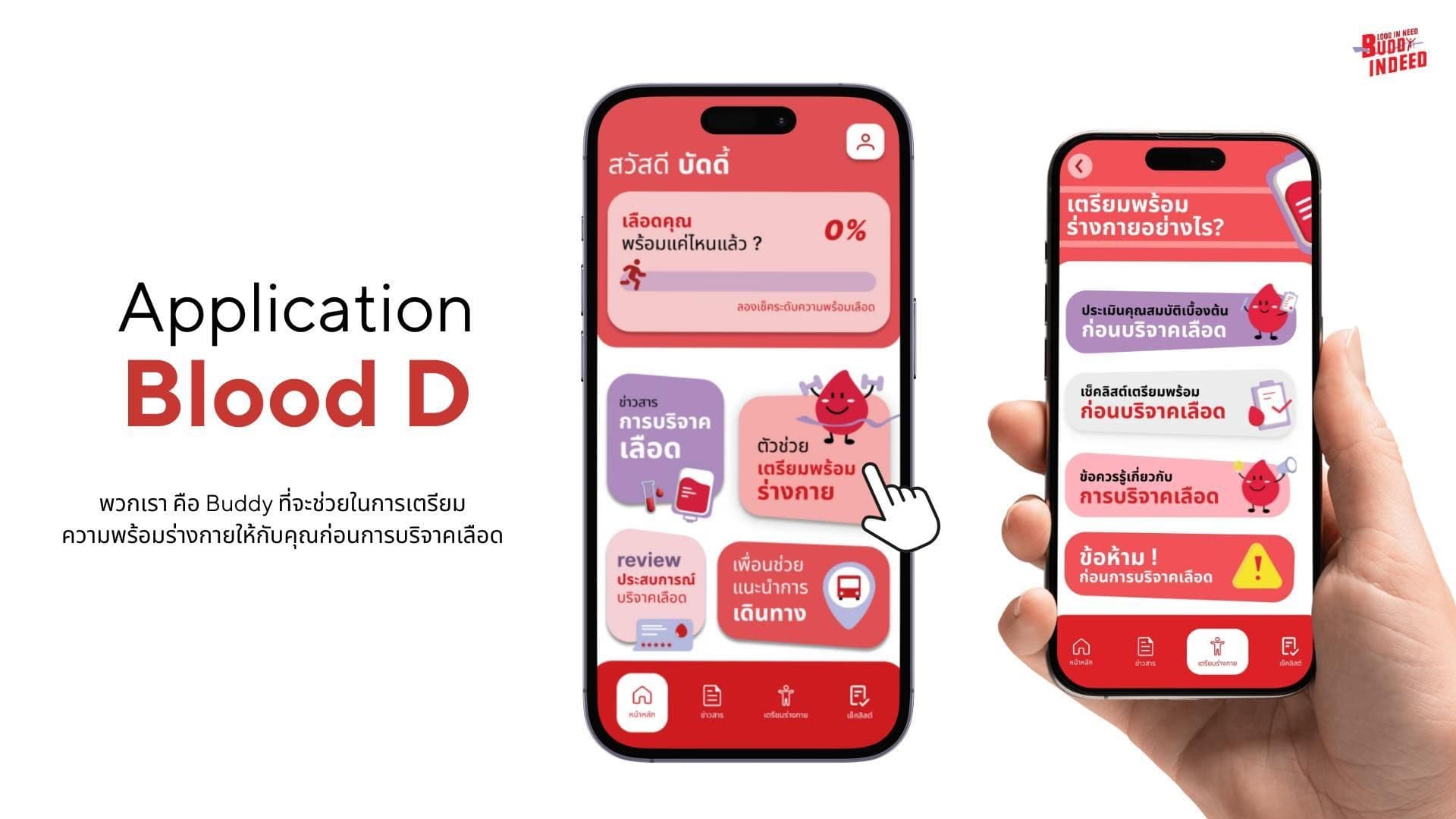
In the world of blood donation, there are 2 types of people: those who donate blood and those who don't. Most campaigners emphasize how to persuade more people to donate blood and recruit more new blood donors. We believe that even though such focus is important, there're more critical aspects that might have been neglected, which is: for those who have already made up their minds to be blood doners, will they be successful in donating when the time comes? According to our studies, only 63 % of attempted doners are successful. Regrettably, 37 % has to go home disappointed as their bodies are not fit for the conditions required by Red Cross medical staff at blood donation centers (which include some most basic preparations such as low-fat food intake and 8-hours sleep on the night before). Our campaign, ‘Blood in Need, Buddy Indeed’, focuses on 2 aspects. Firstly, to persuade more people to donate blood. Secondly, for those who have made up their minds to donate blood, we will provide necessary support (both body and mind) so that they are fully prepared and successful in donating blood when the time comes via networks of systems, staffs and the newly designed and prototype of the application ‘Blood D’. Our campaign covers the whole ‘before/during/after’ experience of users (as blood doners). Support includes assessment of their current condition whether they are within the requirement of Red Cross Blood Bank. ‘Blood D’ will also provide relevant information on blood donating events, such as locations, and time booking. Once sign-up, the application “Blood D” will sent friendly reminder and clear infographic on how to prepare their bodies as daily notifications during the 7 days countdown. This is to ensure that the users’ blood will be ‘D’ (homophone of the Thai word ‘ดี’ which mean ‘good’ and at the same time playing on the word ‘ Buddy’) or be the ‘good blood’ that can save lives for those in need. After organizing 4 blood donation events both within and outside the KMITL. The numbers of successful blood doners have increased from 63 % to 78 % (this number is the average of 4 events, with the most successful event of 89%). The campaign has won the first runner up in national blood donation campaign competition. It is highly anticipated that once the application “Blood D” is fully launched, it will help increase the amount of blood collected up to 15% with the same numbers of existing doners.
ในวิกฤตของการขาดแคลนเลือด เป็นอุปสรรคสำคัญต่อการรักษาผู้ป่วยที่ต้องการเลือด การบริจาคเลือดจึงเป็นสิ่งที่สำคัญอย่างยิ่งในการช่วยชีวิตผู้ป่วยที่ต้องการเลือด แต่ปัจจุบันยังคงมีปัญหาเกี่ยวกับปริมาณเลือดที่ไม่เพียงพอต่อความต้องการของผู้ป่วย ซึ่งมีสาเหตุหลายอย่าง ได้แก่ ความไม่พร้อมของผู้บริจาคเลือด ทั้งในด้านร่างกายและจิตใจ การขาดความรู้เกี่ยวกับการเตรียมความพร้อมก่อนการบริจาคเลือด การละเลยข้อห้ามสำคัญ หรือความกังวล รวมถึงความกลัว และการมีประสบการณ์ที่ไม่ดีจากการบริจาคเลือด ซึ่งสาเหตุต่าง ๆ ที่กล่าวมา ล้วนเป็นอุปสรรคที่ส่งผลให้การบริจาคเลือดไม่เป็นผลสำเร็จ และนำไปสู่ปัญหาของการขาดแคลนเลือด ดังนั้นคณะผู้จัดทำโครงการจึงเล็งเห็นปัญหาที่เป็นอุปสรรคต่อความสำเร็จในการบริจาคเลือด นำไปสู่การออกแบบแอพพลิเคชั่นที่ช่วยเตรียมความพร้อมด้านร่างกายและจิตใจสำหรับผู้ที่ต้องการบริจาคเลือด เพื่อให้ผู้ที่ต้องการบริจาคเลือดมีความพร้อมสำหรับการบริจาคเลือดมากที่สุด ซึ่งไม่เพียงเป็นการช่วยเพิ่มอัตราความสำเร็จให้กับการบริจาคเลือด แต่ยังช่วยสร้างความมั่นใจให้กับผู้ที่ต้องการบริจาคเลือด และส่งเสริมให้เกิดการบริจาคเลือดเพิ่มมากขึ้นอีกด้วย
วิทยาลัยการจัดการนวัตกรรมและอุตสาหกรรม
The Water Hyacinth Removal Electric Smart Boat is a small, streamlined boat capable of working in any area. Even small areas with a lot of water hyacinth volumes with advanced technology that the researcher has created and designed. The structure of the boat is made of aluminum material, is 4.80 meters long and 1.20 meters wide, and is powered by a diesel engine 14 hp. Reinforcing drive in tandem with spinning, chopping weeds and the ability to remove water hyacinths by spinning 3-5 per day with only one operator on boat. Therefore, the control and removal of water hyacinths by smart boat works better than conventional mechanization. It can work quickly and at a low cost. This water hyacinth removal electric smart boat concept will be built on the original system.
คณะวิทยาศาสตร์
Agricultural products and by-products are important raw materials in various industries including cosmetics and pharmaceuticals. Agro-based fibers have the composition, properties and structure that make them suitable for uses as composite-cosmetic industry. Upon microwave digestion, cellulose have been successfully synthesized into nanocrystalline cellulose (NCC) with lengths from 50-1000 nm, widths between 5-70 nm. Nanocrystalline cellulose was grafted with cosmetic active ingredients such as glycerin), sodium hyaluronate), glycolic acid, and nicotinamide. The beauty active ingredients attached nanocelluloses can penetrate through the skin to enhance beauty and youth.
คณะแพทยศาสตร์
This research studies the effect of CBD on the excitability of mice nociceptive trigeminal ganglion neurons. The electrophysiological parameters of the mouse trigeminal ganglion cells are measured using a Whole Cell Current Clamp Model on a primary cell culture treated with 0.5 uM CBD for 24 hours compared to a control group. After obtaining the results statistical analysis is done using a Mann Whitney-U test.