
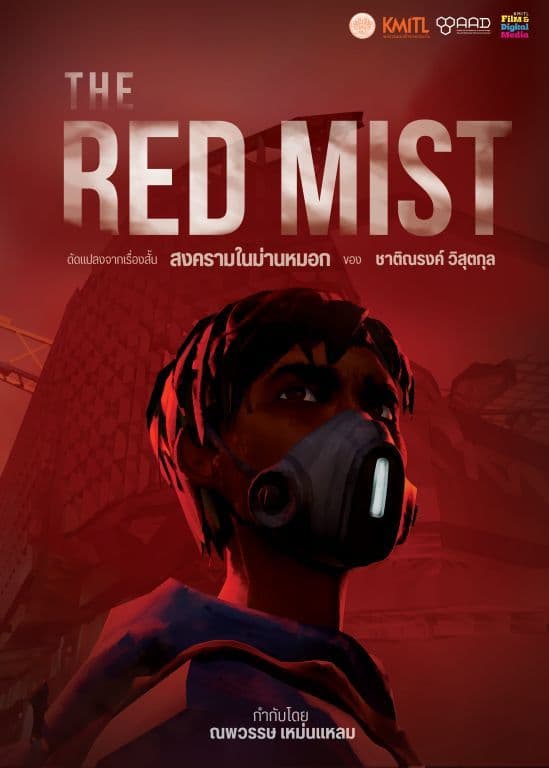
The thesis artwork titled “The Red Mist” presents a narrative adapted from a short story of the same name by Assistant Professor Chatnarong Wisutkul in 2003. The story is set in a future world where people's greed and selfishness have led to a war, forcing them to rely on "breathing machines" to survive in the "red toxic mist." Phakin, a 15-year-old boy, embarks on a journey with a group of refugees. As they pass through abandoned cities, they encounter a boy without a breathing machine who has recently lost his father. Phakin decides to help him, despite objections from others. The boy tries to end his life by shutting off his breathing machine, and when Phakin intervenes to save him, he collapses from inhaling the toxic air. Witnessing Phakin's selfless act, the others are moved and join forces to save both of them. Phakin demonstrates that in difficult times, humans must cooperate and help each other rather than being divided and selfish.
ภาพยนตร์ศิลปนิพนธ์ชิ้นนี้เกิดจากความสนใจส่วนตัวเกี่ยวกับการสร้างสรรค์ผลงานภาพยนตร์ และการกำกับศิลป์ ในรูปแบบของแอนิเมชัน 3 มิติ ด้วยโปรแกรม Unreal Engine เป็นหลัก ซึ่งข้าพเจ้าได้มีโอกาสอ่านผลงานเรื่องสั้น เรื่อง “สงครามในม่านหมอก” เขียนโดย ผศ. ชาติณรงค์ วิสุตกุล ที่ถูกตีพิมพ์เมื่อปี พ.ศ. 2546 และมีการพูดถึงเกี่ยวกับเหตุการณ์หลังสงครามที่คล้ายคลึงกับการเหตุการณ์ในปัจจุบัน จึงอยากนำเรื่องสั้นเรื่องนี้มาพัฒนาเป็นภาพยนตร์แอนิเมชัน 3 มิติ ที่จะถ่ายทอดเรื่องราวของการกระทำและความคิดของมนุษย์ นำเสนอให้สอดคล้องกับเหตุการณ์ในปัจจุบันคือ ปัญหามลพิษ ในรูปแบบที่เข้าใจง่าย และน่าสนใจ ภาพยนตร์นำเสนอเรื่องราวของโลกหลังสงครามที่ผู้คนต้องพึ่งพา “เครื่องหายใจ” ในการใช้ชีวิต ภาคิน เด็กหนุ่มอายุ 15 ปีที่กำลังพาครอบครัวลี้ภัยจาก “หมอกพิษสีแดง” ร่วมกับกลุ่มผู้อพยพ พวกเขาเดินทางผ่านเมืองร้าง และบังเอิญพบเข้ากับสองพ่อลูกที่ไม่มีเครื่องหายใจ ภาคินตัดสินใจช่วยเหลือพวกเขาแม้คนอื่นไม่เห็นด้วยก็ตาม แล้วผู้เป็นพ่อก็สิ้นใจในเวลาต่อมา เด็กชายพยายามจะปลิดชีวิตตัวเองโดยการปิดเครื่องหายใจ ภาคินที่เข้าไปยื้อชีวิตเด็กได้หมดสติลงจากการหายใจเอาอากาศพิษเข้าไป ปราณเห็นสิ่งที่ภาคินทำเพื่อช่วยเหลือเขาและคนอื่น ได้สำนึกและช่วยชีวิตทั้งสองภาคินทำให้ทุกคนรู้ว่า ในช่วงเวลาที่ยากลำบาก มนุษย์เราต้องร่วมมือ ช่วยเหลือกันไม่ใช่แตกแยก และเห็นแก่ตัว

คณะสถาปัตยกรรม ศิลปะและการออกแบบ
This research aims to study the guidelines and develop a prototype of an application for public transport users to plan their journey and increase safety in using different types of public transport to travel to King Mongkut's Institute of Technology Ladkrabang. The objectives are as follows: 1) To study the factors of user experience (UX) and user interface (UI) design that affect the users of the application for using public transport. 2) To study the needs of users of public transport applications who must travel to King Mongkut's Institute of Technology Ladkrabang. 3) To present the guidelines for designing the user experience (UX) and user interface (UI) and to produce a prototype of the application for using public transport to travel to King Mongkut's Institute of Technology Ladkrabang. The research includes a review of the literature on User Experience (UX) and User Interface (UI) design, as well as a look at examples of public transportation applications and pick-up sites near King Mongkut's Institute of Technology Ladkrabang. This study is based on qualitative research. There are examples of employing relevant applications during the interview. The target audience is students aged 18 to 35 who will give prototypes for application development to satisfy their requirements. Provide information that is actually useful to users. The research results found that the public transport vehicles that the target group used the most were the Songthaew (the pick-up truck), train, airport rail link, motorcycle taxi, taxi, and bus, respectively. Users were concerned about various safety issues and wanted to design features to increase safety and confidence in using public transport vehicles for students, such as sending locations to relevant officials in the event of an emergency or when assistance was needed, and important information about public transport vehicles that students needed, such as calculating prices, calculating travel times, bus schedules, official and clear pick-up and drop-off points, bus routes, driver registration, suggestions or route recommendations, and the time of public transport vehicles arriving at the point where users were waiting, etc. The guidelines for designing the User Experience (UX) were presented from the analysis of the target group's data, which was a prioritization of the features of the menu for recording frequently used routes, a menu showing nearby pick-up points, a menu for searching for routes and selecting using various user constraints, such as calculating travel prices or travel times, and a menu that could set fonts and color modes to support a variety of users. This was because the study of user needs for fonts found an equal demand for Thai fonts with looped (Looped font) and without looped (Loopless font), as well as a study of the application's color requirements, which required both light and dark colors to be displayed in approximately equal amounts. This includes the design of the user interface (User Interface) by designing symbols that allow users to access the desired information quickly without confusion.
คณะวิทยาศาสตร์
With the development of space technology, wide-field sky surveys using telescopes have expanded the range of new data available for time-domain astronomical research. Traditional data analysis methods can no longer respond quickly and accurately enough to the growing volume of data. Thus, classifying time-series data, such as light curves, has become a significant challenge in the era of big data. In modern times, analyzing light curves has become essential for using machine learning techniques to handle and filter through massive amounts of data. Machine learning algorithms can be divided into two categories: shallow learning and deep learning. Numerous researchers have proposed and developed a variety of algorithms for light curve classification. In this study, we experimented with Support Vector Machine (SVM) and XGBoost, which are shallow machine learning algorithms, as well as 1D-CNN and Long Short-Term Memory (LSTM), which are deep learning algorithms, which are branches of deep machine learning, to classify variable stars. The training and testing data used in this study were from the Optical Gravitational Lensing Experiment-III (OGLE-III), consisting of variable star data from the Large Magellanic Cloud (LMC), categorized into five main classes: Classical Cepheids, δ Scutis, eclipsing binaries, RR Lyrae stars, and Long-period variables. The results demonstrate the performance analysis of each machine learning algorithm type applied to light curve data, while also highlighting the accuracy and statistical metrics of the algorithms used in the experiments.
คณะสถาปัตยกรรม ศิลปะและการออกแบบ
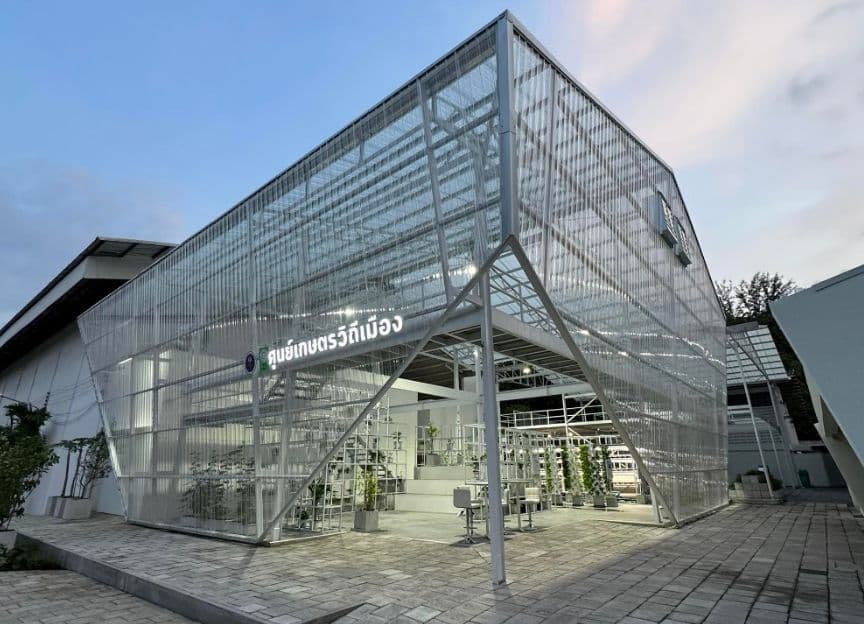
From the current situation and uncertainty; leads to the concept of food security. It is the application of innovation and technology to create high productivity in a limited area. The unused buildings in urban areas were renovated for planting, created as a learning area for planting in urban area. The different methods of growing plants were presented. There are 35 planting innovations for disseminating knowledge, to create food security, self-reliant, supports sustainable living.