
This research aims to study the guidelines and develop a prototype of an application for public transport users to plan their journey and increase safety in using different types of public transport to travel to King Mongkut's Institute of Technology Ladkrabang. The objectives are as follows: 1) To study the factors of user experience (UX) and user interface (UI) design that affect the users of the application for using public transport. 2) To study the needs of users of public transport applications who must travel to King Mongkut's Institute of Technology Ladkrabang. 3) To present the guidelines for designing the user experience (UX) and user interface (UI) and to produce a prototype of the application for using public transport to travel to King Mongkut's Institute of Technology Ladkrabang. The research includes a review of the literature on User Experience (UX) and User Interface (UI) design, as well as a look at examples of public transportation applications and pick-up sites near King Mongkut's Institute of Technology Ladkrabang. This study is based on qualitative research. There are examples of employing relevant applications during the interview. The target audience is students aged 18 to 35 who will give prototypes for application development to satisfy their requirements. Provide information that is actually useful to users. The research results found that the public transport vehicles that the target group used the most were the Songthaew (the pick-up truck), train, airport rail link, motorcycle taxi, taxi, and bus, respectively. Users were concerned about various safety issues and wanted to design features to increase safety and confidence in using public transport vehicles for students, such as sending locations to relevant officials in the event of an emergency or when assistance was needed, and important information about public transport vehicles that students needed, such as calculating prices, calculating travel times, bus schedules, official and clear pick-up and drop-off points, bus routes, driver registration, suggestions or route recommendations, and the time of public transport vehicles arriving at the point where users were waiting, etc. The guidelines for designing the User Experience (UX) were presented from the analysis of the target group's data, which was a prioritization of the features of the menu for recording frequently used routes, a menu showing nearby pick-up points, a menu for searching for routes and selecting using various user constraints, such as calculating travel prices or travel times, and a menu that could set fonts and color modes to support a variety of users. This was because the study of user needs for fonts found an equal demand for Thai fonts with looped (Looped font) and without looped (Loopless font), as well as a study of the application's color requirements, which required both light and dark colors to be displayed in approximately equal amounts. This includes the design of the user interface (User Interface) by designing symbols that allow users to access the desired information quickly without confusion.
1. ยังไม่มีแอปพลิเคชันสำหรับรถโดยสารสาธารณะเพื่อการเดินทางมาสจล.โดยตรง (www.condonewb.com ,2564) 2. จากการสำรวจบางแอปพลิเคชันนั้นไม่ ได้รับการเพิ่มเติมข้อมูลที่เป็ นปั จจุบันและไม่ ได้รับการพัฒนา อย่างต่อเนื่องนั้นก่อให้เกิดความสับสนในผู ้ใช้งานแอปพลิเคชัน (เว็บไซต์ rottuthai.com อัปเดทปี ล่าสุด 2562) 3. กลุ่มผู้โดยสารมีทัศนคติที่ ไม่ปลอดภัยในการโดยสารรถตู้สาธารณะ (ณิชา สุขวัฒนากรณ์ ,2562)
คณะเทคโนโลยีการเกษตร
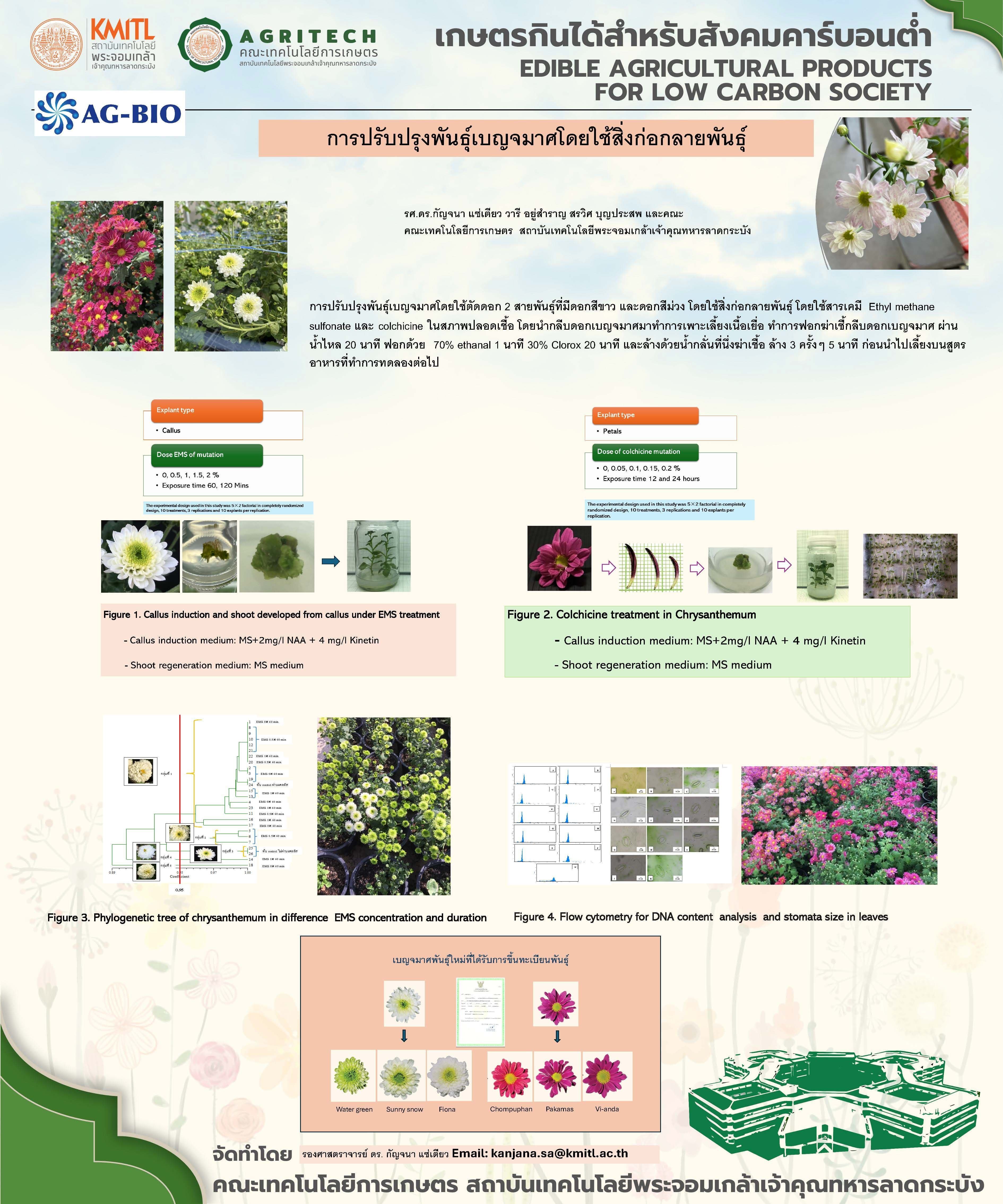
This study examines the effects of chemical mutagens, ethyl methane sulfonate (EMS) and colchicine in inducing mutations in Chrysanthemum spp. through tissue culture techniques. In vitro cultures of Chrysanthemum were treated with various concentrations of EMS and colchicine to assess their impact on shoot regeneration and mutation frequency. Results indicated that EMS significantly increased phenotypic variability, leading to enhanced flower color and size, while colchicine treatment effectively induced polyploidy, resulting in plants with greater flower size and overall vigor. Morphological assessments, along with genetic analyses using molecular markers, confirmed the mutations associated with these treatments. The integration of chemical mutagenesis with tissue culture presents a promising approach for developing novel Chrysanthemum varieties with improved ornamental traits.
คณะสถาปัตยกรรม ศิลปะและการออกแบบ
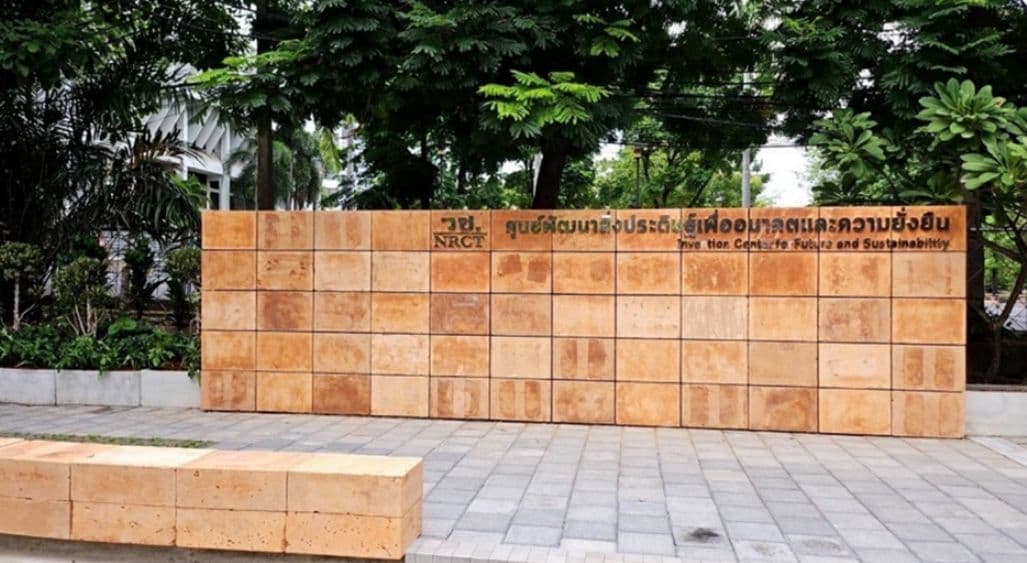
The " Center of Invention for Future and Sustainability Project (Continuing)" serves as a continuation of a pilot initiative focused on the retrofitting of older buildings (Vach. 7), specifically a five-story structure. The primary aim of this project is to develop methodologies for enhancing the sustainability of existing buildings in order to mitigate carbon dioxide emissions. In the execution of the Future and Sustainability Innovation Development Center Project (Continuing), a comprehensive analysis of relevant data and theoretical frameworks has been undertaken, leading to the formulation of a research methodology designed to identify optimal strategies for retrofitting older buildings to reduce carbon dioxide emissions. This approach is structured into three principal phases: the combustion of fuels associated with transportation, labor, and materials; the electricity consumption during the construction process; and the accumulation of greenhouse gases from both existing and new construction materials. The project employs an experimental research design, wherein empirical data is collected to evaluate and quantify the equivalent carbon dioxide emissions arising from the construction of new buildings compared to the retrofitting of the selected case study building. Subsequent analysis of the collected data revealed that retrofitting the existing structure—through the integration of sustainable design principles—resulted in greenhouse gas emissions of 11.88 kgCO2e/sq.m. In contrast, the emissions associated with new building construction amounted to 299.35 kgCO2e/sq.m., indicating a reduction in carbon dioxide emissions by a factor of approximately 26 when compared to the construction of new buildings.
คณะสถาปัตยกรรม ศิลปะและการออกแบบ
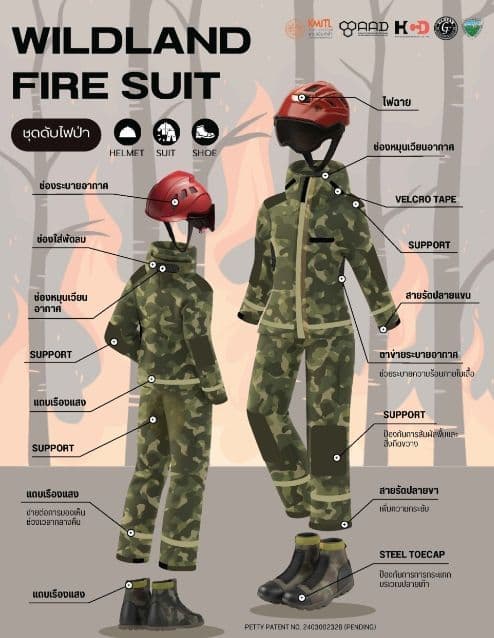
The forest firefighting suit consists of the following components and uses: The forest firefighting suit is designed and developed to be suitable for the behavior of the officers and the conditions of the work area, consisting of a shirt and pants. The material used in the sewing of the suit is aramid fabric, which has the property of being able to prevent the spread of fire, to prevent the officers from burning while performing their duties in the event that the forest fire spreads close to them, which is different from the current suits that cannot prevent fires. The shirt is designed with a mesh on the side of the body to release internal heat so that air can circulate well. The sleeves at the elbows have a support point to prevent contact with the ground or obstacles. The collar has a slot for a portable fan and a fan air circulation channel on the back, which can be turned on while performing forest firefighting duties, helping to prevent the body temperature from getting too hot, reducing the risk of heatstroke. When the fan battery runs out, it can be removed for charging and put back in when needed. The pants are designed with mesh on the inside or in blind spots to release internal heat so that air can circulate well. The pants at the knees have a support point to prevent contact with the ground or obstacles. The forest firefighting suit, consisting of a shirt and pants, has been designed and developed to be able to be produced domestically, reducing imports from abroad