


This research aims to investigate the adulteration of Khao Dawk Mali 105 rice based on storage age using Near-Infrared Spectroscopy (NIRS) with Fourier Transform Near-Infrared Spectroscopy (FT-NIR) in the wavenumber range of 12,500 – 4,000 cm-1 (800 – 2,500 nm). Storage duration significantly impacts the quality of cooked rice. This research is divided into two parts: 1) to investigate the feasibility of separating rice according to storage age (1, 2, and 3 years) using the best model created by an Ensemble method combined with Second Derivative, which achieved an accuracy of 96.3%. 2) To investigate adulteration based on storage age by adulterating at 0% (all 2- and 3-year-old rice), 10%, 20%, 30%, 40%, 50%, 60%, 70%, 80%, 90%, and 100% (all 1-year-old rice). The best model was created using Gaussian Process Regression (GPR) combined with Smoothing + Multiplicative Scatter Correction (MSC), with coefficients of determination (r²), root mean square error of prediction (RMSEP), bias, and prediction ability (RPD) values of 0.92, 8.6%, 0.9%, and 3.6 respectively. This demonstrates that the adulteration model can be applied to separate rice by storage age (1, 2, and 3 years). Additionally, the color values of rice with different storage ages show differences in L* and b* values.
โรงงานผู้ผลิตข้าวพบปัญหาการปลอมปนของข้าวสารที่มีอายุการเก็บรักษาต่างกัน โดยทั่วไปการคัดแยกการปลอมปนจะใช้วิธีมาตรฐานโดยการหุงข้าว จากนั้นนำข้าวหุงสุกไปวัดเนื้อสัมผัสเพื่อแยกอายุของข้าว ซึ่งใช้เวลาและเป็นการทำลายตัวอย่างและเกิดความล่าช้าในการตรวจสอบคุณภาพข้าวสาร งานวิจัยนี้ใช้เทคนิคเนียร์อินฟราเรดสเปกโทรสโกปี (Near-Infrared Spectroscopy, NIRS) ในการตรวจสอบการปลอมปนของข้าวสารพันธุ์ขาวดอกมะลิ 105 (KDML 105) ที่อายุการเก็บรักษาต่างกันเพื่อแก้ไขปัญหาดังกล่าว
คณะวิทยาศาสตร์
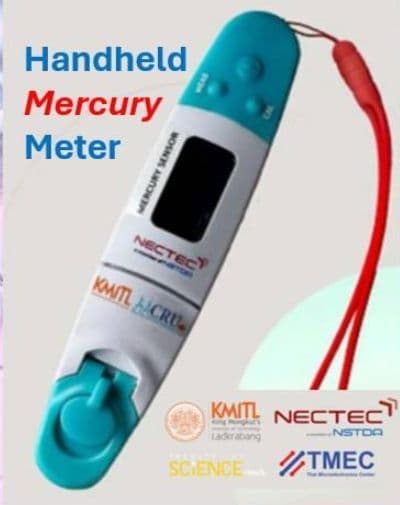
This work presents the fabrication of the handheld meter for potentiometric detection of Hg (II). The meter was constructed based on using an ion-sensitive field-effect transistor (ISFET) platform. The developed meter provides high accuracy and precision (%Recovery was in the range of 92.55 - 109.32 and %RSD was 2.38). It was applied to the analysis of cosmetic samples. The results by the developed electrode were not significantly different at a 95% confidence level compared to the results by using ICP-OES.

คณะวิทยาศาสตร์
Currently, climate change and human activities are causing rapid deterioration of coral reefs worldwide. Monitoring coral health is essential for marine ecosystem conservation. This project focuses on developing an Artificial Intelligence (AI) model to classify coral health into four categories: Healthy, Bleached, Pale, and Dead using Deep Learning techniques. With pre-trained convolutional neural network (CNN) for image classification. To improve accuracy and mitigate overfitting, 5-fold Cross-Validation is employed during training, and the best-performing model is saved. The results of this project can be applied to monitor coral reef conditions and assist marine scientists in analyzing coral health more efficiently and accurately. This contributes to better conservation planning for marine ecosystems in the future.
คณะอุตสาหกรรมอาหาร
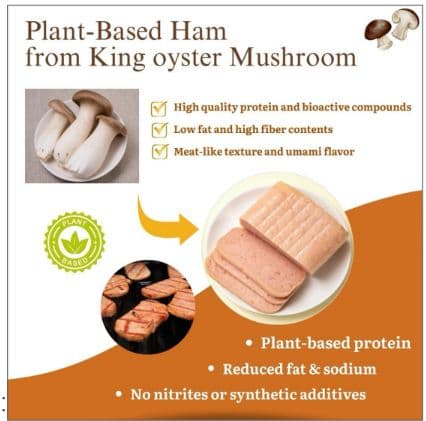
This project therefore aims to develop a "Plant-based Ham Product Prototype" using king oyster mushrooms (Pleurotus eryngii) as the primary ingredient — a natural raw material with strong potential in terms of nutritional value and meat-like texture. The project also seeks to improve the production process to achieve a product with satisfactory textural and flavor characteristics, meeting the needs of a new generation of health- and environmentally-conscious consumers, while providing a foundation for further commercial development within the alternative protein market.