

Background: The RGL3 gene plays a role in key signal transduction pathways and has been implicated in hypertension risk through the identification of a copy number variant deletion in exon 6. Genome-wide association studies have highlighted RGL3 as associated with hypertension, providing insights into the genetic underpinnings of the condition and its protective effects on cardiovascular health. Despite these findings, there is a lack of data that confirms the precise role of RGL3 in hypertension. Additionally, the functional impact of certain variants, particularly those classified as variants of uncertain significance, remains poorly understood. Objectives: This study aims to analyze alterations in the RGL3 protein structure caused by mutations and validate the location of the ligand binding sites. Methods: Clinical variants of the RGL3 gene were obtained from NCBI ClinVar. Variants of uncertain significance and likely benign were analyzed. Multiple sequence alignment was conducted using BioEdit v7.7.1. AlphaFold 2 predicted the wild-type and mutant 3D structures, followed by quality assessment via PROCHECK. Functional domain analysis of RasGEF, RASGEF_NTER, and RA domains was performed, and BIOVIA Discovery Studio Visualizer 2024 was used to evaluate structural and physicochemical changes. Results: The analysis of 81 RGL3 variants identified 5 likely benign and 76 variants of uncertain significance (VUS), all of which were missense mutations. Structural modeling using AlphaFold 2 revealed three key domains: RasGEF_NTER, RasGEF, and RA, where mutations induced conformational changes. Ramachandran plot validation confirmed 79.7% of residues in favored regions, indicating an overall reliable structure. Moreover, mutations within RasGEF and RA domains altered polarity, charge, and stability, suggesting potential functional disruptions. These findings provide insight into the structural consequences of RGL3 mutations, contributing to further functional assessments. Discussion & Conclusion: The identified RGL3 mutations induced physicochemical alterations in key domains, affecting charge, polarity, hydrophobicity, and flexibility. These changes likely disrupt interactions with Ras-like GTPases, impairing GDP-GTP exchange and cellular signaling. Structural analysis highlighted mutations in RasGEF and RA domains that may interfere with activation states, potentially affecting protein function and stability. These findings suggest that mutations in RGL3 could have functional consequences, emphasizing the need for further molecular and functional studies to explore their pathogenic potential.
ยีน RGL3 มีบทบาทในการส่งสัญญาณระดับเซลล์ที่สำคัญ และมีความเชื่อมโยงกับความเสี่ยงต่อภาวะความดันโลหิตสูงเนื่องจากการกลายพันธุ์ของยีนในเอ็กซอน 6 การศึกษาความสัมพันธ์เชื่อมโยงในจีโนม (GWAS) แสดงให้เห็นว่า RGL3 เกี่ยวข้องกับภาวะความดันโลหิตสูง ซึ่งทำให้เห็นถึงข้อมูลเชิงลึกเกี่ยวกับพื้นฐานทางพันธุกรรมของภาวะนี้ และอาจช่วยให้ค้นพบผลที่สามารถปกป้องหัวใจและหลอดเลือดจากยีนนี้ แม้ว่าจะมีการค้นพบดังกล่าว แต่ปัจจุบันก็ยังขาดข้อมูลที่ยืนยันบทบาทที่ชัดเจนของ RGL3 ในภาวะความดันโลหิตสูง นอกจากนี้ ผลกระทบทางด้านโครงสร้าง และหน้าที่ของการแปรผันทางพันธุกรรมที่ไม่ทราบนัยยะสำคัญ (VUS) ยังคงไม่มีข้อมูลอธิบายชัดเจน
วิทยาลัยนวัตกรรมการผลิตขั้นสูง
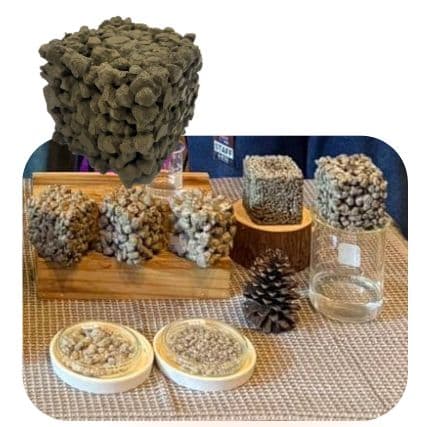
This research develops drainage flooring materials using steel slag industrial waste as the primary raw material, combined with Fly Ash and HPMC to enhance structural strength and water permeability, guided by the Waste-to-Wealth concept. The innovation simultaneously addresses urban flooding and industrial waste management challenges. The resulting paving blocks meet ASTM C1701 infiltration standards and are suitable for public walkways, pedestrian paths, and parking areas. The project aims to produce exhibition-ready prototypes for KMITL Innovation EXPO 2026 with strong potential for further commercial development.
คณะเทคโนโลยีการเกษตร
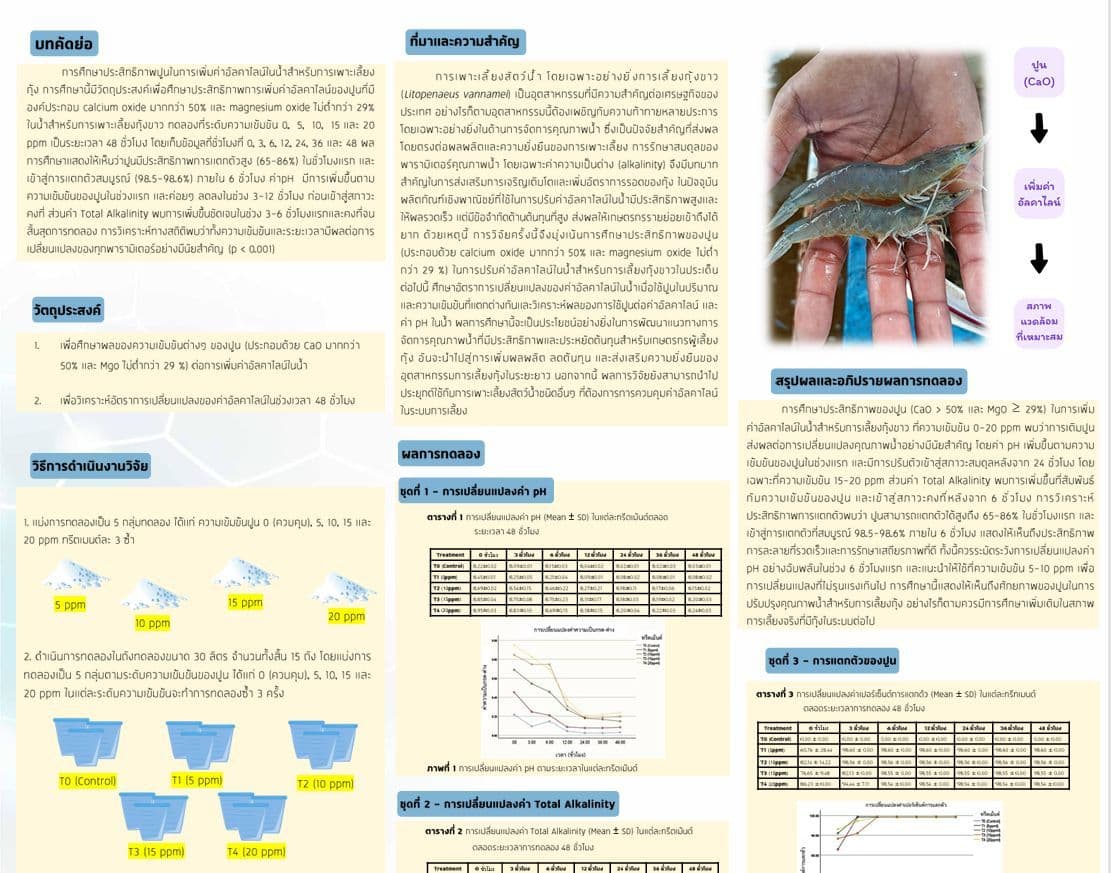
This study aimed to investigate the efficacy of lime containing more than 50% calcium oxide and not less than 29% magnesium oxide in enhancing water alkalinity for Pacific White Shrimp (Litopenaeus vannamei) aquaculture. The experiment was conducted at concentrations of 0, 5, 10, 15, and 20 ppm over a 48-hour period, with data collected at 0, 3, 6, 12, 24, 36, and 48 hours. Results demonstrated that lime exhibited high dissolution efficiency (65-86%) within the first hour and reached complete dissolution (98.5-98.6%) within 6 hours. The pH values initially increased proportionally with lime concentration, gradually decreased during 3-12 hours, before stabilizing. Total alkalinity showed significant increase during the first 3-6 hours and remained stable until the end of the experiment. Statistical analysis revealed that both concentration and time significantly affected all parameters (p < 0.001)
คณะบริหารธุรกิจ
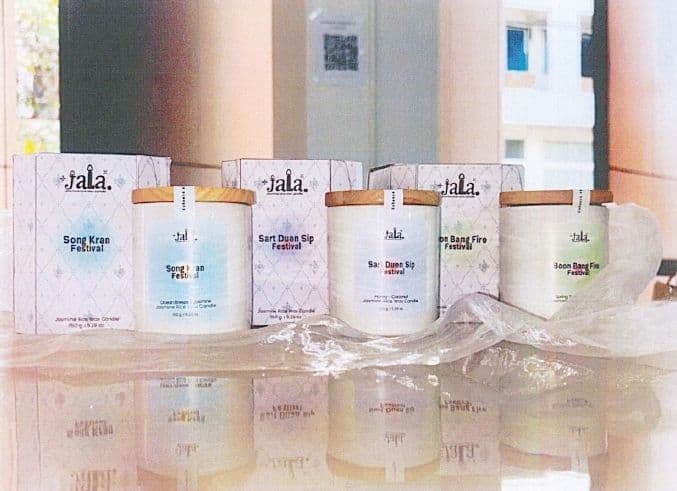
JALA is a brand that established a business around jasmine rice wax scented candles with the aim of addressing the stress people face in everyday life. The brand utilizes "Aromatherapy" to help relax the mind and alleviate stress. The scented candles made from jasmine rice wax are an innovative product, distinguished by their clean burn, safety for users and the environment, and high vitamin E content that nourishes the skin. They also retain a unique fragrance that provides true relaxation. JALA aims to offer products that blend traditional Thai elements with modern design, making their scented candles not only therapeutic but also a reflection of Thai culture and modern identity. The brand caters to health-conscious and environmentally aware consumers.