

Otitis Media is an infection of the middle ear that can occur in individuals of all ages. Diagnosis typically involves analyzing images taken with an otoscope by specialized physicians, which relies heavily on medical experience to expedite the process. This research introduces computer vision technology to assist in the preliminary diagnosis, aiding expert decision-making. By utilizing deep learning techniques and convolutional neural networks, specifically the YOLOv8 and Inception v3 architectures, the study aims to classify the disease and its five characteristics used by physicians: color, transparency, fluid, retraction, and perforation. Additionally, image segmentation and classification methods were employed to analyze and predict the types of Otitis Media, which are categorized into four types: Otitis Media with Effusion, Acute Otitis Media with Effusion, Perforation, and Normal. Experimental results indicate that the classification model performs moderately well in directly classifying Otitis Media, with an accuracy of 65.7%, a recall of 65.7%, and a precision of 67.6%. Moreover, the model provides the best results for classifying the perforation characteristic, with an accuracy of 91.8%, a recall of 91.8%, and a precision of 92.1%. In contrast, the classification model that incorporates image segmentation techniques achieved the best overall performance, with an mAP50-95 of 79.63%, a recall of 100%, and a precision of 99.8%. However, this model has not yet been tested for classifying the different types of Otitis Media.
โรคหูน้ำหนวกเป็นโรคที่เกิดจากการอักเสบของหูชั้นกลาง โดยมีอาการปวดหู หูอื้อ และมีน้ำไหลซึมออกมาจากหู ในบางกรณีที่ได้รับการรักษาไม่ถูกต้องหรือไม่ทันการ อาจพบว่ามีน้ำหนองซึมรวมอยู่ด้วย นอกจากนี้หากอาการอักเสบเกิดความรุนแรงเพิ่มมากขึ้น อาจส่งผลให้ผู้ป่วยสูญเสียการได้ยินและเกิดภาวะแทรกซ้อนซึ่งเป็นสาเหตุอันนำไปสู่การเกิดโรคอื่น ๆ ในกระบวนการรักษาโรคหูน้ำหนวกจำเป็นต้องมีแพทย์ผู้เชี่ยวชาญทำการวินิจฉัย โดยสอดกล้องออโตสโคปเข้าไปในรูหูเพื่อตรวจสอบ อย่างไรก็ตาม ในขั้นตอนนี้มักพบปัญหาและข้อจำกัดบางประการ เช่น ทักษะและประสบการณ์ของแพทย์ผู้ตรวจอาจไม่ชำนาญพอจะวินิจฉัยได้อย่างถูกต้องแม่นยำ ความพร้อมของเครื่องมือและอุปกรณ์ซึ่ง ในบางครั้งจำเป็นต้องมีการวินิจฉัยเพิ่มด้วยการวัดขนาดแก้วหูหรือการถ่ายภาพ ดังนั้นแล้วในขั้นตอนการรักษานี้สามารถพัฒนาเครื่องมือร่วมกับการประยุกต์ใช้ศาสตร์องค์-ความรู้ทางด้านคอมพิวเตอร์เข้ามาเพื่อแก้ปัญหา รวมทั้งช่วยลดภาระงานของบุคลากรทางการแพทย์ โดยเฉพาะอย่างยิ่งคือการขาดแคลนบุคลากรซึ่งมีไม่เพียงพอต่อปริมาณผู้ป่วย นอกจากนี้เพื่อให้การรักษามีประสิทธิภาพ ยังต้องคำนึงถึงความพร้อมของแพทย์ผู้รักษาซึ่งไม่ใช่เพียงทักษะหรือเครื่องมือ แต่รวมไปถึงสภาพร่างกายที่อาจเกิดจากความเหนื่อยล้าและโอกาสเกิดข้อผิดพลาดจากการวินิจฉัย หัวข้อปัญหาพิเศษนี้จึงได้นำเสนอแนวทางการแก้ไขปัญหาโดยการนำทฤษฎีการเรียนรู้เชิงลึก(Deep Learning) มาประยุกต์ใช้ เพื่อเป็นเครื่องมือช่วยในการจำแนกอาการผิดปกติของโรคหูน้ำหนวกจากภาพถ่ายและภาพเคลื่อนไหว ซึ่งเก็บรวบรวมจากแพทย์ผู้เชี่ยวชาญ ทั้งนี้ ปัจจัยสำคัญที่เป็นจุดสังเกตในการวินิจฉัยโรค ได้แก่ ปริมาณของเหลวในหูชั้นกลาง การหดตัวของเยื่อหูชั้นกลาง สีของของเหลวในหูชั้นกลาง ความโปร่งใสของเยื่อหูชั้นกลาง การทะลุของเยื่อหู และการขยับของเยื่อ-แก้วหูเมื่อเป่าลมทดสอบ ทั้งหมดนี้สามารถนำไปวิเคราะห์และจำแนกเป็นอาการได้ดังนี้ หูปกติ เยื่อ-แก้วหูยุบ เยื่อแก้วหูทะลุ มีของเหลวขังในเยื่อแก้วหู เยื่อแก้วหูอักเสบเฉียบพลัน และหูชั้นกลางทะลุ

คณะอุตสาหกรรมอาหาร
In recent years, many people have shown greater interest in plant-based proteins because of their health benefits and lower impact on the environment. This study will look at the physical and chemical properties of chickpeas and red beans. It will also create a plant-based burger that tastes and feels similar to meat-based burgers while providing comparable nutrition. We will steam the ingredients and then analyze important properties such as texture, color, water activity (aW), pH, and how well they retain water and oil. Additionally, we will conduct a sensory evaluation to understand consumer preferences.
คณะวิศวกรรมศาสตร์
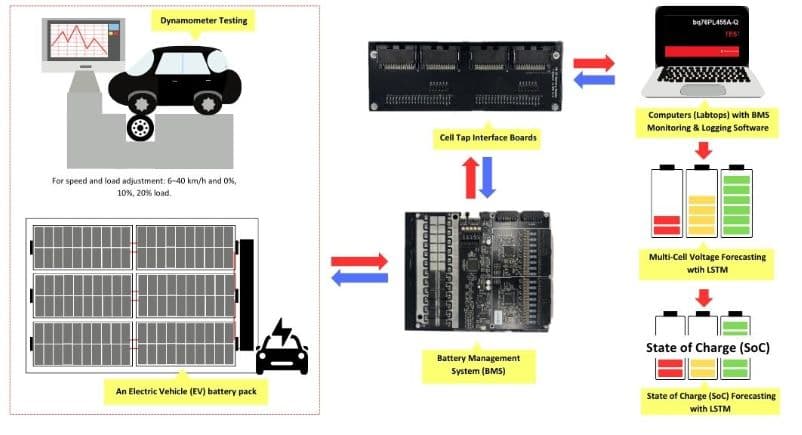
This research develops a "Smart Battery Management System (BMS) Demonstration Kit for Electric Vehicles" — a scaled-down prototype that measures battery cell voltage, current, and temperature while precisely controlling cell balancing and charge-discharge processes, supported by a real-time dashboard. The kit integrates LSTM and GRU AI models for accurate prediction of battery voltage and State of Charge (SoC) under varying load conditions, enabling early anomaly detection and predictive maintenance. Designed for exhibition displays and as a teaching resource for higher education and vocational institutions, this demonstration kit delivers meaningful impact across education, research, and innovation development in Thailand's electric vehicle industry.
คณะอุตสาหกรรมอาหาร
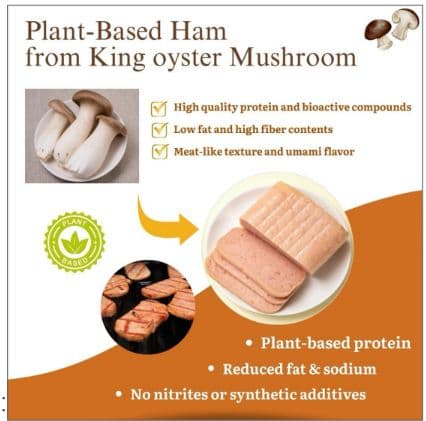
This project therefore aims to develop a "Plant-based Ham Product Prototype" using king oyster mushrooms (Pleurotus eryngii) as the primary ingredient — a natural raw material with strong potential in terms of nutritional value and meat-like texture. The project also seeks to improve the production process to achieve a product with satisfactory textural and flavor characteristics, meeting the needs of a new generation of health- and environmentally-conscious consumers, while providing a foundation for further commercial development within the alternative protein market.