
KMITL Expo 2026 LogoKMITL 66th Anniversary Logo

Smart BMS Demonstrator for EV Energy Management – Empowering the Future of Education and Thai Industry

Smart BMS Demonstrator for EV Energy Management – Empowering the Future of Education and Thai Industry

Abstract

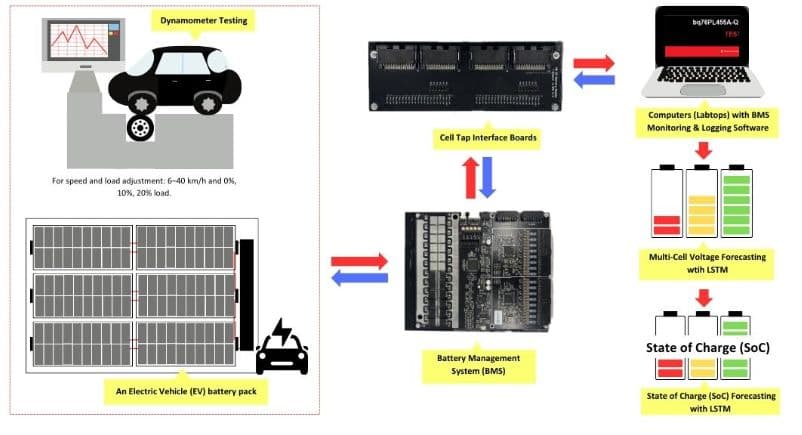
This research develops a "Smart Battery Management System (BMS) Demonstration Kit for Electric Vehicles" — a scaled-down prototype that measures battery cell voltage, current, and temperature while precisely controlling cell balancing and charge-discharge processes, supported by a real-time dashboard. The kit integrates LSTM and GRU AI models for accurate prediction of battery voltage and State of Charge (SoC) under varying load conditions, enabling early anomaly detection and predictive maintenance. Designed for exhibition displays and as a teaching resource for higher education and vocational institutions, this demonstration kit delivers meaningful impact across education, research, and innovation development in Thailand's electric vehicle industry.

Objective

ในยุคที่โลกกำลังเปลี่ยนผ่านสู่ระบบพลังงานสะอาด ยานยนต์ไฟฟ้า (EV) ได้กลายเป็นหนึ่งในเทคโนโลยีสำคัญที่ถูกขับเคลื่อนทั้งในระดับนโยบายภาครัฐและอุตสาหกรรมยานยนต์ทั่วโลก โดยเฉพาะในประเทศไทยที่รัฐบาลได้ประกาศวิสัยทัศน์ “30@30” เพื่อให้ยานยนต์ไฟฟ้ามีสัดส่วนการผลิตไม่น้อยกว่า 30% ของการผลิตรถยนต์ภายในประเทศภายในปี พ.ศ. 2573 อย่างไรก็ตาม แม้จะมีการเติบโตของตลาด EV อย่างต่อเนื่อง แต่ยังพบข้อจำกัดสำคัญคือ การขาดแคลนองค์ความรู้และระบบประกอบที่มีคุณภาพในประเทศ โดยเฉพาะ ระบบบริหารจัดการแบตเตอรี่ หรือ BMS (Battery Management System) ซึ่งถือเป็นหัวใจสำคัญของการควบคุมความปลอดภัย ประสิทธิภาพ และอายุการใช้งานของแบตเตอรี่ใน EV จากประสบการณ์ของทีมวิจัยที่ได้ดำเนินโครงการต่อยอดระบบ BMS สำหรับยานยนต์ไฟฟ้า ทีมพบว่าผู้ประกอบการภายในประเทศส่วนใหญ่ยังขาดความรู้ความเข้าใจเกี่ยวกับมาตรฐาน BMS ที่ถูกต้อง และมีการนำระบบราคาถูกจากต่างประเทศที่ไม่มีการควบคุมคุณภาพมาใช้งานในเชิงพาณิชย์ ทำให้เกิดความเสี่ยงทั้งในด้านประสิทธิภาพและความปลอดภัยของผู้ใช้งาน อีกทั้งยังไม่มีต้นแบบหรือชุดจัดแสดงที่สามารถอธิบายการทำงานของ BMS และเทคโนโลยี AI ที่เกี่ยวข้องในลักษณะที่เข้าใจง่าย และสามารถนำไปใช้ในงานด้านการเรียนการสอน หรือนิทรรศการวิชาการเพื่อการขยายผลได้จริง ด้วยเหตุนี้โครงการนี้จึงมีวัตถุประสงค์เพื่อพัฒนา “ชุดสาธิตระบบ BMS อัจฉริยะสำหรับยานยนต์ไฟฟ้า” ที่สามารถแสดงการทำงานของระบบควบคุมแบตเตอรี่ พร้อมการวิเคราะห์ข้อมูลแรงดันและสถานะประจุ (SoC) แบบเรียลไทม์โดยใช้โมเดลปัญญาประดิษฐ์ เช่น LSTM และ GRU ซึ่งพัฒนาโดยทีมวิจัย พร้อมแสดงผลผ่านแดชบอร์ดที่เข้าใจง่าย เหมาะแก่การจัดแสดงในงาน KMITL Innovation EXPO 2026 และยังสามารถใช้ในห้องเรียนหรือการอบรมวิชาชีพได้ในระยะยาว โครงการนี้จึงมีความสำคัญทั้งในเชิงวิชาการ อุตสาหกรรม และสังคม โดยเป็นสื่อกลางเชื่อมโยงองค์ความรู้ด้านเทคโนโลยีแบตเตอรี่ การจัดการพลังงานและ AI เข้ากับผู้เรียน นักพัฒนาและผู้ประกอบการ พร้อมทั้งสามารถเป็นต้นแบบสำหรับการต่อยอดสู่อุปกรณ์ BMS ที่ผลิตได้เองในประเทศในอนาคต ช่วยลดการพึ่งพาต่างประเทศและเพิ่มขีดความสามารถในการแข่งขันของอุตสาหกรรม EV ไทยอย่างยั่งยืน
Other Innovations

Effect of Seed Priming Technique with Chaetomorpha sp. on Germination and Seedlings Growth of Chili

คณะเทคโนโลยีการเกษตร

Effect of Seed Priming Technique with Chaetomorpha sp. on Germination and Seedlings Growth of Chili

This study investigated the effects of seed priming with Chaetomorpha sp. seaweed extract on seed germination and seedling growth of chili pepper. The objective was to examine the influence of seaweed extract concentrations on seed germination and seedling development. Seeds were primed in different concentrations of Chaetomorpha sp. extract, compared with a control treatment. The experiment was conducted using a completely randomized design with four replications. Results showed that seed priming with seaweed extract enhanced seed germination characteristics. Primed seeds exhibited improved germination percentage, germination index, and germination rate compared to the control. Additionally, seedlings from primed seeds showed enhanced root and shoot development. This study demonstrates the potential of Chaetomorpha sp. extract as a promising seed priming agent for improving chili pepper seed quality, which can be applied in the production of high-quality chili pepper seedlings.

Read more
Study on the Production Process and Shelf-Life Preservation of  Plant-Based Crab Cake under Refrigerated Conditions (Lab Scale)

คณะอุตสาหกรรมอาหาร

Study on the Production Process and Shelf-Life Preservation of Plant-Based Crab Cake under Refrigerated Conditions (Lab Scale)

Plant-based refers to food or products that are primarily made from plants. It can be divided into two categories: one is food that comes entirely from plants and does not include any animal products, and the other is food that contains small amounts of animal products, such as products that contain milk and eggs in limited quantities, which may also be considered part of the definition of plant-based. Plant-based meat products that closely resemble real meat and attract consumers are considered a relatively new innovation. Although tofu, tempeh, and seitan have been around for a long time, recent discoveries have led to the production of plant-based meat products that provide a sensory experience, making it difficult for consumers to distinguish between real meat and plant-based meat. Furthermore, the development of plant-based food products must prioritize quality and safety to maximize consumer benefits. Textured Vegetable Protein (TVP) is a plant-based protein made from soybeans using an extruder. It is used as a primary ingredient in the production of plant-based food products due to several advantages. These include: • High Protein Content: TVP is made from soybeans with the fat extracted, resulting in a high protein content. • Texture: When rehydrated, TVP has a texture that closely resembles meat. • Versatility: TVP has a neutral flavor, allowing it to easily absorb the flavors of various seasonings and sauces. • Cost-Effectiveness: Compared to other protein sources, TVP is relatively inexpensive while providing desirable characteristics. These benefits make TVP an attractive option in the production of plant-based foods. This study focuses on developing TVP into a plant-based crab cake and investigating the shelf life of the product in a tightly sealed container under refrigeration. It also analyzes the hygiene and cleanliness of the production process and how these factors affect the presence or growth of microorganisms that may pose a risk to consumers, referencing the cold food safety standards of Thailand. Finally, recommendations for cleaning operational areas will be provided to establishments as a guideline for developing preliminary food safety procedures in laboratory settings.

Read more
Café Customer Classification and Behavioral Analysis

คณะวิทยาศาสตร์

Café Customer Classification and Behavioral Analysis

In a highly competitive business, understanding customers is crucial for an organization to determine its success. Effective marketing is not just about offering good products, promotions, or services; it also requires strategies to reach and build strong relationships with customer groups. Segmenting customers is one method that helps businesses deeply understand the needs and behaviors of the customers who use their services In this internship, the objective is to understand the behavior of customers purchasing coffee and tea at a large cafe group by analyzing stored customer data. As a result of this process, customer groups purchasing coffee and tea were segmented using Naive Bayes, Random Forest, and Deep Learning techniques to compare the accuracy and suitability of different Machine Learning methods, and the insights gained from this analysis can be for further development in analyzing other data set in the future

Read more