

Since organic rice storage silos were faced with an insect problem, an owner solved this problem using the expert system (ES) in the controlled atmosphere process (CAP) under the required standard, fumigating insects with an N2, reducing O2 concentration to less than 2% for 21 days. This article presents the computational fluid dynamics (CFD) assisted ES successfully solved this problem. First, CFD was employed to determine the gas flow pattern, O2 concentration, proper operating conditions, and a correction factor (K) of silos. As expected, CFD results were consistent with the experimental results and theory, assuring the CFD’s credibility. Significantly, CFD results revealed that the ES controlled N2 distribution throughout the silos and effectively reduced O2 concentration to meet the requirement. Next, the ES was developed based on the inference engine assisted by CFD results and the sweep-through purging principle, and it was implemented in the CAP. Last, the experiments evaluated CAP’s efficacy in controlling O2 concentration and insect extermination in the actual silos. The experimental results and owner’s feedback confirmed the excellent efficacy of ES implementation; therefore, the CAP is effective and practical. The novel aspect of this research is a CFD methodology to create the inference engine and the ES.
การเก็บรักษาข้าวใน ไซโลเก็บข้าวอินทรีย์ เป็นแนวทางสำคัญในการรักษาคุณภาพข้าวและลดการสูญเสียหลังการเก็บเกี่ยว อย่างไรก็ตาม ปัญหาการปนเปื้อนของแมลงศัตรูข้าว เป็นอุปสรรคสำคัญที่ส่งผลกระทบต่อคุณภาพและความปลอดภัยของข้าว โดยทั่วไป การกำจัดแมลงในไซโลมักใช้สารรมยาเคมี เช่น ฟอสฟีน (PH₃) หรือ เมทิลโบรไมด์ (CH₃Br) ซึ่งอาจก่อให้เกิดสารตกค้าง ส่งผลต่อสุขภาพผู้บริโภค และสร้างผลกระทบต่อสิ่งแวดล้อม
คณะวิศวกรรมศาสตร์
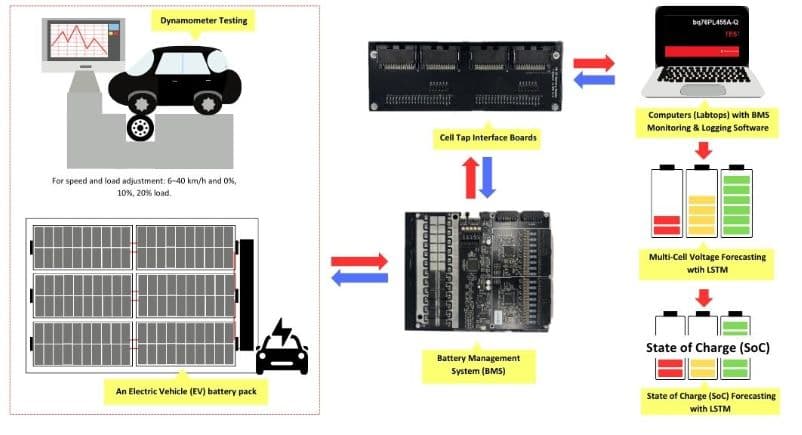
This research develops a "Smart Battery Management System (BMS) Demonstration Kit for Electric Vehicles" — a scaled-down prototype that measures battery cell voltage, current, and temperature while precisely controlling cell balancing and charge-discharge processes, supported by a real-time dashboard. The kit integrates LSTM and GRU AI models for accurate prediction of battery voltage and State of Charge (SoC) under varying load conditions, enabling early anomaly detection and predictive maintenance. Designed for exhibition displays and as a teaching resource for higher education and vocational institutions, this demonstration kit delivers meaningful impact across education, research, and innovation development in Thailand's electric vehicle industry.

วิทยาลัยเทคโนโลยีและนวัตกรรมวัสดุ
This research aims to develop and test a Skin-on-a-Chip (SoC) device that integrates skin cells and endothelial cells within a microfluidic system to closely simulate the biological environment of human skin. The device reduces reliance on animal testing while lowering research costs and time, and improves the accuracy of pharmaceutical and cosmeceutical ingredient testing. The project targets TRL 5 prototype development alongside patent filing and pilot-scale manufacturing process development, with a clear pathway toward commercial readiness within two years.

คณะวิศวกรรมศาสตร์
During the recent years, PM2.5 concentration is rising above the safety exposure limit in Thailand. PM2.5 could have originated from various sources such as exhaust fumes, open air burning, wildfire, etc. This concludes that all cities or places would have different PM source contributions. Most studies regarding the PM source findings were done based on chemical analysis. Our research team would like to predict the PM sources physically by nanostructures analysis. These methods would require the PM dust to be collected in a limited amount of time and dry. The use of paper filters may cause contamination from filter material which may cause errors in result evaluation. Our team suggests using Electrostatic Precipitator (ESP) where electrostatics is used to capture PM dust. This research mainly focuses on designing and building the ESP system for PM collection whereas the requirement is to collect at least 100 mg of PM dust within 1 day which would be adequate for nanostructure analysis. The study revealed that the customized ESP system could achieve of up to 80% collecting efficiency (which is more than the commercial ESP that we previously used), there’s a also a parametric study of relationships between flow velocity and collecting efficiency where collecting efficiency is inversely proportional to flow velocity. The suggested air velocity is not to exceed 2 m/s. However, there’re still more room for improvement of the ESP system for PM collection such as the convenience of PM collection process which resulted from the ESP construction geometry and sizes.