

**Innovative Walking Stick "Buddy Take Care"** The "Buddy Take Care" walking stick is designed to physically support the elderly or individuals recovering from injuries, enabling convenient mobility, reducing the risk of falls, and enhancing walking safety. It is crafted as a keychain-style walking stick with a one-touch open-close mechanism. Building upon existing market products, the Buddy walking stick incorporates additional functionalities such as a portable flashlight, a medicine compartment, and an AirTag slot to maximize utility. Its design prioritizes ease of use, convenience, and safety, specifically tailored for elderly users
ปัจจุบันประเทศไทยได้ก้าวเข้าสู่สังคมผู้สูงอายุอย่างเต็มรูปแบบ ผู้สูงอายุบางกลุ่มประสบปัญหา การเดิน การทรงตัวทำให้มีความเสี่ยงต่อการหกล้ม ซึ่งอาจส่งผลกระทบรุนแรงไม้เท้าจึงเป็นอุปกรณ์ที่ผู้สูงอายุนิยมใช้เพื่อช่วยในการเคลื่อนไหว อย่างไรก็ตาม ไม้เท้าที่พบในท้องตลาดมักมีข้อจำกัด เช่น ขนาดใหญ่ พกพายากเมื่อใช้งานเป็นเวลานานอาจทำให้รู้สึกปวดมือ ทำให้กลุ่มของพวกเราต้องการออกแบบไม้เท้าในรูปแบบใหม่ที่พกพาง่าย และปลอดภัยกับการใช้งานต่อผู้สูงอายุโดยเฉพาะ
คณะสถาปัตยกรรม ศิลปะและการออกแบบ
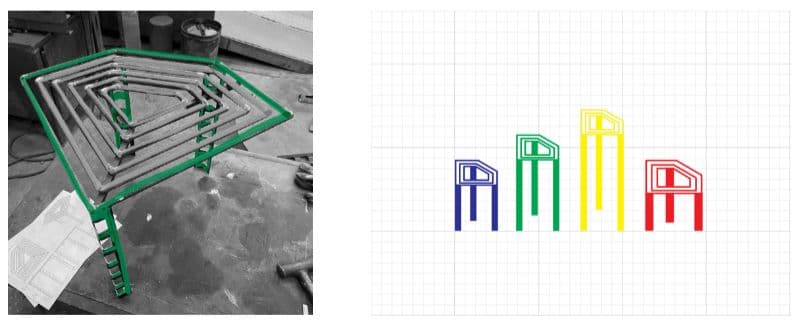
This research focuses on transforming waste materials from a micro-pile industrial establishment into value-added products through the Upcycle design process, guided by the principles of creative innovation and the 3Rs resource efficiency framework. The study aims to investigate the types and potential of discarded materials for creative product development, resulting in distinctive household and decorative items designed within the constraints of available technology and in-house craftsmanship. The outcomes were achieved through collaborative work among the industrial establishment, metal craftsmen, and the community as end users, leading to prototype products with viable commercial potential. Furthermore, the project serves as a knowledge transfer platform from academic institutions to the industrial sector, providing a practical guideline for entrepreneurs, designers, and start-ups interested in developing new products from waste materials in a creative and sustainable manner.

คณะเทคโนโลยีการเกษตร
The design of Dreamscape Park, a public park covering an area of 50 rai, is based on the concept of ART. The design focuses on preserving green spaces while enhancing functionality to cater to people of all ages. The park features a landmark in the form of a water pond shaped like a drop of ink and a medium-sized amphitheater for various activities. Additional relaxation areas include a café, chill-out seating, outdoor activity zones, and sports facilities such as a basketball court, a takraw court, and walking/running paths around the park. There are also pet zones, children's play areas, gardens at various points, and accessible pathways throughout the area. Users can enjoy a peaceful environment and engage in activities according to their preferences.

วิทยาลัยเทคโนโลยีและนวัตกรรมวัสดุ
The development of skin-on-a-chip models plays a crucial role in research for drug and cosmetic development. Traditional approaches often utilize two-dimensional (2D) methods that rely on culturing cells on flat surfaces, resulting in a lack of complexity in skin structure and realistic cell interactions. Moreover, traditional methods have limitations in mimicking fluid flow and nutrient circulation, which affects the accuracy of pharmaceutical testing and the prediction of drug effects. This has led to the advancement of three-dimensional (3D) skin models using new microfluidic technology, enhancing the realism of skin structure by replicating both the epidermis and dermis layers, as well as simulating fluid flow similar to physiological conditions in the human body. The design of 3D systems allows for more realistic cell arrangement and interactions, enabling better simulation of skin functions and increasing the accuracy in evaluating the effects of various substances on cell responses, including absorption, inflammation, and wound healing. Therefore, the development of three-dimensional (3D) skin models not only addresses the limitations of traditional methods but also represents a significant step forward in creating models that can be effectively applied in drug testing and pharmaceutical product development.