

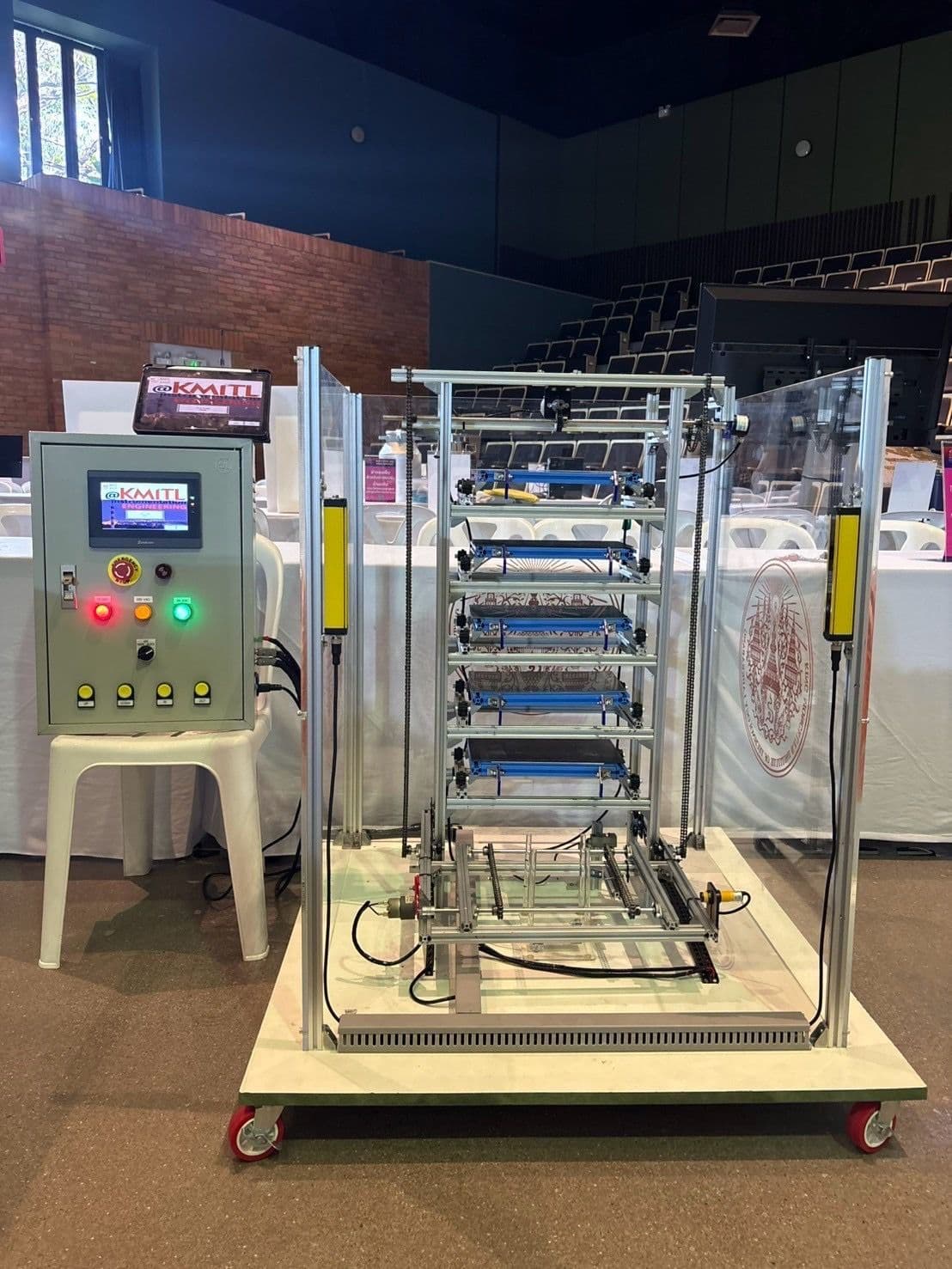
This project aims to introduce an Automated Vertical Metal Sheet Storage System. The project is aimed at teaching how to make an Automation Vertical Metal Sheet Storage System with the integration of microcontroller devices. The project is divided into two main sections, which are the structure and control systems of the Automation Vertical Metal Sheet Storage System that will be designed and drawn through a computer program and constructed using major aluminum structures upon completion of their actual sizes outlined in the programs. Also, a Microcontroller control system using GX Works 2 program from Mitsubishi PLC has been designed for this purpose where it controls up and down movements as well as sideways movement of the pallet. It also has a weighing capability along with touch screen display for displaying information about the steel plates and controlling the Automation Vertical Metal Sheet Storage System with safety light curtain that protect users safety. These tests have shown that the machine operates normally. There are few mistakes whose rates fall within those expected by humans.
ปัจจุบันในขณะที่เศรษฐกิจภายในประเทศพัฒนาและอุตสาหกรรมการผลิตยังคงขยายตัวอย่างรวดเร็ว ทำให้หลายองค์กรประสบปัญหาผลผลิตไม่เพียงพอต่อความต้องการของตลาดส่งผลให้เกิดปัญหาความต้องการแรงงานในการผลิตจำนวนมาก แต่ในปัจจุบันเกิดการขาดแคลนแรงงานและหลายองค์กรต้องปรับปรุงประสิทธิภาพของกระบวนการภายในบริษัทตั้งแต่กระบวนการจัดซื้อจนถึงการส่งมอบผลิตภัณฑ์ขั้นสุดท้ายให้กับลูกค้าเพื่อให้บริษัทสามารถแข่งขันในธุรกิจได้ การจัดการคลังสินค้าเป็นสิ่งสำคัญโดยเฉพาะอย่างยิ่งกิจกรรมการจัดการองค์กรและการจัดการคลังสินค้าส่งผลโดยตรงว่าต้นทุนด้านโลจิสติกส์สามารถตอบสนองความต้องการของลูกค้าได้อย่างมีประสิทธิภาพหรือไม่ คลังสินค้าประกอบด้วยกิจกรรมหลัก ได้แก่ การรับสินค้า การเคลื่อนย้าย การจัดเก็บ และการจัดวางคลังสินค้า เลือกใช้อุปกรณ์ขนย้ายเพื่อใช้ภายในคลังสินค้ารวมทั้งกระจายสินค้า หากบริษัทมีการจัดการคลังสินค้าที่มีประสิทธิภาพ จะช่วยเพิ่มศักยภาพภายในของบริษัทและสามารถลดต้นทุนผ่านการดำเนินงานที่มีประสิทธิภาพมากขึ้น ระบบที่ใช้ในการจัดเก็บผลิตภัณฑ์แผ่นเหล็กต้องมีคนทำงานอย่างน้อย 4 คนเพื่อขนส่งแผ่นเหล็กขนาดใหญ่ หลังจากนั้นแผ่นเหล็กจะถูกยกขึ้นและวางบนพาเลท รูปแบบการจัดเก็บแผ่นเหล็กที่ได้รับความนิยมมักมีปัญหาในการใช้พื้นที่ว่าง ปัญหาในการนับสินค้าและปัญหาในระบบการจัดเก็บไฟล์ เช่น พนักงานบันทึกข้อมูลไม่ถูกต้องเกี่ยวกับประเภทของโลหะ ปริมาณ ขนาด และตำแหน่งของผลิตภัณฑ์ที่จัดเก็บไว้ในไฟล์ สิ่งเหล่านี้ส่งผลกระทบอย่างมากต่อประสิทธิภาพการทำงานในคลังสินค้า นอกจากนี้ยังมีผลกระทบต่อต้นทุน เวลา และประสิทธิภาพในการดำเนินงาน ดังนั้น ผู้จัดทำโครงการได้คิดค้นแนวคิดในการสร้างโครงการระบบจัดเก็บแผ่นเหล็กที่คล้ายกับระบบจัดเก็บอัตโนมัติ เพื่อศึกษาระบบการทำงาน การออกแบบและสร้างต้นแบบระบบจัดเก็บแผ่นเหล็กแนวตั้งอัตโนมัติสำหรับจัดเก็บแผ่นเหล็กขนาดต่างๆ โดยระดับการจัดเก็บของแผ่นเหล็กไม่เกิน 10 ซม. และน้ำหนักไม่เกิน 5 กก. ระบบจะมีทั้งหมด 5 ชั้น มีไมโครคอนโทรลเลอร์ควบคุมการทำงานและโหลดเซลล์(เพื่อชั่งน้ำหนัก) มีหน้าจอสัมผัสสำหรับควบคุมเครื่องและปุ่มหยุดฉุกเฉินและม่านแสงนิรภัยเพื่อป้องกันด้านความปลอดภัยของผู้ใช้งาน

คณะวิทยาศาสตร์
This project presents the development of a "Smart Cat House" using Internet of Things (IoT) and image processing technology to facilitate and enhance the safety of cat care for owners. The infrastructure of the smart cat house consists of an ESP8266 board connected to an ESP32 CAM camera for cat monitoring, and an Arduino board that controls various sensors such as a motion sensor in the litter box, a DHT22 temperature and humidity sensor, an ultrasonic water and food level sensor, including a water supply system for cats, an automatic feeding system, and a ventilation system controlled by a DC FAN that adjusts its operation according to the measured temperature to maintain a suitable environment. There is also an IR sensor to detect the cat's entry into the litter box and an automatic sand changing system with a SERVO MOTOR. All systems are connected and controlled through the Blynk application, which can be used on mobile phones, allowing owners to monitor and care for their pets remotely. Cat detection and identification uses image processing technology from the ESP32 CAM camera in conjunction with YOLO (You Only Look Once), a high-performance object detection algorithm, to detect and distinguish between cats and people. Data from various sensors are sent to the Arduino board to control the operation of various devices in the smart cat house, such as turning lights on and off, automatically changing sand, adjusting temperature and humidity, feeding food and water at scheduled times, or ventilation. The use of a connection system via ESP8266 and the Blynk application makes it easy and convenient to control various devices. Owners can monitor and control the operation of the entire system from anywhere with internet access.
คณะวิทยาศาสตร์
This study aimed to investigate the effectiveness of extracts from moringa seeds, roselle seeds, and tamarind seeds as coagulants to improve water quality in surface water sources. Extracts from these seeds serve as environmentally friendly coagulants and provide alternative options for enhancing surface water quality. The turbidity of surface water sources ranged between 14 and 24 NTU. The coagulation process used the Jar Test method, where the moringa seed, roselle seed, and tamarind seed extracts functioned as both primary coagulants and coagulant aids. In the preparation process, the seeds were finely ground and extracted using a 0.5-M sodium chloride (NaCl) solution. These extracts were then applied as coagulants to reduce turbidity and enhance water quality, with each concentration tested in 300 ml of water. The results indicated that the most effective way to remove turbidity using 2,000 mg/L of moringa seed extract, achieving a turbidity reduction of approximately 73.19% at a cost of 0.0309 baht per 300 ml of water. Followed by Tamarind seed extract, with a concentration of 4,000 mg/L, followed with a turbidity reduction of approximately 56.75% at a cost of 0.0933 baht per 300 ml. Lastly, roselle seed extract at 6,000 mg/L achieved a turbidity reduction of approximately 32.67% at a cost of 0.0567 baht per 300 ml of water.
คณะวิทยาศาสตร์
A new colorimetric assay for the rapid detection of tannic acid in beverage samples based on displacement phenomenon of aggregated gallic acid-modified platinum nanoparticles is developed for the first time. PtNPs were functionalized with gallic acid, promoting the formation of the green-hued aggregated nanoparticles. While colorimetry offers a rapid method for identifying tannic acid, challenges remain in sensitivity and accuracy of detection on the PtNPs colorimetric probe, particularly in the presence of anthocyanin interferences. To address this, we developed a sample preparation method to degrade anthocyanin in beverages. Tannic acid was easily displaced onto the gallic acid-coated PtNPs surfaces, causing dispersion and resulting in a visible color change from green to orange−brown. Under the optimal conditions, the colorimetric sensor exhibited a linear response in the range of 1−2,000 µmol L−1 (R2 = 0.9991). The limit of detection (LOD) and the limit of quantification (LOQ) were found at 0.02 and 0.09 µmol L−1, respectively. The proposed sensor expressed superior selectivity over other interfering substances and demonstrated excellent precision with a relative standard deviation (RSD) of 1.00%−3.36%. More importantly, recoveries ranging from 95.0−104.7% were obtained, indicating the capability of proposed colorimetric sensor to detect tannic acid rapidly and accurately in real beverage samples.