
KMITL Expo 2026 LogoKMITL 66th Anniversary Logo

The development of precision automation system for Siamese fighting fish (Betta splendens)

The development of precision automation system for Siamese fighting fish (Betta splendens)

Abstract

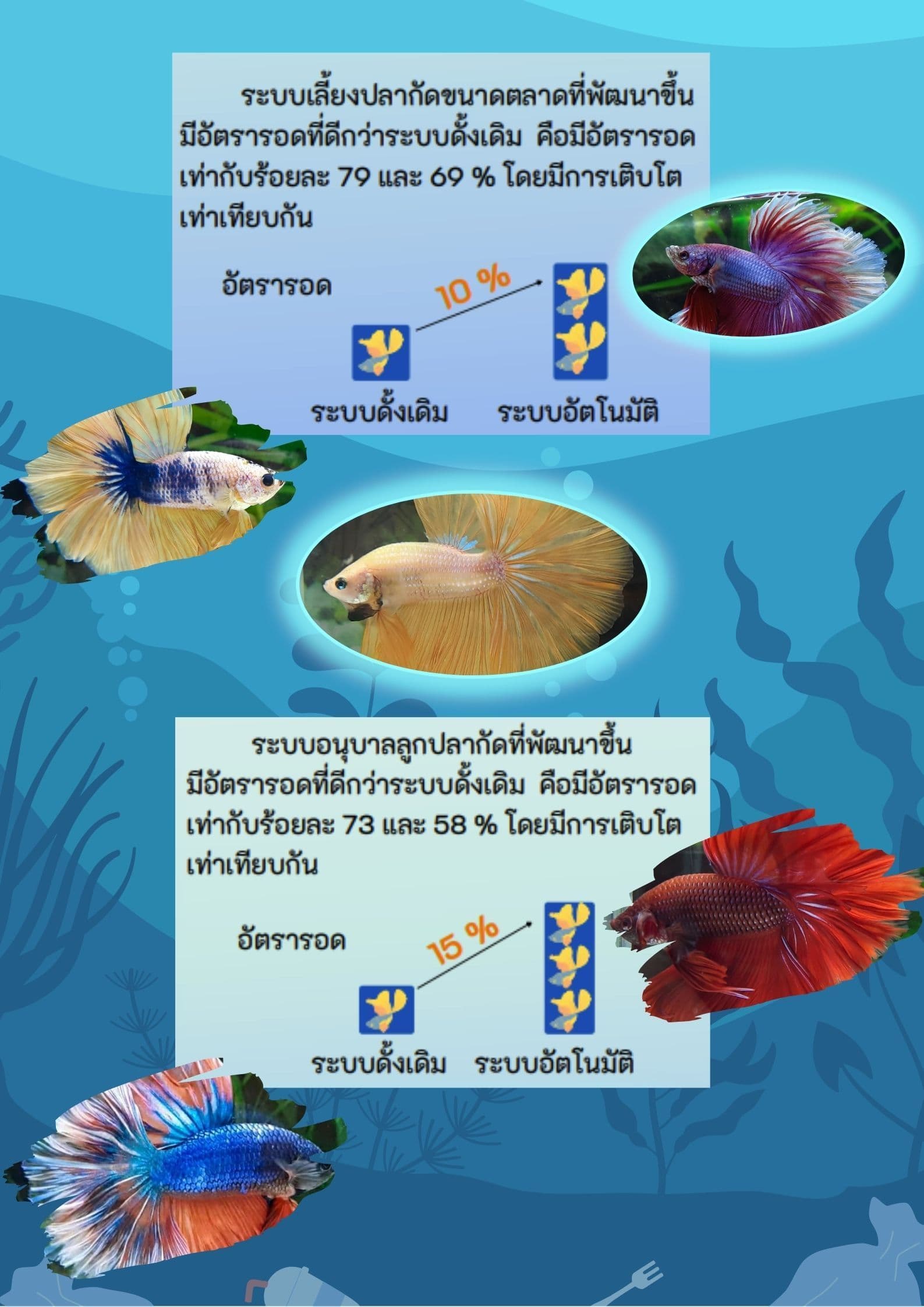
Siamese fighting fish (Betta splendens) is an ornamental fish that is the first exported economically valuable fish in the country, but there is a limitation to increase the production of betta fish due to climate variability and the shortage of Thai workers. This research aims to develop 2 systems: a betta fish fry nursery system and a market-sized betta fish rearing system by using automated technology to precisely control the water quality in the system and reduce labor costs. Using precise automation consists of two systems: a minimal-waste system, which repurposes some of the waste generated from farming, and a zero-waste system, which treats and recycles all wastewater from farming. These systems aim to address issues related to water quality, animal welfare, and labor requirements in Betta fish farming. Experimental results show that these systems improve Betta fish survival rates by 10-15% compared to traditional methods. When considering net returns, the zero- waste system provides the highest profitability.

Objective

ในการเพาะเลี้ยงปลากัดประกอบด้วย ระบบอนุบาลลูกปลากัด เป็นการเลี้ยงลูกปลากัดในบ่อปูนซีเมนต์ขนาดเส้นผ่านศูนย์กลาง 60-80 เซนติเมตร มีการเพิ่มระดับน้ำแทนการเปลี่ยนถ่ายน้ำสัปดาห์ละ 5-10 เซนติเมตรจากระดับน้ำเดิม และการเลี้ยงปลาขนาดตลาด เป็นการเลี้ยงปลากัดในขวดแบนเรียงต่อกันจำนวนมากบนพื้นคอนกรีต มีการให้อาหารหรือเปลี่ยนถ่ายน้ำโดยใช้แรงงานคน 1 คนต่อการเลี้ยงปลากัด 10,000 – 40,000 ตัว ดังนั้นระบบอนุบาลและการเลี้ยงปลากัดขนาดตลาดแบบพัฒนาใหม่โดยใช้เทคโนโลยีในการควบคุมคุณภาพน้ำ การให้อาหารและการเปลี่ยนถ่ายน้ำด้วยระบบอัตโนมัติ จะช่วยแก้ปัญหาอัตราการตายของปลา การใช้แรงงาน และยังสามารถเพิ่มอัตราการรอดของลูกปลากัดได้อีกด้วย

Other Innovations

Power of Leaves: A Natural Fluorescent Seed Coating Innovation for Anti-Counterfeiting

คณะเทคโนโลยีการเกษตร

Power of Leaves: A Natural Fluorescent Seed Coating Innovation for Anti-Counterfeiting

This experiment aimed to study the suitable types of polymers for coating with chlorophyll extract and the quality of cucumber seeds after coating. The experiment was planned using a Completely Randomized Design (CRD) with four replications, consisting of five methods involving seeds coated with different types of polymers: Polyvinylpyrrolidone, Sodium Alginate, Carboxy Methyl Cellulose, and Hydroxypropyl Methylcellulose, each polymer being coated alongside chlorophyll, with uncoated seeds serving as the control method. The coating substance was prepared by extracting chlorophyll from mango leaves, then mixed with each type of polymer at a concentration of 1%, using an 8% concentration of chlorophyll extract. The properties of each coating method, such as pH and viscosity of the coating substance, were examined before coating the cucumber seeds with a rotary disk coater model RRC150 at a coating rate of 1,100 milliliters per 1 kilogram of seeds. Subsequently, the seeds were dried to reach the initial moisture level using a hot air blower, and seed quality was assessed in various aspects, including seed moisture, germination rate under laboratory conditions, germination index, and seed fluorescence under a portable ultraviolet light illuminator, as well as light emission spectrum analysis using a Spectrophotometer. The experiment found that each type of polymer could be used to form a film together with chlorophyll, which had appropriate pH and viscosity for the coating without affecting seed quality and showed fluorescence on the seed surface both under portable ultraviolet light and spectral emission analysis with a Spectrophotometer. Using HPMC as the film-forming agent with chlorophyll was the most suitable method, enhancing seed fluorescence efficiency.

Read more
Self Doubt

คณะสถาปัตยกรรม ศิลปะและการออกแบบ

Self Doubt

A Photographic series that expresses the abstract states of myself, towards the question of existence that results from being surrounded by expectations of both surrender and freedom of expression, this series focuses on my own subjectivities in order to bring back memories of almost forgotten feelings and make them clear once more.

Read more
A Human-engaging Robotic Interactive Assistant

คณะวิศวกรรมศาสตร์

A Human-engaging Robotic Interactive Assistant

The integration of intelligent robotic systems into human-centric environments, such as laboratories, hospitals, and educational institutions, has become increasingly important due to the growing demand for accessible and context-aware assistants. However, current solutions often lack scalability—for instance, relying on specialized personnel to repeatedly answer the same questions as administrators for specific departments—and adaptability to dynamic environments that require real-time situational responses. This study introduces a novel framework for an interactive robotic assistant (Beckerle et al. , 2017) designed to assist during laboratory tours and mitigate the challenges posed by limited human resources in providing comprehensive information to visitors. The proposed system operates through multiple modes, including standby mode and recognition mode, to ensure seamless interaction and adaptability in various contexts. In standby mode, the robot signals readiness with a smiling face animation while patrolling predefined paths or conserving energy when stationary. Advanced obstacle detection ensures safe navigation in dynamic environments. Recognition mode activates through gestures or wake words, using advanced computer vision and real-time speech recognition to identify users. Facial recognition further classifies individuals as known or unknown, providing personalized greetings or context-specific guidance to enhance user engagement. The proposed robot and its 3D design are shown in Figure 1. In interactive mode, the system integrates advanced technologies, including advanced speech recognition (ASR Whisper), natural language processing (NLP), and a large language model Ollama 3.2 (LLM Predictor, 2025), to provide a user-friendly, context-aware, and adaptable experience. Motivated by the need to engage students and promote interest in the RAI department, which receives over 1,000 visitors annually, it addresses accessibility gaps where human staff may be unavailable. With wake word detection, face and gesture recognition, and LiDAR-based obstacle detection, the robot ensures seamless communication in English, alongside safe and efficient navigation. The Retrieval-Augmented Generation (RAG) human interaction system communicates with the mobile robot, built on ROS1 Noetic, using the MQTT protocol over Ethernet. It publishes navigation goals to the move_base module in ROS, which autonomously handles navigation and obstacle avoidance. A diagram is explained in Figure 2. The framework includes a robust back-end architecture utilizing a combination of MongoDB for information storage and retrieval and a RAG mechanism (Thüs et al., 2024) to process program curriculum information in the form of PDFs. This ensures that the robot provides accurate and contextually relevant answers to user queries. Furthermore, the inclusion of smiling face animations and text-to-speech (TTS BotNoi) enhanced user engagement metrics were derived through a combination of observational studies and surveys, which highlighted significant improvements in user satisfaction and accessibility. This paper also discusses capability to operate in dynamic environments and human-centric spaces. For example, handling interruptions while navigating during a mission. The modular design allows for easy integration of additional features, such as gesture recognition and hardware upgrades, ensuring long-term scalability. However, limitations such as the need for high initial setup costs and dependency on specific hardware configurations are acknowledged. Future work will focus on enhancing the system’s adaptability to diverse languages, expanding its use cases, and exploring collaborative interactions between multiple robots. In conclusion, the proposed interactive robotic assistant represents a significant step forward in bridging the gap between human needs and technological advancements. By combining cutting-edge AI technologies with practical hardware solutions, this work offers a scalable, efficient, and user-friendly system that enhances accessibility and user engagement in human-centric spaces.

Read more