
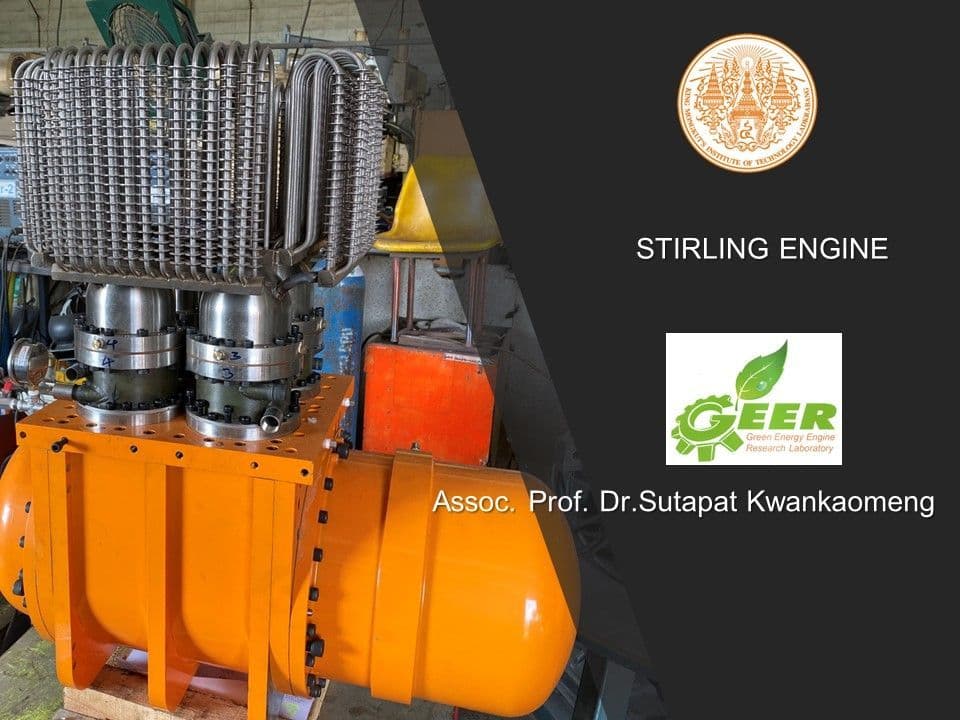
Stirling engine is the external heated engine that heat is sup-plied externally to the heater part of the engine. Thus, Stirling cycle engine can be employed with various sources of renewable energy such as biomass, biofuel, solar energy, geothermal energy, recovery heat, and waste. The integration of gasifier, burner, and heat engine as a power system offers more fuel choices of each local area with potential resources resulting independent from shortage and cost fluctuation of fossil fuel. This research aims to investigate the integration of the Stirling engine with a wood pellet gasifier for electric power generation. Biomass can be controlled to have continuously combustion with ultra-low toxic emission. Stirling engine, therefore, is a promising alternative in small-scale-electricity production. Even though many biomass-powered Stirling engines were successfully constructed and marketed but these engines and the use of biomass resources as fuel for power generation are quite new concepts in some developing countries. Especially, the capital cost of this engine is high and unaffordable for installation compared to other power systems. Therefore, this research aims to the study attractive and feasibility of the compact Stirling engine with green energy.
เนื่องจากความต้องการพลังงานที่มีมากขึ้น แต่เชื้อเพลิงฟอสซิลซึ่งเป็นแหล่งพลังงานหลักมีอยู่อย่างจำกัดและเป็นสาเหตุหนึ่งของมลพิษและภาวะโลกร้อน ดังนั้นพลังงานทางเลือกจึงเป็นกุญแจสำคัญเพื่อความยั่งยืนด้านพลังงาน ประเทศไทยมีศักยภาพของพลังงานชีวมวลจากเกษตรกรรม ดังนั้นการพัฒนาระบบผลิตไฟฟ้าที่มลพิษต่ำและสามารถใช้ได้กับแหล่งพลังงานทดแทนจึงจำเป็นอย่างยิ่ง โดยเฉพาะเครื่องยนต์สเตอร์ลิงซึ่งมีโครงสร้างชิ้นส่วนไม่ซับซ้อน ปราศจากการสันดาปภายในเครื่องยนต์จึงเป็นเครื่องยนต์ที่มีศักยภาพผลิตไฟฟ้าด้วยพลังงานสะอาดและเป็นมิตรกับสิ่งแวดล้อมและความสำเร็จของโรงไฟฟ้าเครื่องยนต์สเตอร์ลิง ในประเทศไทย เพื่อคนไทย

คณะอุตสาหกรรมอาหาร
This study aims to investigate the co-encapsulation technique of vitamin C and coenzyme Q10 within liposomes to enhance their stability and encapsulation efficiency and evaluate their antioxidant activity and release behavior under simulated gastrointestinal conditions. Liposomes were prepared using the High-Speed Homogenization Method, and their characteristics, including particle size, zeta potential, encapsulation efficiency, and antioxidant activity, were analyzed using DPPH, ABTS, and FRAP assays. The results demonstrated that co-encapsulation significantly improved the stability of vitamin C and coenzyme Q10 compared to single encapsulation. The liposomes exhibited high encapsulation efficiency and maintained strong antioxidant activity. The release profile under simulated gastrointestinal conditions also indicated a sustained and controlled release. These findings highlight the potential of the co-encapsulation technique in enhancing the efficacy of functional bioactive compounds, making it applicable to the food and nutraceutical industries.
คณะบริหารธุรกิจ
In a world increasingly focused on sustainability and reducing environmental impact, DreamHigh is pioneering an innovative approach to packaging solutions using mycelium—a natural, biodegradable, and renewable material derived from fungi. Our mission is to revolutionize the packaging industry by offering eco-friendly alternatives that not only reduce waste but also align with global efforts to combat climate change. Mycelium packaging offers a compelling alternative to traditional plastic and Styrofoam packaging, which contribute significantly to environmental pollution. It is fully biodegradable, compostable, and capable of breaking down in natural environments within weeks, leaving no toxic residues behind. Additionally, mycelium-based products are lightweight, durable, and customizable, making them suitable for a wide range of applications, from consumer goods packaging to protective shipping materials. DreamHigh’s business plan outlines a scalable production process leveraging advanced mycelium cultivation techniques and partnerships with local agricultural sectors to utilize agricultural waste as a key raw material. This not only ensures cost-efficiency but also supports a circular economy by repurposing waste that would otherwise be discarded.
คณะบริหารธุรกิจ
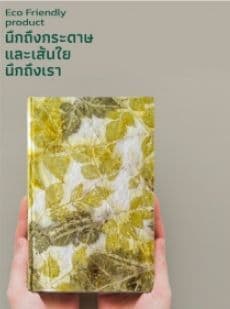
In an era where sustainability is at the heart of business operations, eco-friendly packaging is gaining increasing attention. This research explores sustainable business models for alternative packaging, focusing on the case of corn-based paper, an innovation that effectively replaces conventional plastic packaging. The study analyzes key factors that enable businesses using natural raw materials to remain competitive in the market, as well as the growth potential of sustainable packaging compared to plastic-based alternatives. Additionally, it examines the factors influencing consumer behavior in choosing eco-friendly products and evaluates the impact on profitability and social responsibility. This research employs both qualitative and quantitative methods, including case studies of businesses utilizing alternative materials, in-depth interviews with industry experts, and consumer behavior surveys. The findings are expected to provide insights into the business potential of corn-based packaging, strategies for market expansion, and approaches for long-term sustainability. The results of this study will serve as a valuable reference for entrepreneurs seeking to develop green businesses and policymakers aiming to promote sustainable packaging in the market.