

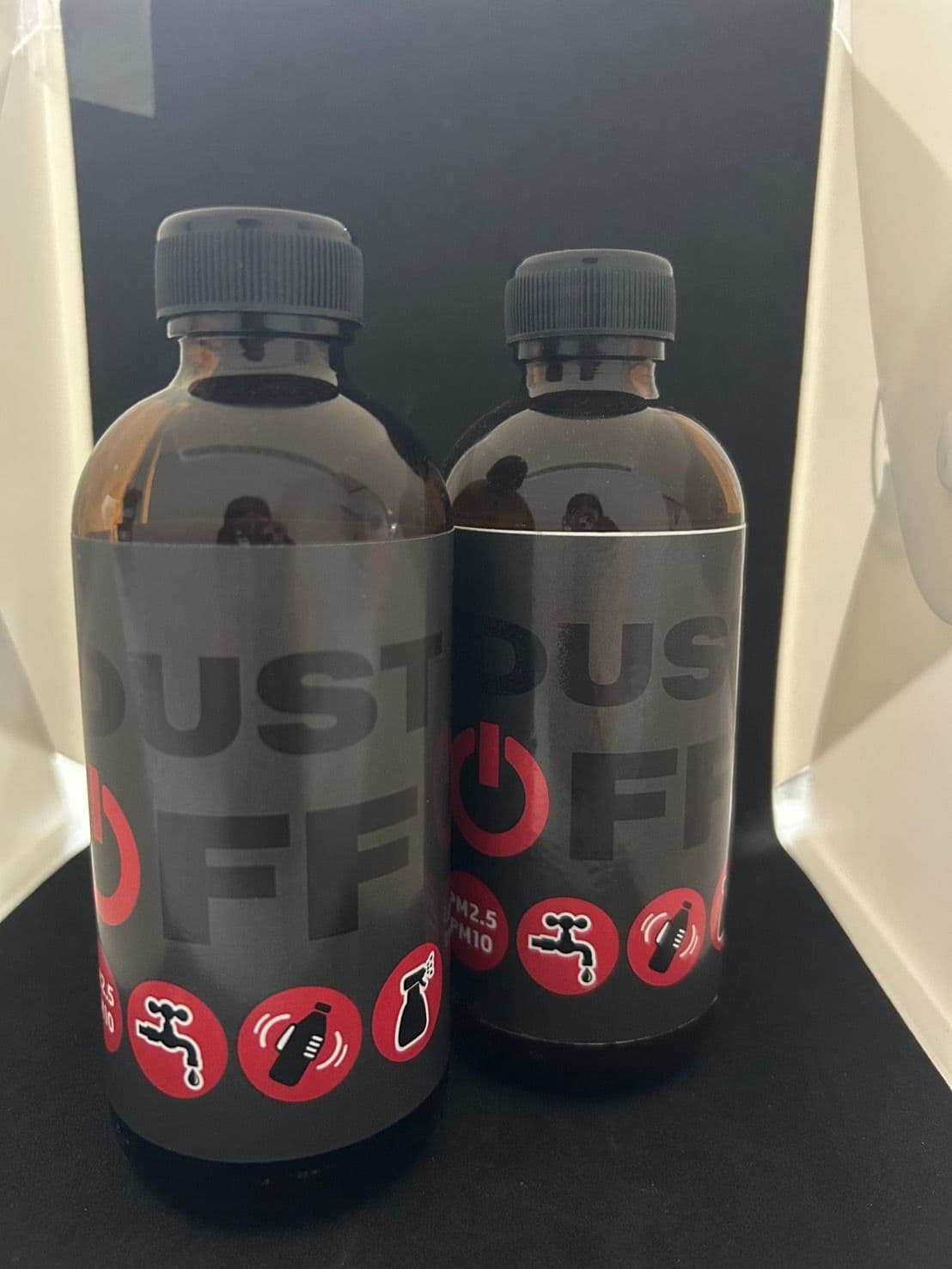
The extreme weathers according to PM 2.5 is a global problem with out any borders. This pollutant can directly attack human health. The objective of the study was aimed to develop medicinal plant essential oil emulsions in order to use to decrease PM 2.5 based on chemical characterization of water-soluble anions and cations. A mount of 31 medicinal plant essential oil emulsions were prepared and then initially careened and tested for their efficiency in reducing PM 2.5 under test chamber by spraying method. It was found that spraying for 1 hr with kaffir lime essential oil emulsion at 0.025% concentration could reduce PM 2.5 obtained from engine exhaust pipe effectively when PM 2.5 of 24.7 µg/m3 was detected within 6 hrs, followed by kaffir lime essential oil emulsion at 0.05% and Eucalyptus essential oil emulsion at 0.05% and 0.025% concentration resulting in 27.3, 30.0 and 95.3 µg/m3, respectively. Whereas, water (blank) and control group (water and carboxymethylcellulose, CMC 0.2%) showed high revels of PM 2.5 with 126.4 and 157.3 µg/m3, respectively. This kaffir lime essential oil emulsion at 0.025% concentration showed 3-6 time decline of PM 2.5 upward 2 hrs compared with control group. Field experiment was performed at 3 Bangkok parks, namely, Suantaweewanarom, Suanbankharepirom and Suanthonbureerom. There were many factors affecting the decline of PM 2.5 caused by this essential oil emulsion, particularly, the windy as well as temperature and humidity. PM 2.5 level tended to be decreased after the beginning of spraying. In general, PM 2.5 levels appeared at those 3 parks were decreased rapidly within 1 hr as by average of 21.8 (7.7-27.3) µg/m3, Whereas, decline of only 6.4 (5.0-8.0) µg/m3 was observed in control (water). Incase of calm wind, (10-20 km/hr) this plant essential oil emulsion could even reduce PM 2.5 at 37.0-44.0 µg/m3 and reached to 13.5-16.5 µg/m3 within 3 hrs. As high level of PM 2.5 as 98.0-101.0 µg/m3 , it could reduce PM 2.5 to be an average of 23.0-26.5 µg/m3 within 3 hrs, Whereas, the use of water performed low capacity of PM 2.5 reduction found with only 31.0-40.0 µg/m3. However, windy condition (15-35 km/hr), the efficacy of this essential oil emulsion seem to be lower but tended to work better than using water alone
สถานการณ์มลพิษทางอากาศที่เกิดจากอนุภาคขนาดเล็ก (fine particulate matter) โดยเฉพาะอนุภาคหรือฝุ่นที่มีขนาดเล็กกว่า 2.5 µm (PM2.5) นับว่าเป็นปัญหาด้านสิ่งแวดล้อมในระดับโลก ในสหรัฐอเมริกาและยุโรปหลายประเทศได้ศึกษาติดตามการเกิดการแพร่กระจาย และผลกระทบต่อบรรยากาศและมนุษย์มาตั้งแต่ปี ค.ศ. 1980 (Yang et al., 2000) ในปัจจุบัน PM2.5 ไม่ได้ส่งผลกระทบในด้านทัศนียภาพการมองเห็น (Buseck et al., 1999) แต่ยังส่งผลกระทบที่สำคัญต่อสุขภาพของมนุษย์ (Pope et al., 2006) สารมลพิษที่เป็นฝุ่นละอองขนาดเล็กนี้สามารถเข้าสู่อวัยวะระบบทางเดินหายใจ ได้โดยตรง และทะลุไปถึงถุงลมปอดได้ทันที่ (Chen et al., 2015) ทำให้เกิดการระคายเคืองหรือทำลายระบบทางเดินหายใจได้โดยตรง เช่น เกิดการระคายเคืองตา ผิวหนังอักเสบ ระคายคอ แน่นหน้าอก หายใจถี่ หลอดลมอักเสบ หอบหืด หรือถุงลมโป่งพอง รวมทั้งโรคระบบหัวใจ และหลอดเลือดได้ นอกจากนี้โลหะหนักต่างๆ (เช่น Cr, Mn, Ni, Cu, Zn, As, Cd และ Pb) ที่ปะปนอยู่ใน PM2.5 นั้น หลายชนิดยังเป็นสารก่อมะเร็ง และมีความเสี่ยงต่อการเสียชีวิต ที่เกิดจากมะเร็งในปอดผ่านการหายใจ โดยเฉพาะที่อาจจะเกิดขึ้นกับแรงงานในโรงงาน หรือเหมืองแร่ในประเทศต่างๆ (Jarup, 2003) ดังนั้นวัตถุประสงค์ของการศึกษาครั้งนี้จึงเป็นการเสาะหาชนิดน้ำมันหอมระเหยจากพืชที่เหมาะสม โดยเฉพาะการเป็นประจุลบของสารในการจับกับประจุบวกและความสามารถในการละลายน้ำได้ดีของ PM 2.5 โดยจัดทำเป็นสูตรนาโนหรือไมโครอิมัลชันของน้ำมันหอมระเหยจากพืช และกำหนดแนวทางในการวางระบบฉีดพ่นเป็นละอองฝอยเพื่อลดปริมาณฝุ่นละออง PM2.5 ทั้งระดับพื้นที่ชุมชน โรงแรมที่พัก หรือในโรงงานอุตสาหกรรมที่สามารถควบคุมคุณภาพและมีความคุ้มค่าทางเศรษฐกิจ โดยการคาดว่าจะเป็นนวัตกรรมการลดฝุ่นละออง PM2.5 โดยใช้สารธรรมชาติที่ปลอดภัยต่อมนุษย์และสิ่งแวดล้อม
คณะสถาปัตยกรรม ศิลปะและการออกแบบ
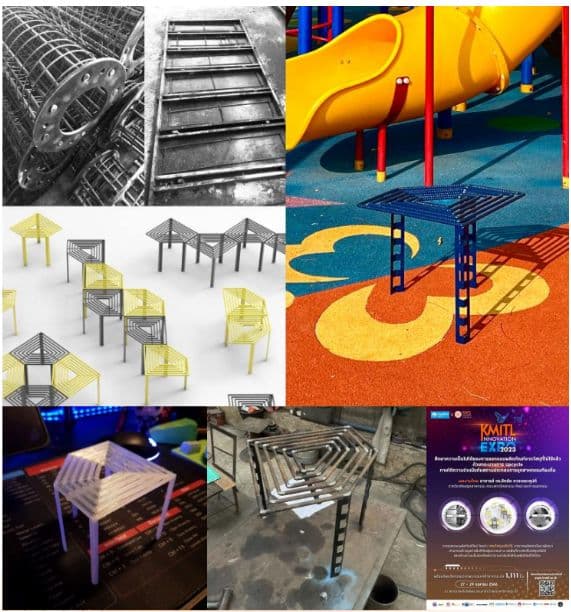
This study investigates the feasibility of designing products from industrial waste materials at a micro-pile establishment through the Upcycle process, guided by creative innovation principles and the 3Rs framework. The research examines the types and potential of discarded materials for developing distinctive decorative and household product prototypes, achieved through collaboration among academic institutions, the industrial establishment, craftsmen, and the local community. The resulting prototypes demonstrate viable commercial potential while serving as a practical knowledge base for entrepreneurs, designers, and start-ups seeking to develop new products from waste materials in a creative and sustainable manner.

คณะเทคโนโลยีสารสนเทศ
The project of game development to educate about Egyptian civilization This is intended to be a game to promote learning about ancient Egyptian civilization. The original learning may feel boring. Do not attract the attention of learners Therefore saw the presentation in the form of a game on virtual reality technology that inserts knowledge history With the aim of making learning more interesting The organizers can choose to use Unreal Engine 5.1 (Unreal Engine 5.1) and Oculus Quest II (Oculus Quest2) to develop. Within the game, players must find a way to escape from this room within the specified period of solving puzzles in various forms such as statues, traps, etc. In order to solve puzzles and leave this room, players must collect all the information inside the room. In addition, the game shows the life of the player and when the player cannot solve the puzzle correctly.
คณะวิทยาศาสตร์
Atopic dermatitis patients are the second largest number among skin disease patients. There is no cure for atopic dermatitis, and it can only be treated to relieve symptoms, causing chronic disease. There is a chance that opportunistic infections will enter and cause more disease from the patient's wound, causing the patient to have complications from other infections. This study is interested in studying the reduction of the chance of opportunistic infections in patients with atopic dermatitis using natural extracts. The interest is in Plu Kaow and long pepper because there is data supporting the inhibition of microorganisms. The leaves of both plants are crudely extracted, soaked in 95% ethanol for 7 days, filtered with a Buchner filter, and the extracts are tested for phytochemicals to analyze phenolic components, flavonoids, tannins, anthocyanin, DPPH, and tested for antimicrobial properties. The experiments consisted of 5 types of gram-positive and gram-negative bacteria: E. coli, Bacillus subtilis, Pseudomonas aeruginosa, Staphylococcus aureus, and Staphylococcus epidermidis. The researcher expects that this can be further developed and used to treat patients with atopic dermatitis.