

This project is a carbon safe haven of Bangkok, aspiring to be the prototypal gateway of the future's carbon net zero ambitions. The project aims to answer the fundamental "flaw" of the existing urban fabric, still being extremely inefficient and highly polluting. Conversely, Carbon Oasis would not only create its own energy, but look to provide its excess energy and water surplus' back to the city and its surroundings. Taking parts of the existing city and implementing new concepts to inspire a change in the urban fabric and its people.
โครงการนี้เริ่มต้นจากความสนใจส่วนตัวในด้านสิ่งแวดล้อมและ Green Design โดยณปัจจุบันโลกกำลังเผชิญกับวิกฤตสภาพภูมิอากาศ ซึ่งตอนนี้อุณหภูมิโลกได้เพิ่มสูงขึ้นถึงระดับ 1.5°C และกำลังเข้าใกล้ขีดจำกัด 2°C เพื่อรับมือกับสถานการณ์นี้องค์กร United Nations ได้กำหนดเป้าหมายใว้ในปี 2015 ในการบรรลุ Carbon Net Zero ภายในปี 2050 โครงการนี้ทำขึ้นเพื่อเป็นจุดเริ่มต้นของการเปลี่ยนแปลงในสถาปัตยกรรมสู่อนาคต
คณะเทคโนโลยีการเกษตร
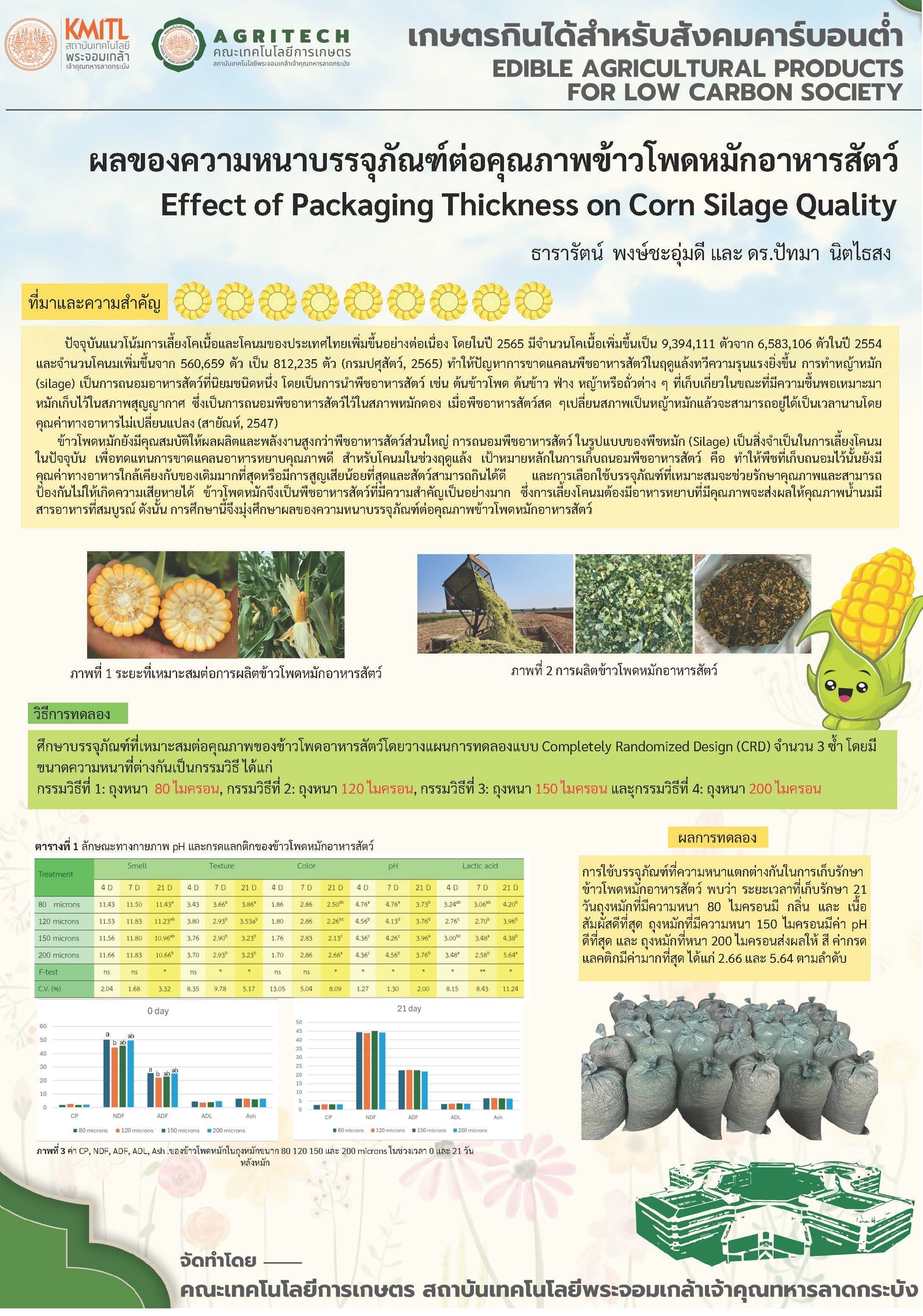
Climate change and the increasing unpredictability of environmental conditions have aggravated the shortage of animal feed crops during the dry season. This study examines effect of packaging thickness on the quality of corn silage during long-term storage, to maintain its nutritional value during feed shortages. The results show that packaging with thicknesses of 80, 120, 150, and 200 microns effectively maintain good physical quality, including odor, texture, color, and pH levels, during the 0–21day storage period. The silage had a fermented like fruit flavor or vinegar flavor, a silage texture, and well-preserved leaves and stems. Its color remained yellowish-green, with pH values between 3.7 and 4.7. Additionally, lactic acid analysis found that silage in 200-micron-thick packaging for 21 days had the highest lactic acid content (5.64%). However, there were no significant differences in the nutritional value of the silage across different packaging thicknesses

คณะครุศาสตร์อุตสาหกรรมและเทคโนโลยี
The Research aims to create Computer Assisted Instruction (CAI) on Kitchen Design for Residence for 20 undergraduate students at the Interior Environmental Design Division, School of Industrial Education and Technology, King Mongkut’s Institute of Technology Ladkrabang. This CAI is a self-learning program for Interior environmental design courses focused on kitchen design for residences. The program is designed to interact with students to create learner engagement and improve learning achievement by providing course content and end-of-chapter quizzes. The research hypothesis is CAI: Interior Environmental Design: Kitchen design for residence affects learners’ learning achievement and students' knowledge toward learning by this CAI. The Development testing (DT) with E1/E2 is the criterion for this instructional media to examine learning achievement. The research findings indicate that CAI is an effective instructional media, scoring 71.50/89.00, which meets the criteria of 80/80, demonstrating students’ learning achievement. Students achieved higher scores than before by using Computer-Assisted Instruction (CAI).
คณะวิทยาศาสตร์
A smartphone-based colorimetric sensor for quantitative detection of pyridoxine (Vitamin B6, VB-6) in functional drink samples has been realized by developing double layer hydrogel. Electrostatic interaction initiates the cross-linking and produces double layer hydrogel.