

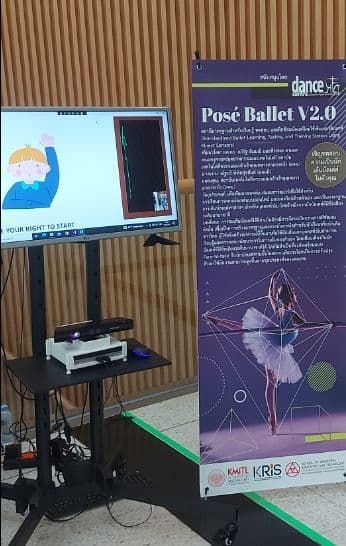
Ballet dancing requires clear and precise body gestures. To raise standard and motivation for Thai ballet dancers, this testing console is developed such that dancers and beginners are able to learn and keep track of their dancing progress. Their gestures can be compared with internationally recognized ballet dancers without face-to-face learning. This enables self-development according to their purposes and pace. The portable console is easy to use. Connect it to a monitor, turn on, and enjoy.
แม้ว่าบัลเลต์จะเป็นนาฏศิลป์แบบคลาสสิคที่กำเนิดมาตั้งแต่สมัยเรอเนสซองส์ในคริสต์ศตวรรษที่ 15 บัลเลต์ก็ยังเป็นที่นิยมในปัจจุบันทั้งในกลุ่มนักเต้นอาชีพและบุคคลทั่วไป ตลอดจนเป็นรากฐานและนำมาประยุกต์ให้เข้ากับการเต้นในหลายๆรูปแบบ โดยนักเต้นอาชีพที่มีชื่อเสียงมักมีประสบการณ์ในการเต้นบัลเลต์ไม่มากก็น้อย สำหรับในประเทศไทยนั้น แม้ว่าจะมีนักบัลเลต์ที่มีชื่อเสียงในระดับนานาชาติหลายท่าน แต่ก็ยังถือว่ามีจำนวนน้อยเมื่อเทียบกับจำนวนนักเรียน ดังนั้น เพื่อเป็นการสร้างมาตรฐานและแรงบันดาลใจสำหรับนักเรียนหรือนักเต้นชาวไทย ผู้วิจัยจึงสร้างอุปกรณ์นี้ขึ้นมาเพื่อให้นักเต้นและบุคคลทั่วไปสามารถเรียนรู้และตรวจสอบพัฒนาการในการเต้นของตัวเอง โดยเทียบเคียงกับนักบัลเลต์ที่มีชื่อเสียงระดับนานาชาติได้ โดยไม่จำเป็นที่จะต้องเรียนแบบ Face-to-face กับนักบัลเลต์ท่านนั้นโดยตรง เพื่อประโยชน์ในการปรับปรุงตัวเองให้มีความสามารถสูงขึ้นตามจุดประสงค์ของแต่ละคน
วิทยาลัยอุตสาหกรรมการบินนานาชาติ
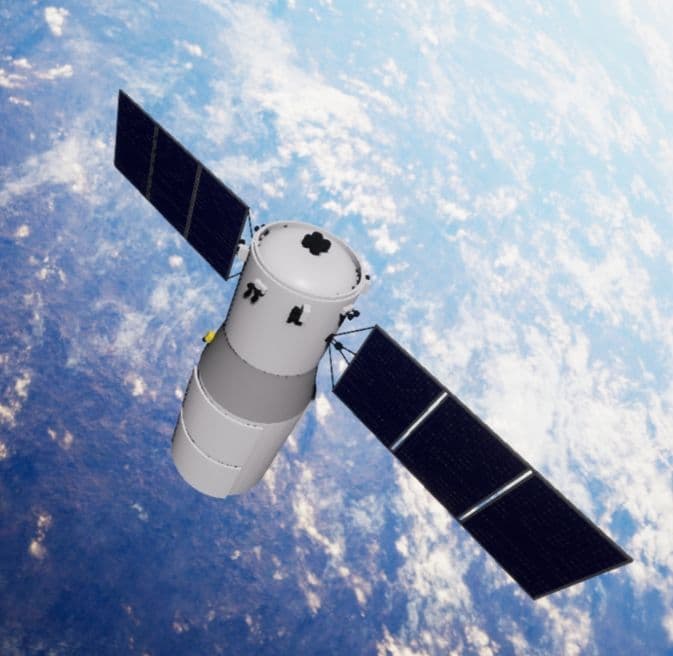
The capture of a target spacecraft by a chaser is an on-orbit docking operation that requires an accurate, reliable, and robust object recognition algorithm. Vision-based guided spacecraft relative motion during close-proximity maneuvers has been consecutively applied using dynamic modeling as a spacecraft on-orbit service system. This research constructs a vision-based pose estimation model that performs image processing via a deep convolutional neural network. The pose estimation model was constructed by repurposing a modified pretrained GoogLeNet model with the available Unreal Engine 4 rendered dataset of the Soyuz spacecraft. In the implementation, the convolutional neural network learns from the data samples to create correlations between the images and the spacecraft’s six degrees-of-freedom parameters. The experiment has compared an exponential-based loss function and a weighted Euclidean-based loss function. Using the weighted Euclidean-based loss function, the implemented pose estimation model achieved moderately high performance with a position accuracy of 92.53 percent and an error of 1.2 m. The in-attitude prediction accuracy can reach 87.93 percent, and the errors in the three Euler angles do not exceed 7.6 degrees. This research can contribute to spacecraft detection and tracking problems. Although the finished vision-based model is specific to the environment of synthetic dataset, the model could be trained further to address actual docking operations in the future.
คณะวิศวกรรมศาสตร์
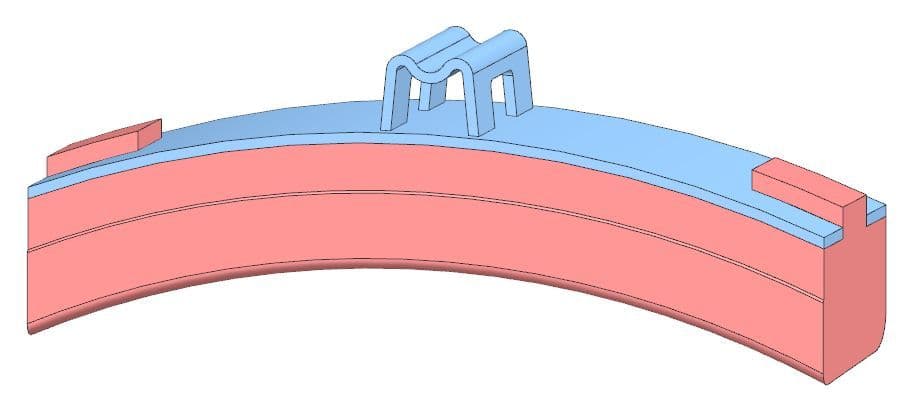
The railway brake system usually uses compressed air brake system which uses high-pressure air to press the brake shoe on the surface of the wheel to reduce the speed of the train. Repeated friction generates heat at the contact surface, increasing thermal stress on the cast iron brake shoe. The purpose of this study is to investigate the thermal stress on a prototype of cast iron brake shoe using the finite element method compare the analytical results to the actual brake shoe and redesign a brake shoe prototype to reduce thermal stress. Based on the results of the thermal stress study using the finite element method, it has shown that the location of the thermal stress on the prototype brake shoe according to the location of the crack on the real brake shoe. The brake shoe's design which includes single notch in the center of brake shoe which is can help to reduce thermal stress. The results from this study should be validated with the results from the field test to evaluate both of thermal distribution and braking efficiency in term of braking distances as well.

คณะวิทยาศาสตร์
This study aimed to investigate the effectiveness of extracts from moringa seeds, roselle seeds, and tamarind seeds as coagulants to improve water quality in surface water sources. Extracts from these seeds serve as environmentally friendly coagulants and provide alternative options for enhancing surface water quality. The turbidity of surface water sources ranged between 14 and 24 NTU. The coagulation process used the Jar Test method, where the moringa seed, roselle seed, and tamarind seed extracts functioned as both primary coagulants and coagulant aids. In the preparation process, the seeds were finely ground and extracted using a 0.5-M sodium chloride (NaCl) solution. These extracts were then applied as coagulants to reduce turbidity and enhance water quality, with each concentration tested in 300 ml of water. The results indicated that the most effective way to remove turbidity using 2,000 mg/L of moringa seed extract, achieving a turbidity reduction of approximately 73.19% at a cost of 0.0309 baht per 300 ml of water. Followed by Tamarind seed extract, with a concentration of 4,000 mg/L, followed with a turbidity reduction of approximately 56.75% at a cost of 0.0933 baht per 300 ml. Lastly, roselle seed extract at 6,000 mg/L achieved a turbidity reduction of approximately 32.67% at a cost of 0.0567 baht per 300 ml of water.