

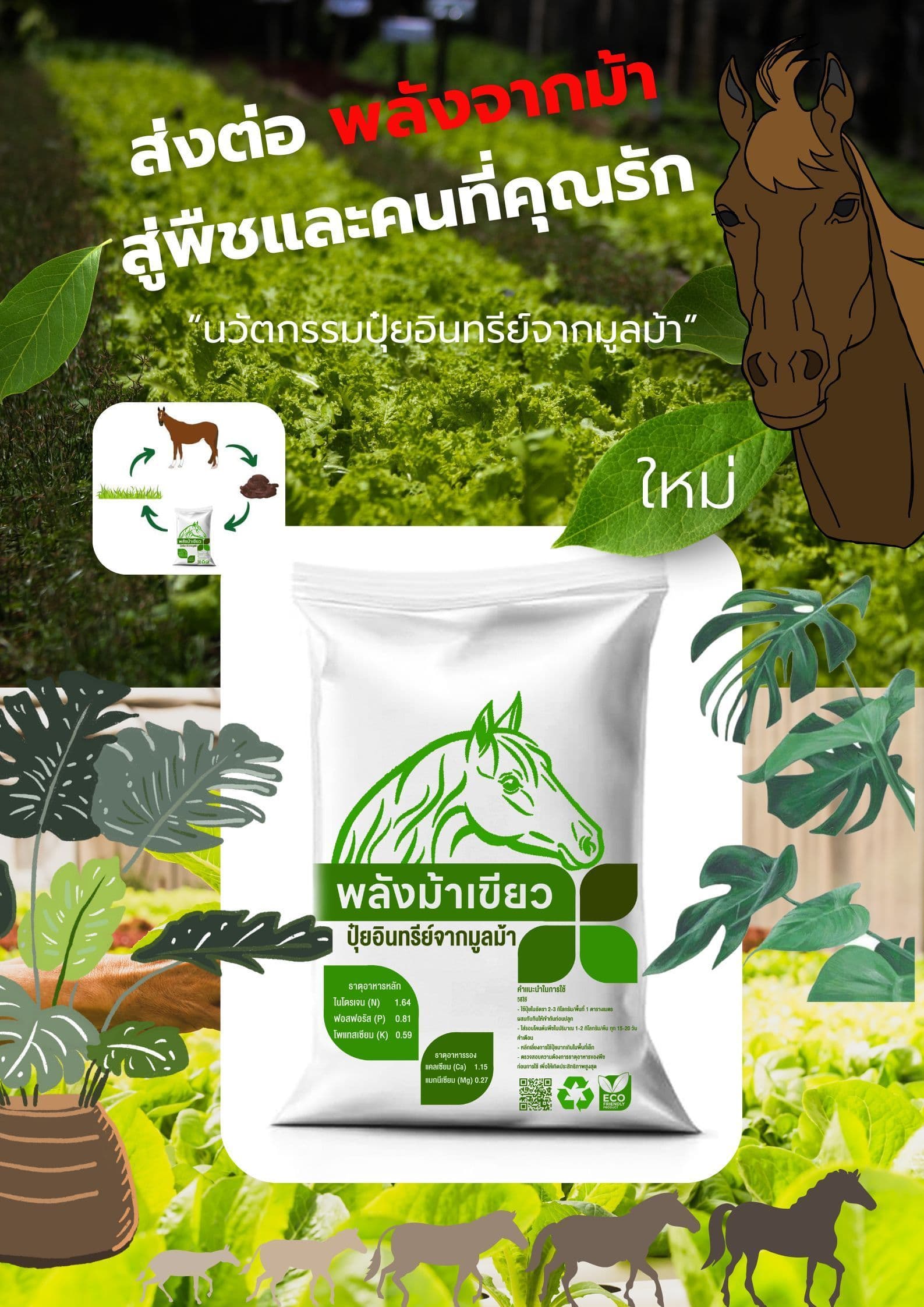
This research aims to study the waste management process of horse manure, the production process of organic fertilizer from horse waste, and opinions on the use of innovative organic fertilizer from horse manure. A mixed-method approach, combining qualitative and quantitative research, is employed. The organic fertilizer is produced from horse manure, which is a waste that incurs disposal costs. Through the fermentation process, it is transformed into an environmentally friendly fertilizer containing essential nutrients beneficial to plants. According to the laboratory analysis of the organic fertilizer conducted by the Soil Science Laboratory, Faculty of Agricultural Technology, King Mongkut's Institute of Technology Ladkrabang, it was found that organic fertilizer from horse manure contains essential nutrients for plant growth, including macronutrients, secondary nutrients, and micronutrients. This reflects the potential of horse waste management, the production process of organic fertilizer from horse manure, the efficiency of the organic fertilizer, and strategies for adding value to expand its commercialization.
ปัจจุบันกีฬาขี่ม้าในประเทศไทยได้รับความนิยม และเกิดฟาร์มเลี้ยงม้าในประเทศไทยมากขึ้น ส่งผลให้เกิดปัญหาการจัดการของเสียจากม้า โดยม้าแต่ละตัวผลิตมูลเฉลี่ย 18-23 กิโลกรัมต่อวัน หรือประมาณ 1 ตันต่อเดือน หากไม่มีการจัดการที่เหมาะสม อาจก่อให้เกิดปัญหาด้านสิ่งแวดล้อม เช่น กลิ่นเหม็น การแพร่กระจายของเชื้อโรค และข้อร้องเรียนจากชุมชนโดยรอบ เจ้าของฟาร์มต้องเสียค่าใช้จ่ายในการกำจัดมูลม้า แนวทางหนึ่งที่ช่วยลดปัญหาคือการนำของเสียจากม้ามาผลิตเป็นปุ๋ยอินทรีย์ ซึ่งเป็นกระบวนการที่ช่วยลดของเสียและเพิ่มมูลค่าทางเศรษฐกิจ เพื่อพัฒนาคุณภาพปุ๋ยอินทรีย์ สามารถนำสารเร่งหมักมาใช้เพื่อลดระยะเวลาการหมัก และเสริมแหนแดงเพื่อเพิ่มปริมาณไนโตรเจนในปุ๋ย ซึ่งช่วยให้ได้ปุ๋ยที่มีประสิทธิภาพสูงขึ้นและสามารถนำไปใช้เชิงพาณิชย์ สร้างรายได้ให้กับเจ้าของฟาร์มและเป็นมิตรกับสิ่งแวดล้อม

วิทยาลัยอุตสาหกรรมการบินนานาชาติ
This analysis focuses on the essential components of flight plans when operating at low altitudes. The study explores the critical elements that pilots and flight operators must consider to guarantee the safety of passengers, crew, and aircraft while flying at low altitudes. By examining factors such as weather conditions, airspace restrictions, terrain considerations, and emergency procedures, this analysis aims to provide valuable insights into optimizing flight planning processes for low-altitude operations
คณะวิทยาศาสตร์
Agricultural products and by-products are important raw materials in various industries including cosmetics and pharmaceuticals. Agro-based fibers have the composition, properties and structure that make them suitable for uses as composite-cosmetic industry. Upon microwave digestion, cellulose have been successfully synthesized into nanocrystalline cellulose (NCC) with lengths from 50-1000 nm, widths between 5-70 nm. Nanocrystalline cellulose was grafted with cosmetic active ingredients such as glycerin), sodium hyaluronate), glycolic acid, and nicotinamide. The beauty active ingredients attached nanocelluloses can penetrate through the skin to enhance beauty and youth.
คณะเทคโนโลยีการเกษตร
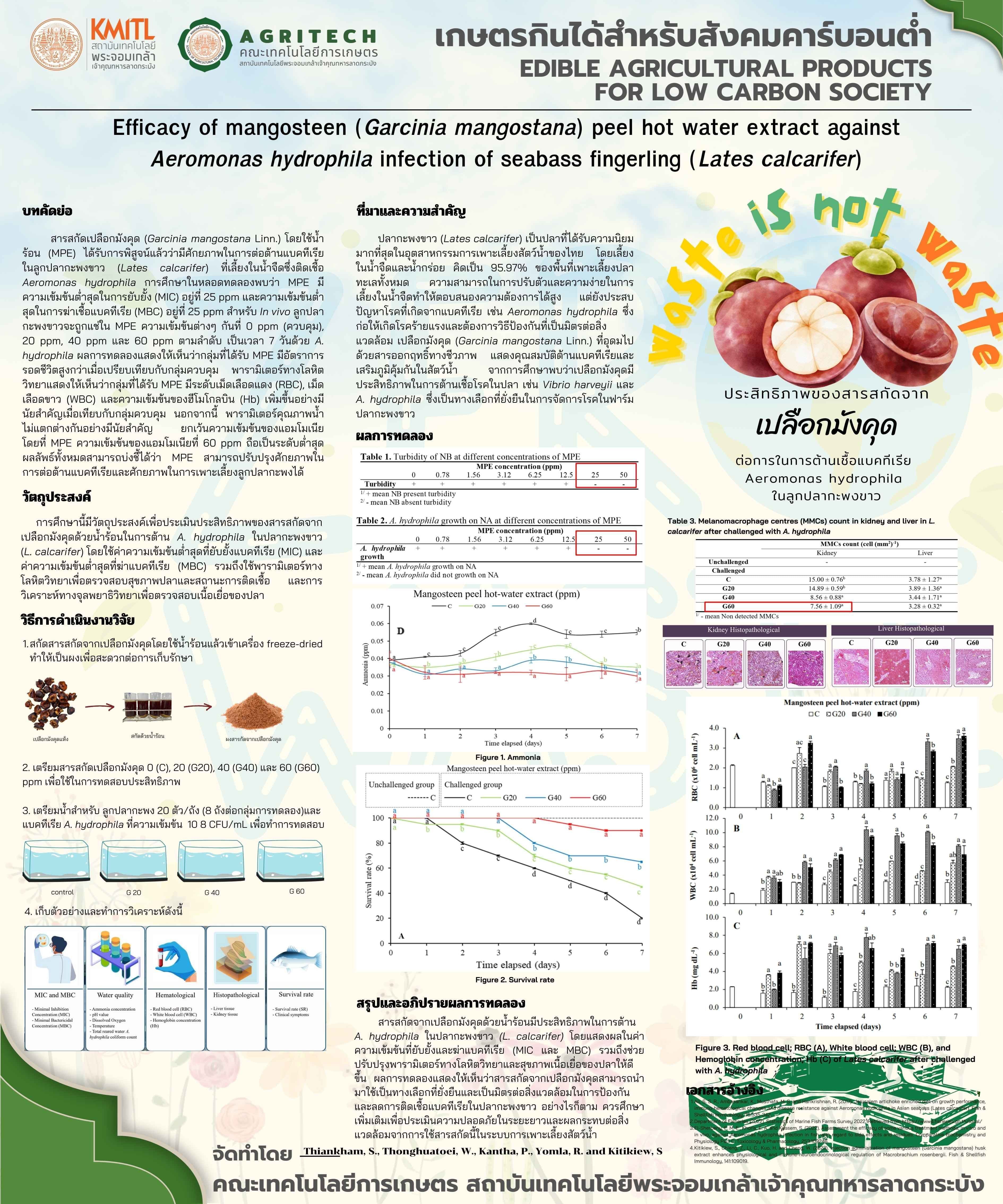
Mangosteen peel (Garcinia mangostana Linn.) extract using hot water (MPE) has been shown to have antibacterial potential in freshwater sea bass (Lates calcarifer) larvae infected with Aeromonas hydrophila. In vitro studies showed that MPE has a minimum inhibitory concentration (MIC) of 25 ppm and a minimum bactericidal concentration (MBC) of 25 ppm. In vivo, sea bass larvae were immersed in various concentrations of MPE at 0 ppm (control), 20 ppm, 40 ppm and 60 ppm, respectively, for 7 days with A. hydrophila. The results showed that the MPE-treated group had a higher survival rate compared to the control group. Hematological parameters showed that the MPE-treated group had significantly increased red blood cell (RBC), white blood cell (WBC) and hemoglobin (Hb) concentrations compared to the control group. In addition, the water quality parameters were not significantly different, except for ammonia concentration, with MPE having an ammonia concentration of 60 ppm being the lowest. All results can indicate that MPE can improve the antibacterial potential and the culture potential of sea bass larvae.