

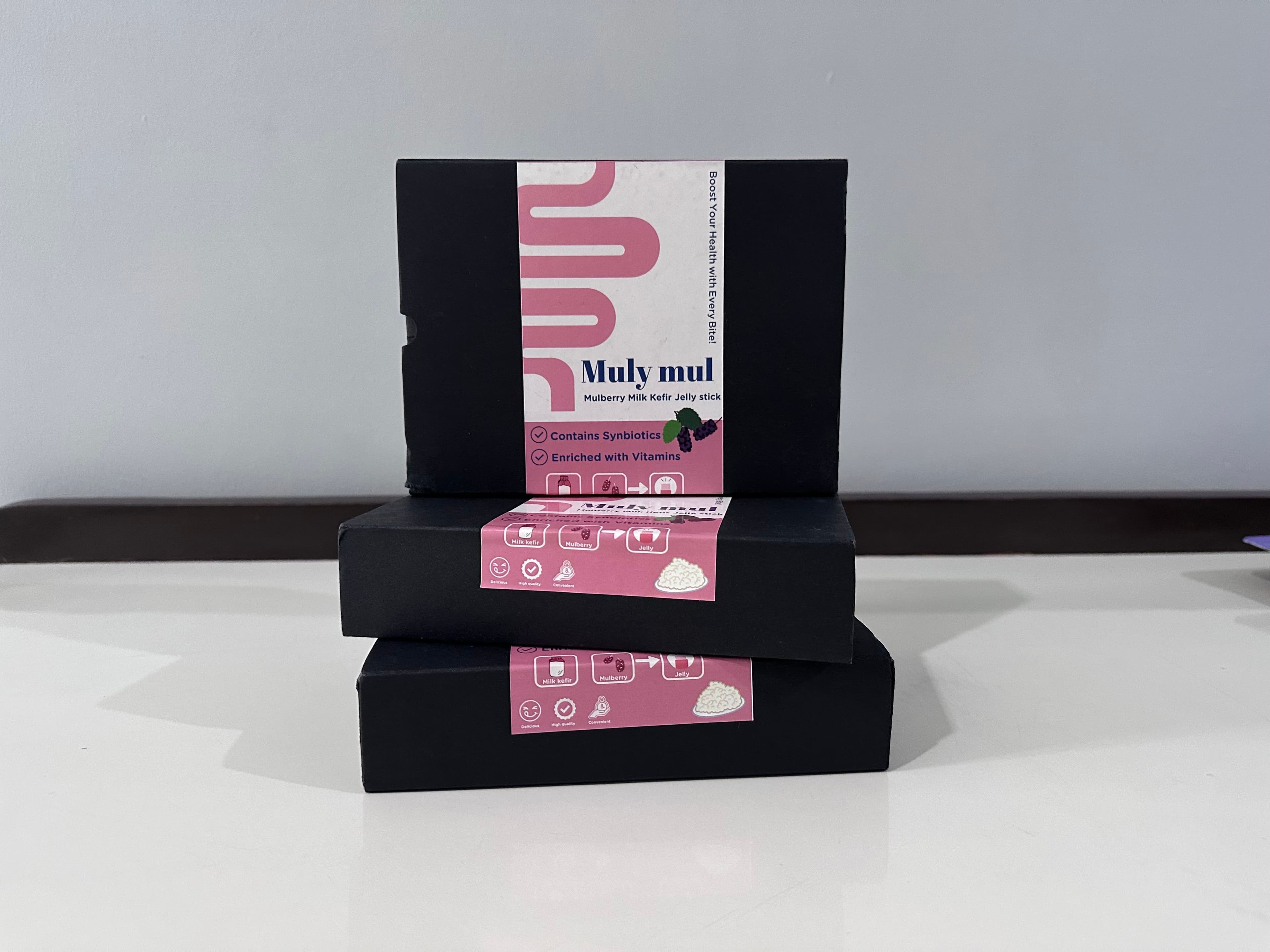
A new jelly snack alternative for health-conscious individuals—delicious, convenient, and gut-friendly. Rich in probiotics and prebiotics, packed with antioxidants, and essential vitamins. Suitable for health enthusiasts and lactose-intolerant individuals. Free from artificial colors and flavors
เนื่องจากในปัจจุบันผู้คนนิยมหันมารับประทานอาหารที่มีโพรไบโอติกกันจำนวนมาก เช่น การรับประทานคีเฟอร์ แต่การรับประทานคีเฟอร์นมนั้นก็มีรสชาติและสัมผัสที่ทำให้รับประทานได้ยาก พวกเราจึงคิดผลิตภัณฑ์ Muly mul เจลลี่คีเฟอร์นมรสมัลเบอร์รี ที่มาในรูปแบบซอง เนื้อเจลลี่นุ่มละมุน สามารถรับประทานได้ง่าย และสะดวกสบายมากขึ้น Mulylul ตอบโจทย์ต่อผู้บริโภคที่ต้องการหาขนมที่มีประโยชน์ในการรับประทาน โดยMuly Mul เจลลี่คีเฟอร์นมรสมัลเบอร์รีมีทั้งซินไบโอติกซึ่งมีส่วนช่วยในการขับถ่ายโดยการเพิ่มแบคทีเรียที่ดีให้แก่ร่างกาย ช่วยในการลดการอักเสบ กระตุ้นภูมิคุ้มกัน และยังสารต้านอนุมูลอิสระ และวิตามินต่างๆที่จำเป็นต่อร่างกายอีกด้วย นอกจากนี้Muly mul ยังใช้วัตถุดิบจากเกษตรกรในจังหวัดสระบุรี ซึ่งจะช่วยเพิ่มมูลค่าของวัตถุดิบ สนับสนุนเกษตรกรในพื้นที่และยังช่วยยกระดับเศรษฐกิจในท้องถิ่นด้วย

วิทยาเขตชุมพรเขตรอุดมศักดิ์
Cooling suit with two-phase flow heat-exchange system is a state-of-the-art heat sink, designed for thermal dissipation in fire fighter, racing driver and worker who needs to wear Personal Protective Equipment (PPE). The liquid cooling system with gas injection can enhance heat transfer performance and continuously maintain the temperature at 18-20 degree Celsius.

คณะครุศาสตร์อุตสาหกรรมและเทคโนโลยี
This research confirms the potential of bamboo fiber as a sustainable raw material for the textile industry, demonstrating exceptional properties that meet both functional requirements and environmental friendliness. The study focuses on integrating sustainability concepts with material innovation, encompassing fiber property analysis, production process development, and product design. The research objectives were to: 1) develop the properties of bamboo fiber for production; 2) study factors in designing environmentally friendly textile products from bamboo fiber; and 3) forecast future prospects for environmentally friendly textile product design using bamboo fiber. The findings revealed that 60-day-old bamboo possessed optimal properties for fiber separation, with an average fiber size of 5.32 μm, smaller than other natural fibers, resulting in superior moisture absorption and ventilation properties. When blended with recycled polyester fiber in a 30:70 ratio, the yarn exhibited strength and unique tactile characteristics. Although the antibacterial properties against Staphylococcus aureus were low, the fibers demonstrated excellent whiteness and softness. Factor analysis identified four key components in product design: Local Materials, Green Products, Healthy, and Sustainability. Consumer satisfaction evaluation of the prototype products showed high levels of acceptance, with the model explaining 84.7% of consumer satisfaction. The developed production process reduced chemical usage and hazardous waste. Furthermore, utilizing fast-growing bamboo minimized long-term environmental impact, contributing to sustainable development in Thailand's rural communities across economic, environmental, and occupational stability dimensions. The research demonstrates that developing bamboo fiber blended with recycled polyester creates sustainable products that meet consumer demands for health consciousness, local material utilization, and green product promotion. Commercial implementation of these products can enhance economic value and promote environmentally friendly product development in the future.
คณะวิศวกรรมศาสตร์
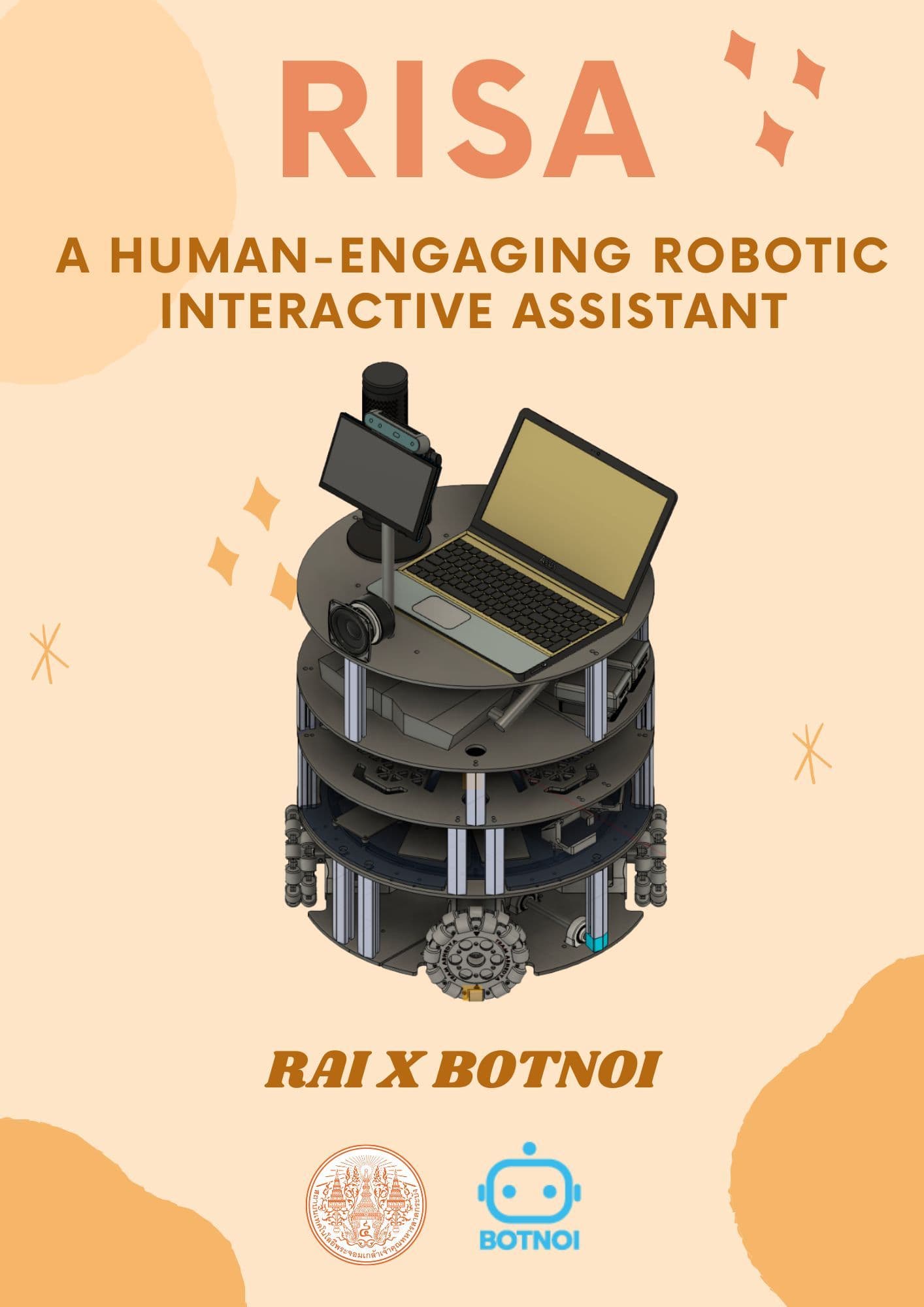
The integration of intelligent robotic systems into human-centric environments, such as laboratories, hospitals, and educational institutions, has become increasingly important due to the growing demand for accessible and context-aware assistants. However, current solutions often lack scalability—for instance, relying on specialized personnel to repeatedly answer the same questions as administrators for specific departments—and adaptability to dynamic environments that require real-time situational responses. This study introduces a novel framework for an interactive robotic assistant (Beckerle et al. , 2017) designed to assist during laboratory tours and mitigate the challenges posed by limited human resources in providing comprehensive information to visitors. The proposed system operates through multiple modes, including standby mode and recognition mode, to ensure seamless interaction and adaptability in various contexts. In standby mode, the robot signals readiness with a smiling face animation while patrolling predefined paths or conserving energy when stationary. Advanced obstacle detection ensures safe navigation in dynamic environments. Recognition mode activates through gestures or wake words, using advanced computer vision and real-time speech recognition to identify users. Facial recognition further classifies individuals as known or unknown, providing personalized greetings or context-specific guidance to enhance user engagement. The proposed robot and its 3D design are shown in Figure 1. In interactive mode, the system integrates advanced technologies, including advanced speech recognition (ASR Whisper), natural language processing (NLP), and a large language model Ollama 3.2 (LLM Predictor, 2025), to provide a user-friendly, context-aware, and adaptable experience. Motivated by the need to engage students and promote interest in the RAI department, which receives over 1,000 visitors annually, it addresses accessibility gaps where human staff may be unavailable. With wake word detection, face and gesture recognition, and LiDAR-based obstacle detection, the robot ensures seamless communication in English, alongside safe and efficient navigation. The Retrieval-Augmented Generation (RAG) human interaction system communicates with the mobile robot, built on ROS1 Noetic, using the MQTT protocol over Ethernet. It publishes navigation goals to the move_base module in ROS, which autonomously handles navigation and obstacle avoidance. A diagram is explained in Figure 2. The framework includes a robust back-end architecture utilizing a combination of MongoDB for information storage and retrieval and a RAG mechanism (Thüs et al., 2024) to process program curriculum information in the form of PDFs. This ensures that the robot provides accurate and contextually relevant answers to user queries. Furthermore, the inclusion of smiling face animations and text-to-speech (TTS BotNoi) enhanced user engagement metrics were derived through a combination of observational studies and surveys, which highlighted significant improvements in user satisfaction and accessibility. This paper also discusses capability to operate in dynamic environments and human-centric spaces. For example, handling interruptions while navigating during a mission. The modular design allows for easy integration of additional features, such as gesture recognition and hardware upgrades, ensuring long-term scalability. However, limitations such as the need for high initial setup costs and dependency on specific hardware configurations are acknowledged. Future work will focus on enhancing the system’s adaptability to diverse languages, expanding its use cases, and exploring collaborative interactions between multiple robots. In conclusion, the proposed interactive robotic assistant represents a significant step forward in bridging the gap between human needs and technological advancements. By combining cutting-edge AI technologies with practical hardware solutions, this work offers a scalable, efficient, and user-friendly system that enhances accessibility and user engagement in human-centric spaces.