

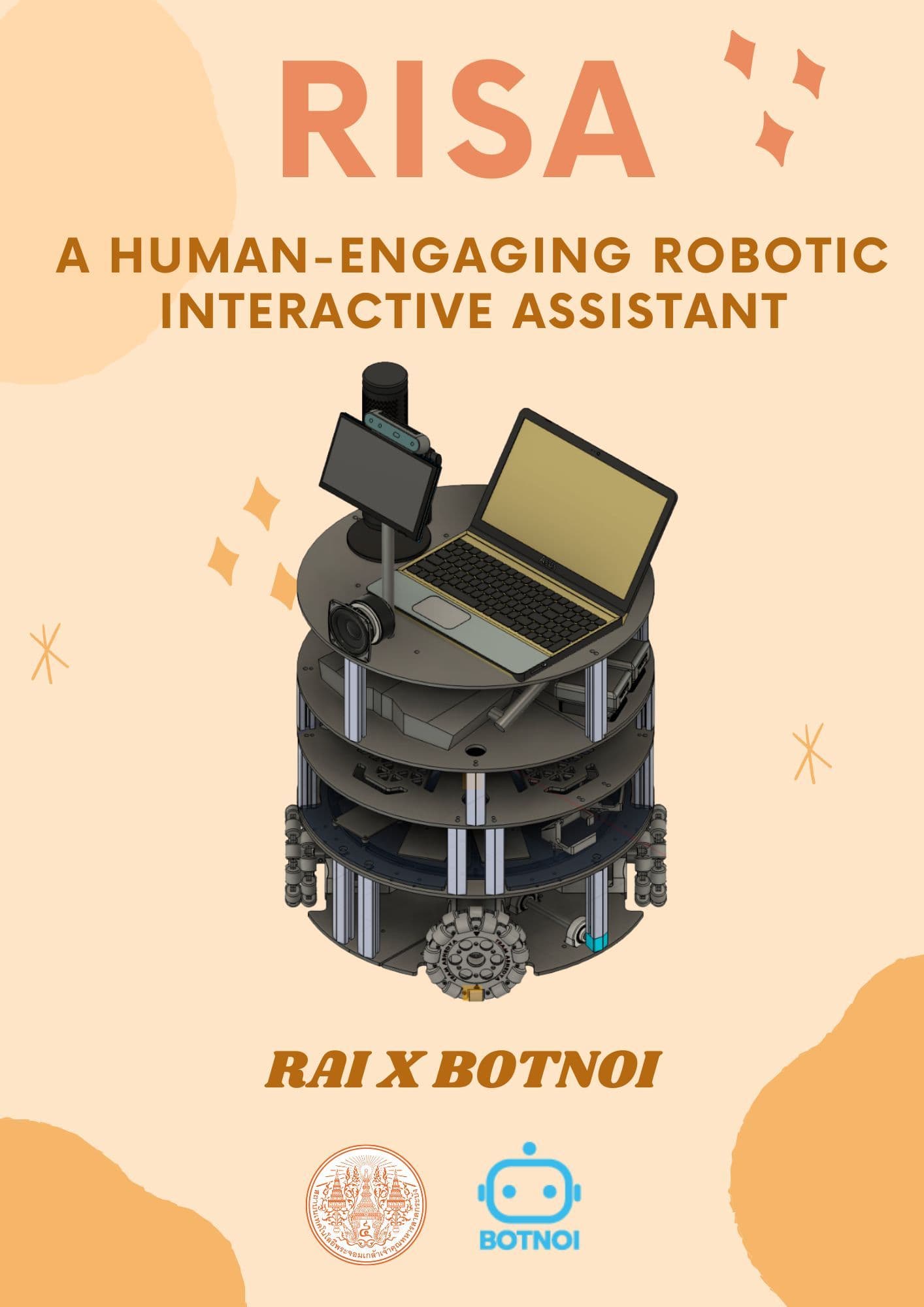
The integration of intelligent robotic systems into human-centric environments, such as laboratories, hospitals, and educational institutions, has become increasingly important due to the growing demand for accessible and context-aware assistants. However, current solutions often lack scalability—for instance, relying on specialized personnel to repeatedly answer the same questions as administrators for specific departments—and adaptability to dynamic environments that require real-time situational responses. This study introduces a novel framework for an interactive robotic assistant (Beckerle et al. , 2017) designed to assist during laboratory tours and mitigate the challenges posed by limited human resources in providing comprehensive information to visitors. The proposed system operates through multiple modes, including standby mode and recognition mode, to ensure seamless interaction and adaptability in various contexts. In standby mode, the robot signals readiness with a smiling face animation while patrolling predefined paths or conserving energy when stationary. Advanced obstacle detection ensures safe navigation in dynamic environments. Recognition mode activates through gestures or wake words, using advanced computer vision and real-time speech recognition to identify users. Facial recognition further classifies individuals as known or unknown, providing personalized greetings or context-specific guidance to enhance user engagement. The proposed robot and its 3D design are shown in Figure 1. In interactive mode, the system integrates advanced technologies, including advanced speech recognition (ASR Whisper), natural language processing (NLP), and a large language model Ollama 3.2 (LLM Predictor, 2025), to provide a user-friendly, context-aware, and adaptable experience. Motivated by the need to engage students and promote interest in the RAI department, which receives over 1,000 visitors annually, it addresses accessibility gaps where human staff may be unavailable. With wake word detection, face and gesture recognition, and LiDAR-based obstacle detection, the robot ensures seamless communication in English, alongside safe and efficient navigation. The Retrieval-Augmented Generation (RAG) human interaction system communicates with the mobile robot, built on ROS1 Noetic, using the MQTT protocol over Ethernet. It publishes navigation goals to the move_base module in ROS, which autonomously handles navigation and obstacle avoidance. A diagram is explained in Figure 2. The framework includes a robust back-end architecture utilizing a combination of MongoDB for information storage and retrieval and a RAG mechanism (Thüs et al., 2024) to process program curriculum information in the form of PDFs. This ensures that the robot provides accurate and contextually relevant answers to user queries. Furthermore, the inclusion of smiling face animations and text-to-speech (TTS BotNoi) enhanced user engagement metrics were derived through a combination of observational studies and surveys, which highlighted significant improvements in user satisfaction and accessibility. This paper also discusses capability to operate in dynamic environments and human-centric spaces. For example, handling interruptions while navigating during a mission. The modular design allows for easy integration of additional features, such as gesture recognition and hardware upgrades, ensuring long-term scalability. However, limitations such as the need for high initial setup costs and dependency on specific hardware configurations are acknowledged. Future work will focus on enhancing the system’s adaptability to diverse languages, expanding its use cases, and exploring collaborative interactions between multiple robots. In conclusion, the proposed interactive robotic assistant represents a significant step forward in bridging the gap between human needs and technological advancements. By combining cutting-edge AI technologies with practical hardware solutions, this work offers a scalable, efficient, and user-friendly system that enhances accessibility and user engagement in human-centric spaces.
งานวิจัยนี้มีที่มาจาก ความต้องการที่เพิ่มขึ้นสำหรับผู้ช่วยอัจฉริยะ ใน สภาพแวดล้อมที่เน้นมนุษย์เป็นศูนย์กลาง เช่น ห้องปฏิบัติการและสถาบันการศึกษา ซึ่งเผชิญปัญหาเรื่อง ข้อจำกัดด้านทรัพยากรบุคคล ในการให้ข้อมูลแก่ผู้เยี่ยมชมและนักศึกษา ปัจจุบัน โซลูชันที่มีอยู่มัก ขาดความสามารถในการขยายขนาด และ ปรับตัวให้เข้ากับสภาพแวดล้อมที่เปลี่ยนแปลง ได้อย่างมีประสิทธิภาพ นอกจากนี้ ระบบผู้ช่วยแบบเดิมมักพึ่งพาบุคลากรเฉพาะทาง ทำให้เกิดภาระในการตอบคำถามซ้ำๆ และไม่สามารถรองรับจำนวนผู้ใช้ที่เพิ่มขึ้นได้ ดังนั้น งานวิจัยนี้จึงมุ่งพัฒนา ผู้ช่วยหุ่นยนต์เชิงโต้ตอบ ที่สามารถ ทำงานอัตโนมัติในสภาพแวดล้อมแบบไดนามิก โดยใช้ AI และโมเดลภาษาขนาดใหญ่ (LLM Predictor) ผสานกับ การรู้จำเสียง ท่าทาง และใบหน้า เพื่อเพิ่ม การมีส่วนร่วมของผู้ใช้ และ ความสามารถในการโต้ตอบ แบบเรียลไทม์ ระบบนี้ยังช่วยลดภาระของบุคลากรและเพิ่ม การเข้าถึงข้อมูล ได้อย่างแม่นยำและมีประสิทธิภาพ อีกทั้งยังรองรับการพัฒนาเพิ่มเติมเพื่อให้สามารถขยายขีดความสามารถและใช้งานได้หลากหลายขึ้นในอนาคต

คณะเทคโนโลยีสารสนเทศ
The project of game development to educate about Egyptian civilization This is intended to be a game to promote learning about ancient Egyptian civilization. The original learning may feel boring. Do not attract the attention of learners Therefore saw the presentation in the form of a game on virtual reality technology that inserts knowledge history With the aim of making learning more interesting The organizers can choose to use Unreal Engine 5.1 (Unreal Engine 5.1) and Oculus Quest II (Oculus Quest2) to develop. Within the game, players must find a way to escape from this room within the specified period of solving puzzles in various forms such as statues, traps, etc. In order to solve puzzles and leave this room, players must collect all the information inside the room. In addition, the game shows the life of the player and when the player cannot solve the puzzle correctly.
คณะเทคโนโลยีการเกษตร
This study aimed to investigate the effects of different salinity levels on survival rate and growth performance of golden apple snail (Pomacea canaliculata). The experiment was conducted at salinity levels of 0, 5, 10, and 15 ppt, with four replicates each, over an 8-week period. The results showed that golden apple snails reared at 5-10 ppt exhibited survival rates and growth performance not significantly different (p>0.05) from those in the freshwater control group (0 ppt). These findings suggest the potential for developing golden apple snail culture in brackish water systems and the possibility of integration with other brackish water species in polyculture systems.
คณะวิศวกรรมศาสตร์
This thesis project was conducted to identify the optimal conditions for producing concentrated butterfly pea juice using vacuum evaporation to preserve key compounds in butterfly pea flowers, such as anthocyanins—natural pigments with high antioxidant properties. The study applies a Box-Behnken Design, a statistical method that facilitates analysis of multiple factors. The research focuses on the ratio of dried butterfly pea flowers to water, extraction temperature, and evaporation temperature, each of which has a direct effect on the preservation of key compounds, color, aroma, and flavor. The results indicate that using a dried flower-to-water ratio of 1:15, an extraction temperature of 60°C, and an evaporation temperature of 40°C under low pressure can minimize the loss of essential compounds and best retain the properties of the concentrated butterfly pea juice. Findings from this research provide a foundation for developing an industrial production process for concentrated butterfly pea juice and enhance the potential for creating new products from butterfly pea flowers.