

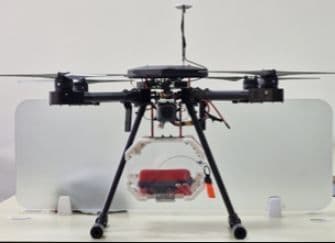
One of the most important aspects of responding to a medical case is the response time. In general, most fatalities are due to the patient not being able to reach the hands of the doctor in time. This also includes the arrival of medical equipment to the scene. The human brain will start to degrade in function after 3 minutes of oxygen starvation which conventional road transportation method first responders presently use is usually unable to reach the site in this golden 3 minutes, resulting in fatalities during transport or before the arrival of first responders at the scene. Therefore, medical equipment transport by fully autonomous aircraft is explored. This is done through drone deliveries which is much quicker than road methods as the equipment could be flown straight to the site as it is not affected by traffic, road conditions, and navigation. In this project, we will explore an aerial delivery system for medical equipment such as Automatic External Defibrillators (AEDs), First aid equipment, and other small requested medical devices. This will be done through a DJI drone platform and their SDK application. The main goal for this project is to decrease the response time by using an autonomous aerial drone to deliver medical equipment.
หนึ่งในสาเหตุที่ทำให้ผู้ป่วยทั่วโลกเสียชีวิตมากที่สุดเกิดจากสภาวะหรือโรคที่มีอาการที่ไม่สามารถคาดการณ์ได้และเกิดขึ้นอย่างกะทันหัน เช่น โรคหัวใจขาดเลือด โรคหลอดเลือดสมอง และโรคปอดอุดกั้นเรื้อรัง ผู้ป่วยอาจไม่มีสัญญาณว่าต้องการความช่วยเหลือทางการแพทย์ก่อนที่จะเกิดอาการ ซึ่งทำให้ยากในการตัดสินใจว่าต้องการความช่วยเหลือทางการแพทย์หรือไม่ ตัวอย่างหนึ่งของสถานการณ์นี้คือการหยุดหายใจนอกโรงพยาบาล (OHCA) ซึ่งมีเพียง 8.8% ของผู้ป่วยเท่านั้นที่สามารถกลับบ้านได้ หากไม่มีการตรวจติดตามผู้ป่วยหรือการตรวจติดตามคลื่นไฟฟ้าหัวใจอย่างต่อเนื่อง แทบไม่มีวิธีใดที่สามารถทำนายได้ว่าเมื่อใดที่ผู้ป่วยจะเกิดอาการหยุดหายใจ เนื่องจากอาการที่เกิดขึ้นอย่างกะทันหันเหล่านี้ การตอบสนองเพื่อลงมือให้ความช่วยเหลือทางการแพทย์กับผู้ป่วยในที่เกิดเหตุจะต้องทำอย่างรวดเร็วที่สุด เนื่องจากโอกาสในการฟื้นตัวสมบูรณ์จะลดลงอย่างมากเมื่อเวลาการตอบสนองเพิ่มขึ้น โดยปกติแล้ว โอกาสในการรอดชีวิตในกรณี OHCA ที่มีจังหวะการทำงานของหัวใจที่สามารถช็อกได้จะลดลง 10% ต่อหนึ่งนาที หลังจากขาดออกซิเจน สมองของมนุษย์จะเริ่มเสื่อมลงหลังจาก 1 นาที และเข้าสู่สภาวะเสียหายของเซลล์ประสาทในระดับกว้างภายใน 3 นาที ดังนั้น ช่วงเวลา 3 นาทีนี้จึงมีความสำคัญอย่างยิ่ง เนื่องจากความตายจะใกล้เข้ามาในเวลา 5 นาที [5] ด้วยเทคโนโลยีการตอบสนองฉุกเฉินในปัจจุบัน เวลาการตอบสนองนี้กำลังถึงขีดจำกัดเนื่องจากปัจจัยจำกัดขนาดใหญ่อย่างการจราจรติดขัดซึ่งทำให้เวลาการตอบสนองไม่แน่นอน [6] เนื่องจากข้อจำกัดเหล่านี้กับเทคโนโลยีรถพยาบาลและการตอบสนองฉุกเฉินในปัจจุบัน โครงการนี้มีเป้าหมายเพื่อสำรวจตัวเลือกการขนส่งอื่น ๆ โดยเฉพาะการขนส่งทางอากาศโดยใช้ยานพาหนะทางอากาศอัตโนมัติหรือโดรน เมื่อเปรียบเทียบกับการขนส่งทางถนน เส้นทางการขนส่งทางอากาศไม่มีข้อจำกัดเรื่องการจราจรติดขัด และเส้นทางสามารถตรงมากขึ้น โดยข้ามการจราจรและแยกที่หนาแน่นทั้งหมด นอกจากนี้ยังปลอดภัยกว่าในการขนส่งอุปกรณ์ เนื่องจากมีปัจจัยที่หยุดการขนส่งน้อยลง สิ่งนี้จะช่วยปรับปรุงเวลาการตอบสนองของอุปกรณ์ต่าง ๆ เช่น AEDs EpiPens และชุดปฐมพยาบาล ซึ่งสามารถใช้งานได้โดยทุกคนในพื้นที่ใกล้เคียง สิ่งนี้อาจถือว่าเป็นการช่วยชีวิตที่สำคัญ
วิทยาลัยเทคโนโลยีและนวัตกรรมวัสดุ
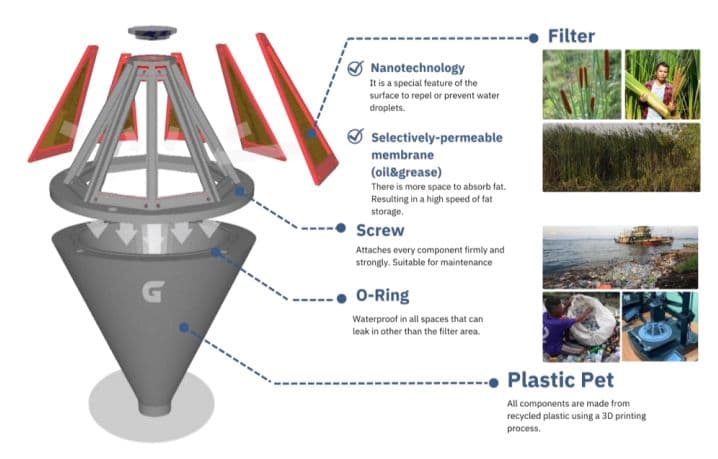
Oil and grease pollution is an urgent environmental problem severely affecting aquatic ecosystems and mangrove forests, particularly in the Mani Rat Canal area, Samut Sakhon Province, where no effective solution currently exists. This research aims to develop a "high-efficiency oil-trapping buoy using superhydrophobic membrane technology" by synthesizing cattail flowers into Carbon Nanofiber material for capturing oil and grease, combined with waste PET plastic collected from mangrove areas as the primary structural material. This approach not only addresses water pollution but also enables the recovered oil to be further processed and utilized, representing an environmentally friendly solution that promotes sustainable resource management.

คณะวิศวกรรมศาสตร์
This project aims to develop a conceptual prototype of a weapon aiming system that simulates an anti-aircraft gun. Utilizing an optical camera, the system detects moving objects and calculates their trajectories in real time. The results are then used to control a motorized laser pointer with two degrees of freedom (DoF) of rotation, enabling it to aim at the predicted position of the target. Our system is built on the Raspberry Pi platform, employing machine vision software. The object motion tracking functionality was developed using the OpenCV library, based on color detection algorithms. Experimental results indicate that the system successfully detects the movement of a tennis ball at a rate of 30 frames per second (fps). The current phase involves designing and integratively testing the mechanical system for precise laser pointer position control. This project exemplifies the integration of knowledge in electronics (computer programming) and mechanical engineering (motor control).
คณะสถาปัตยกรรม ศิลปะและการออกแบบ
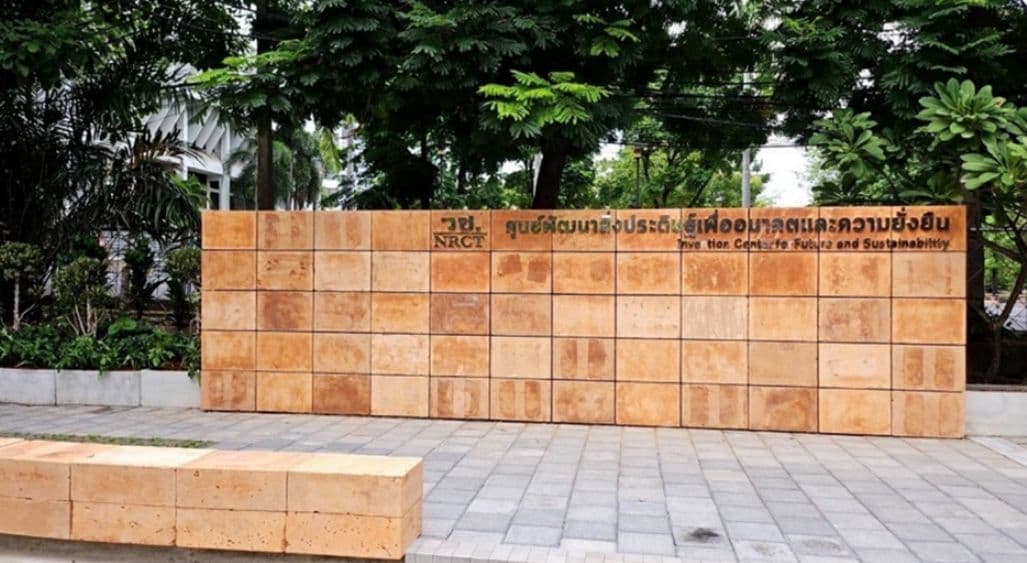
The " Center of Invention for Future and Sustainability Project (Continuing)" serves as a continuation of a pilot initiative focused on the retrofitting of older buildings (Vach. 7), specifically a five-story structure. The primary aim of this project is to develop methodologies for enhancing the sustainability of existing buildings in order to mitigate carbon dioxide emissions. In the execution of the Future and Sustainability Innovation Development Center Project (Continuing), a comprehensive analysis of relevant data and theoretical frameworks has been undertaken, leading to the formulation of a research methodology designed to identify optimal strategies for retrofitting older buildings to reduce carbon dioxide emissions. This approach is structured into three principal phases: the combustion of fuels associated with transportation, labor, and materials; the electricity consumption during the construction process; and the accumulation of greenhouse gases from both existing and new construction materials. The project employs an experimental research design, wherein empirical data is collected to evaluate and quantify the equivalent carbon dioxide emissions arising from the construction of new buildings compared to the retrofitting of the selected case study building. Subsequent analysis of the collected data revealed that retrofitting the existing structure—through the integration of sustainable design principles—resulted in greenhouse gas emissions of 11.88 kgCO2e/sq.m. In contrast, the emissions associated with new building construction amounted to 299.35 kgCO2e/sq.m., indicating a reduction in carbon dioxide emissions by a factor of approximately 26 when compared to the construction of new buildings.